
GST 2.0 car tax slabs India 2025: The Indian automotive market has witnessed a seismic transformation over the past few years. In 2015, sedans made up over 42 percent of passenger-car sales. Today, SUVs command over 60 percent, according to industry data. Walk into any dealership and you’ll notice something striking: showrooms are dominated by hulking SUVs where elegant sedans once reigned supreme.
This isn’t just a styling preference; it’s a fundamental restructuring of buyer behavior, and the Goods and Services Tax particularly the new GST 2.0 regime has played a pivotal role in accelerating this shift.
Understanding the GST 2.0 Framework for Vehicles
When GST 2.0 came into effect in September 2025, India’s automobile taxation underwent its most significant reform since the original GST rollout in 2017. The earlier multi-layered system of 28 percent GST plus compensation cess was scrapped and replaced by a simpler three-tier structure based purely on vehicle size and engine capacity not fuel type.
GST 2.0 Car Tax Slabs India 2025 (Effective September 2025)
| Vehicle Category | GST 2.0 Rate | Engine / Size Criteria | Typical Examples |
|---|---|---|---|
| Small Cars | 18 % | ≤ 4 m length and (≤ 1,200 cc petrol / CNG / LPG or ≤ 1,500 cc diesel) | Maruti Alto K10, Tata Tiago, Hyundai i10 Nios, Tata Punch, Hyundai Venue, Tata Nexon (sub-4 m) |
| Large Cars & SUVs | 40 % | > 4 m length or (> 1,200 cc petrol or > 1,500 cc diesel) | Honda City, Hyundai Creta, Tata Harrier, Toyota Fortuner, Innova Hycross, Mahindra XUV700 |
| Small Hybrids | 18 % | Meet small-car criteria above (rare segment – most hybrids are larger) | — |
| Large Hybrids | 40 % | Exceed small-car limits on size / engine capacity | Maruti Grand Vitara Hybrid, Honda City Hybrid, Toyota Innova Hycross Hybrid |
| Electric Vehicles (EVs) | 5 % | All battery electric vehicles regardless of size or motor output | Tata Tiago EV, Nexon EV, MG ZS EV, BYD Seal, Hyundai Ioniq 5 |
Under GST 2.0, the compensation cess has been abolished. India now follows just three slabs 5 percent for EVs, 18 percent for small cars and hybrids, and 40 percent for larger cars and SUVs.
How GST 2.0 Narrowed the Price Gap
This simplified structure has dramatically narrowed the price gap between sedans and SUVs. Earlier, a mid-size sedan faced about 43 percent total tax versus 50 percent on a full SUV. Under GST 2.0, both now fall in the same 40 percent slab a game-changer for buyer perception.
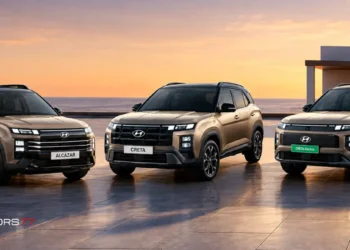
For roughly the same EMI, an Indian family can now move from a compact sedan to a feature-rich compact SUV. Manufacturers were quick to realign their lineups. Toyota’s Fortuner, Hyundai’s Creta, and Kia’s Seltos continue to dominate the market because the new uniform slab keeps SUVs within reach of mid-segment buyers.
Consumer Psychology Behind the Shift
Beyond taxation, the SUV surge reflects deeper psychological and practical factors reshaping Indian car-buying habits. The elevated driving position offers confidence and visibility; ground clearance makes bad roads manageable; and the tall stance projects success.
Social signalling plays a key role: SUVs symbolize achievement in ways sedans no longer do. Younger professionals increasingly see vehicles as lifestyle statements rather than commuting tools.
Meanwhile, changing family patterns weekend travel, larger luggage needs, flexible seating favour the SUV form factor. And although real-world crash safety depends on engineering, many buyers perceive SUVs as safer, reinforcing their dominance.
Manufacturer Strategy Realignment
Car companies didn’t just respond they accelerated the shift. Maruti Suzuki moved swiftly from sedans like the Ciaz to SUVs such as the Brezza, Grand Vitara, and Fronx. Honda’s legendary City now shares showroom space with the Elevate SUV.
Even luxury brands have pivoted: BMW’s X-range now contributes over 60 percent of its Indian sales, and Audi’s Q-series has largely replaced its sedan lineup. Production lines, vendor ecosystems, and R&D investment have all been retooled for SUV platforms.
The Sedan’s Struggle for Relevance
Sedans haven’t vanished but they’re niche. The mid-size sedan market has contracted sharply, with once-popular models like the Toyota Corolla Altis and Volkswagen Jetta disappearing.
Premium sedans such as the BMW 3 Series and Mercedes-Benz C-Class survive by appealing to enthusiasts who value handling precision over practicality. Executive sedans like the E-Class LWB still sell to chauffeur-driven buyers who prioritize rear-seat comfort a niche SUVs can’t yet replicate.
Regional and Demographic Patterns
The SUV wave isn’t uniform across India. Tier-2 and Tier-3 cities now account for most SUV sales, while metros still maintain small sedan pockets. Delhi-NCR leads the nation, with SUVs making up over 45 percent of all car registrations far above the national average of 38 percent.
Demographically, younger buyers skip the traditional hatchback-to-sedan-to-SUV ladder. Many enter directly into sub-4-meter SUVs like the Brezza or Nexon, citing practicality and status.
Looking Ahead: EVs, Hybrids and Market Dynamics
GST 2.0 is not just about simpler taxation—it’s a strategic shift aligning policy with India’s clean-mobility goals. The 5 percent GST on EVs remains unchanged, ensuring electric models like the Tiago EV, Tata Nexon EV, and Hyundai Ioniq 5 stay price-competitive.
Hybrids also benefit from clearer taxation: smaller hybrids qualify for 18 percent, larger ones 40 percent. This clarity encourages investment in both battery-electric and hybrid powertrains.
Environmental considerations could spark a modest sedan comeback in the long run their aerodynamics and lower weight make them inherently more efficient. But for now, the dominance of SUVs looks unshakable.
The Verdict: A Structural Transformation
The shift toward SUVs isn’t a passing trend—it’s a structural realignment of the Indian automotive market. GST 2.0 acted as the final catalyst, eliminating tax ambiguity and reinforcing the appeal of SUVs across all price segments.
For buyers, this means more SUV choices and better price parity. For sedan loyalists, it’s acceptance that their favorite format has moved into a premium niche. For automakers, it marks a permanent strategic pivot.
The great Indian SUV shift is now anchored in policy as much as in preference—a textbook example of how taxation can reshape entire industries. Whether you celebrate this evolution or miss the grace of the sedan, one fact stands undeniable: India’s automotive landscape has changed forever.
Read our detailed analysis on how GST 2.0 price cuts are making small cars more affordable in India — click here to explore the full breakdown