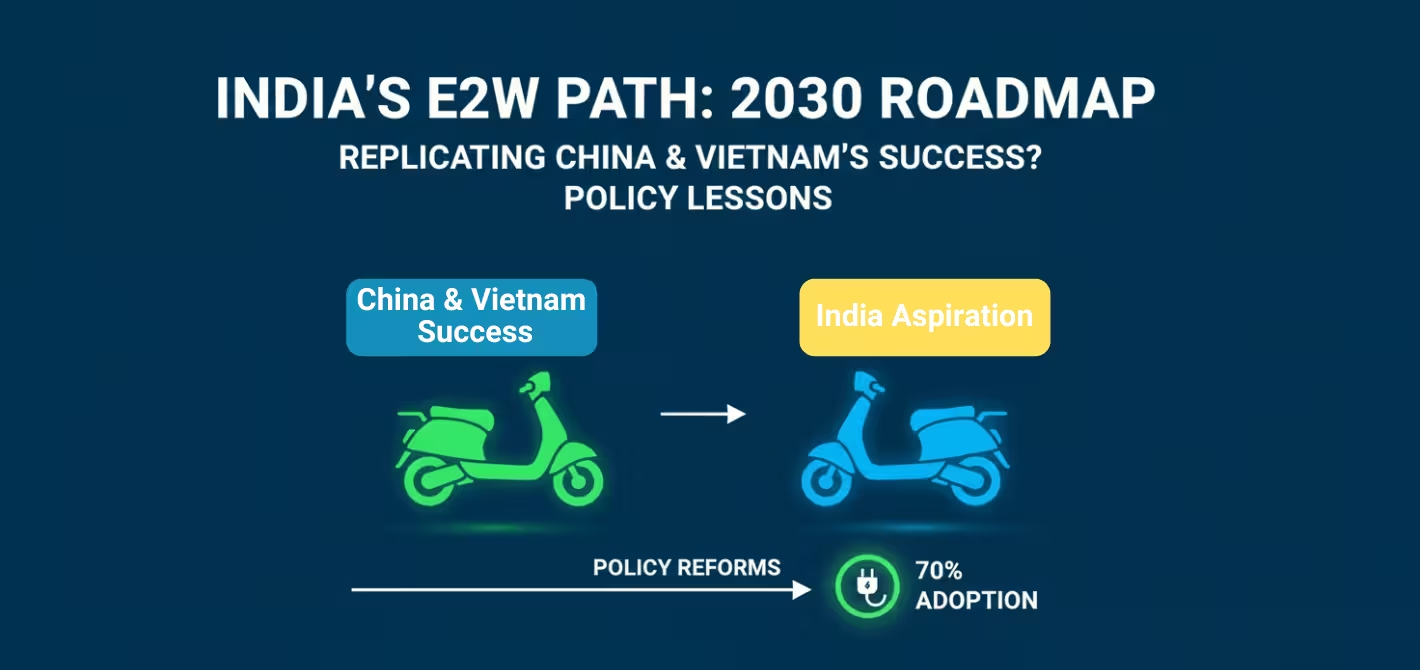
India EV Two-Wheeler Policy Roadmap 2030: China dominates global electric two-wheeler manufacturing with 3.2 million units sold in just six months. Vietnam’s VinFast achieved a staggering 489% year-on-year growth through battery-swapping innovation. India, with 657,000 units sold in H1 2025, stands at a critical juncture. As the world’s second-largest electric two-wheeler market, can India replicate these success stories? This analysis examines what India can learn from its Asian neighbors and how NITI Aayog’s evolving battery swapping policy charts a distinctive third path.
This analysis draws from VinFast corporate releases, NITI Aayog Draft Battery Swapping Policy (April 2022), Vahan registration data, IEA Global EV Outlook, and industry reports from SIAM and JATO Dynamics. Market projections represent analytical estimates based on current trends.
India EV Two-Wheeler Policy Roadmap 2030: The Three-Way Race & India’s Position
| Market | Units (H1 2025) | Growth Rate | Core Strategy |
|---|---|---|---|
| China | 3.2 million | 13% YoY | Manufacturing dominance |
| Vietnam | 234,536 (9M) | 489% YoY | VinFast single-standard infrastructure |
| India | 657,000 | Targeting 2.5-3M (full year) | Multiple open ecosystems (evolving policy) |
India’s electric two-wheeler market has reached a pivotal moment. Current projections suggest 2.5-3 million units for full-year 2025-2026, representing 13-15% market penetration. The government’s FAME scheme provides crucial subsidies, while NITI Aayog’s draft battery swapping policy issued in April 2022 but still under consultation encourages a middle path between universal standardization and complete fragmentation. The question isn’t whether India has potential, it’s whether the country can implement strategies that combine China’s manufacturing strength with infrastructure innovation while navigating the complexities of its evolving battery swapping framework.
China’s Lesson: Patient Manufacturing Builds Lasting Power
China’s electric two-wheeler market has grown from USD 15.75 billion in 2024 to a projected USD 45.32 billion by 2035. But the real achievement lies beneath these numbers. China now produces 80% of global EV batteries and controls 85% of cathode and anode materials, achieving complete supply chain dominance. The journey took 15 years from 2010 to 2025. China started with cheap, low-quality scooters focusing on volume. As manufacturing expertise deepened, quality improved. By 2024-2025, the premium L3 category surged 39.1%, demonstrating consumer willingness to pay for superior products.
China’s battery swapping reality differs from common perception. Multiple Chinese companies including NIU and Yadea operate battery swapping networks, but there’s no universal standard. Different ecosystems coexist, and manufacturers remain free to use fixed-battery charging models. The market determines which approach succeeds.
India’s second-largest market status with 657,000 units in H1 2025 creates a strong foundation, supported by established manufacturers like Bajaj, TVS, Ola, Ather, and Hero, along with emerging players such as Raptee.. The PLI scheme allocates ₹18,100 crore for battery manufacturing, while 1.5 million engineering graduates annually provide the talent pool needed for innovation. However, critical gaps remain visible. India produces less than 2% of global batteries versus China’s 80%. The country imports over 80% of components, mostly from China. Domestic batteries cost 20-30% more than Chinese imports. R&D spending at 0.7% of GDP lags far behind China’s investment levels exceeding 2%.
The manufacturing roadmap requires India to invest ₹50,000-75,000 crore in battery gigafactories by 2030. Developing local supply chains to reduce Chinese import dependence from 80% to 30% creates strategic autonomy. Industry observers suggest the FAME scheme needs a clear 10-year extension, avoiding stop-start cycles that create uncertainty. China took 15 years to achieve dominance. India’s target of 35-40% market penetration by 2030 requires 8-10 years of consistent execution from now.
Vietnam’s Lesson: Infrastructure + Policy = Explosive Growth
Vietnam’s transformation centers on VinFast, which delivered 234,536 electric scooters and e-bikes in nine months of 2025, representing a 489% year-on-year increase. The company captured 43% of Vietnam’s electric two-wheeler market share through a combination of aggressive infrastructure deployment and favorable policy intervention.
The policy catalyst proved decisive. In July 2025, Hanoi announced petrol motorcycles would be banned from city center by mid-2026, with nationwide restrictions by 2028. This single policy decision transformed consumer behavior overnight, creating unprecedented urgency in the market.
VinFast’s single-standard infrastructure approach created one universal battery standard across all its electric two-wheeler models. All VinFast bikes use compatible batteries that work at all VinFast swap stations. Riders swap depleted batteries for charged ones in 2-3 minutes, versus 4-6 hours for home charging. Each swap costs just ₹24, approximately $0.32, with monthly rental at ₹550, delivering 20-40% lower operating costs than petrol scooters. VinFast’s infrastructure ambition demonstrates remarkable scale: 1,000 stations launched in October 2025, expanding to 50,000 by year-end, targeting 150,000 stations nationwide by 2028. This creates a single, seamless network where any VinFast customer can swap anywhere.
An important clarification deserves emphasis. VinFast’s standardization applies only to VinFast’s own products. Other electric two-wheeler brands in Vietnam, including Honda and Yamaha, can still sell fixed-battery models with charging infrastructure. Vietnam hasn’t mandated universal battery standards across all manufacturers. VinFast simply chose internal standardization as a business strategy that aligned with its vertically integrated approach.
India’s Distinct Approach: NITI Aayog’s Open Ecosystem Policy
India is charting a different path. NITI Aayog’s Draft Battery Swapping Policy from April 2022 explicitly rejects both complete standardization and unregulated fragmentation, instead proposing what it calls “multiple open ecosystems.”
The official policy states clearly: “Rather than mandating a rigid set of technical and operational requirements to foster interoperability, this Policy will allow for multiple distinct interoperable solutions to arise from the market.” The policy doesn’t reject standardization entirely. It rejects forced nationwide universal standardization. Instead, it encourages multiple parallel standards, where each standard is shared by at least two manufacturers seeking government support.
On ecosystem compatibility, the policy explains: “Given the nascency of battery swapping, interoperability between EV batteries and other components like EVs and EVSE within a battery swapping ecosystem is adequate for eligibility under the Policy.” This means each manufacturer can develop their own battery ecosystem. Ola batteries don’t need to work in Ather bikes. Raptee can use high-voltage car-like batteries. Compatibility is required within each ecosystem, not across all manufacturers.
For ecosystems seeking government incentives under FAME or other schemes, the policy requires ecosystems to be “open to allow participation from other market players.” Additionally, “Each BSS or Battery Swapping Station should serve at least two EV OEMs or Original Equipment Manufacturers.” A critical clarification applies here. This rule applies only to swap stations seeking government subsidies or FAME incentives. It’s not a blanket mandate for all battery swapping.
If Ola wants FAME subsidies, their swap stations must serve at least two manufacturers, such as an Ola plus TVS partnership. Both brands would use compatible batteries within that shared ecosystem. Government provides financial support for infrastructure deployment under these conditions. However, if Ola builds a purely private network, they can build stations serving only Ola bikes with no requirement to partner with other manufacturers. The tradeoff is receiving no government subsidies or FAME incentives, operating instead as a fully private investment with a commercial model.
Government policy rationale becomes clear through this structure. Public funds should not subsidize closed monopolies. Government investment should support infrastructure accessible to multiple players, preventing resource waste and encouraging collaboration. However, companies remain free to build private, non-subsidized networks with their own standards.
The practical challenge this creates deserves honest examination. How can Raptee, using high-voltage car-like batteries, share swap stations with Ola using standard scooter batteries? They can’t because the technologies are fundamentally incompatible. Possible solutions include Raptee partnering with another high-voltage manufacturer, building separate stations serving its unique segment, the 2-OEM rule getting relaxed for fundamentally different technologies, or the market determining viable partnerships naturally. The policy remains in draft form since April 2022. Industry consultations revealed concerns about implementation feasibility. NITI Aayog planned fresh consultations in 2023-2025 but hasn’t finalized the policy. This uncertainty affects manufacturer investment decisions.
Unlike Vietnam’s single VinFast standard, India’s open ecosystem approach allows innovation diversity where companies like Raptee can develop high-voltage systems suited for performance bikes. Ola can optimize for urban commuters. Ather can target premium segments. Each can innovate without conforming to a universal specification. Market segmentation becomes possible as different ecosystems serve different customer segments with appropriate pricing, performance, and features. Premium ecosystems like Ather coexist with affordable ones like Ola Electric, catering to India’s diverse market. Competitive pressure from multiple ecosystems competing forces continuous improvement in battery technology, swap station convenience, and pricing. Monopolies or single standards reduce this competitive drive. Risk distribution means if one ecosystem fails technologically or commercially, others continue operating. Universal standardization creates single-point-of-failure risk.
However, India’s approach sacrifices certain advantages. Consumer lock-in becomes inevitable as buying an Ola bike means using only Ola-compatible swap stations. Consumers can’t switch ecosystems without changing bikes, reducing flexibility compared to Vietnam’s universal VinFast network. Infrastructure efficiency suffers as multiple competing networks require more total stations to achieve the same coverage. Vietnam’s 150,000 VinFast stations serve all VinFast users, while India might need 300,000 stations across multiple ecosystems for equivalent coverage. Slower initial adoption results as consumers face uncertainty about which ecosystem will win. This hesitation slows adoption compared to Vietnam’s clear, single-standard approach backed by policy certainty. Complex planning challenges emerge as government and private investors must coordinate across multiple ecosystems rather than supporting one unified infrastructure plan.
Can India Achieve 10 Million Units by 2030?
India currently sells approximately 1.3 million electric two-wheelers annually. Reaching 10-11 million by 2030 with 35-40% penetration requires an eightfold increase in five years, representing a 60-70% compound annual growth rate. Vietnam achieved 489% growth in one year through policy catalyst including the petrol ban plus single-standard infrastructure. China achieved dominance through 15 years of manufacturing investment.
For India to reach 10 million units by 2030 through its open ecosystem approach, five critical success factors must align. Policy finalization represents the immediate priority. The battery swapping policy has been in draft since April 2022. Finalizing clear rules, including how the 2-OEM per station requirement applies to incompatible technologies, is essential. Without clarity, manufacturers delay infrastructure investment. Ecosystem consolidation through partnerships becomes necessary. Rather than ten separate ecosystems creating waste, industry should consolidate into 3-4 major ecosystems through strategic partnerships. For example, Ola plus TVS plus one scooter brand could form one ecosystem. Ather plus premium partners could form another. Bajaj plus TVS plus regional players could form a third.
Combined infrastructure scale requires reaching 100,000 plus stations by 2030. India has approximately 10,000 charging and swapping points today. Reaching 100,000 plus across all ecosystems requires ₹30,000-50,000 crore investment through manufacturer deployment and public-private partnerships. This calculation assumes ₹3 lakh per station as a benchmark cost. The target is achievable if 3-4 major ecosystems share the burden rather than over ten fragmented ones.
Policy consistency beyond elections proves essential. The FAME scheme’s stop-start cycles create manufacturer uncertainty. A clear 10-year roadmap surviving election cycles is essential. States must coordinate rather than compete on EV policy. City-level restrictions create urgency following Vietnam’s model. Indian cities should announce clear timelines for petrol two-wheeler restrictions. Delhi could restrict ICE two-wheelers from Connaught Place by 2028. Mumbai could follow for BKC. Bangalore for MG Road. Clear deadlines transform consumer behavior as Hanoi’s ban demonstrated.
The Choice Before India: Three Paths Forward
Path one maintains the status quo, a risky approach. Continuing with draft policy uncertainty allows multiple fragmented ecosystems to develop without coordination. Infrastructure investment remains tentative. The result brings slow adoption, missed 2030 targets, and China capturing export markets.
Path two forces universal standardization following Vietnam’s model. Government mandates single battery standard for all manufacturers by 2027. This forces industry consolidation and enables rapid infrastructure deployment. However, risks include stifling innovation, favoring incumbents, and creating technology lock-in. Industry has already resisted this approach during earlier consultations.
Path three, the recommended approach, involves clarified open ecosystems. Finalizing NITI Aayog policy by mid-2026 with clear implementation rules would encourage 3-4 major ecosystem partnerships. Supporting each ecosystem proportionally while allowing Raptee-like innovation outside mainstream balances efficiency with diversity. Path three offers the best balance, preserving innovation and competition while achieving infrastructure scale through strategic partnerships. It’s distinctly Indian, embracing messy democracy, multiple players, and market-driven solutions rather than copying China’s centralized manufacturing or Vietnam’s single-company model.
If India executes path three effectively by 2030, the country will sell 10-11 million electric two-wheelers annually with 35-40% market penetration. Three to four major battery ecosystems will operate 100,000 plus combined swap and charging stations across urban and highway networks. Each ecosystem serves two or more partnered manufacturers, balancing efficiency with choice. Domestic battery manufacturing will meet 70% of demand through over ₹50,000 crore investment, creating jobs and reducing imports from current 80% dependence. Multiple manufacturers including Ola, Ather, Bajaj-TVS partnership, plus innovators like Raptee will compete on technology, price, and service. Export hub status for affordable EVs to Africa and Latin America will leverage India’s cost innovation capabilities. Energy security through over ₹50,000 crore annual oil import savings will strengthen the economy. Measurable air quality improvement in major cities implementing ICE restrictions will benefit public health.
The ecosystem approach allows both mainstream affordable solutions from Ola and Bajaj-TVS serving mass market, premium performance options from Ather for aspirational buyers, and innovative alternatives from Raptee for niche segments. This diversity matches India’s heterogeneous market better than a single-standard approach.
The Next 24 Months: Critical Window
The period from 2026 to 2027 determines whether India achieves its 2030 targets. NITI Aayog must finalize the battery swapping policy by mid-2026, providing clarity on ecosystem partnerships, the 2-OEM requirement, and subsidy mechanisms. Industry must consolidate into 3-4 major ecosystems through strategic partnerships by end-2026. Launch city pilots deploying 10,000 combined stations across partnered ecosystems in Delhi, Mumbai, Bangalore, and Pune by 2027. Announce phased city-level ICE two-wheeler restrictions starting 2028, progressing from peak hours to congested zones to full restrictions. Commit ₹50,000 crore to battery manufacturing with clear disbursement timelines.
If India delays, China consolidates its manufacturing monopoly. Vietnam-like players in Indonesia and Thailand capture regional markets. India remains import-dependent. The 2030 targets slip to 2035, another lost decade. India possesses everything needed: second-largest market according to Vahan data with 657,000 units, manufacturing base with multiple competing brands, digital infrastructure through UPI enabling seamless payments, engineering talent with 1.5 million graduates annually, and policy frameworks including FAME, PLI, and draft battery policy. What’s missing is execution: finalize policy, enable ecosystem partnerships, deploy infrastructure at Vietnam-like speed, maintain subsidy consistency, and create policy urgency through city-level restrictions.
Uncertainties & Key Assumptions
This analysis assumes NITI Aayog finalizes battery swapping policy by 2026, currently in draft since April 2022. It assumes industry consolidates into 3-4 major ecosystems through voluntary partnerships. It assumes government maintains FAME subsidy consistency for 10 years. It assumes ₹30,000-50,000 crore infrastructure investment materializes, calculated as ₹3 lakh per station multiplied by 100,000 stations. It assumes city-level ICE restrictions overcome political will challenges in India’s federal democracy.
Key uncertainties remain significant. Draft policy remains unfinalized as industry concerns about implementation persist. The 2-OEM partnership requirement may prove difficult for incompatible technologies like Raptee’s high-voltage systems. Political cycles and election timelines could disrupt long-term policy consistency. China’s aggressive export pricing could undercut domestic manufacturing viability. Consumer acceptance of ecosystem lock-in versus Vietnam’s single-standard convenience remains untested.
India’s Third Path: Distinctly Different, Potentially Superior
China took 15 years to dominate through centralized manufacturing scale. Vietnam achieved 489% growth in one year through single-company infrastructure backed by government policy shock. India is attempting something neither achieved: multiple competing ecosystems balanced with collaborative infrastructure. This is messy, democratic, and complex, quintessentially Indian. It sacrifices the elegant simplicity of Vietnam’s single standard and China’s centralized planning. But it potentially delivers what neither model offers: innovation diversity, market segmentation, competitive pressure, and resilience against single-point failures.
Can India reach 10 million units by 2030 through this approach? Yes, but only if the draft policy transforms into clear implementation guidelines in 2026, industry consolidates intelligently rather than fragmenting wastefully, and government provides consistent support across political cycles. The choice will be made in the next 24 months. India can chart its own successful path, neither copying China nor Vietnam but creating a model suited to its unique democratic, competitive, diverse reality. India’s electric future with its distinctive open ecosystem approach begins now.
All market figures from official sources including Vahan, VinFast releases, and IEA reports or established market trackers including SIAM and JATO Dynamics. Infrastructure cost calculations are analytical estimates using ₹3 lakh per station benchmark. Policy analysis based on official NITI Aayog Draft Battery Swapping Policy from April 2022. Market projections represent likely scenarios, not certainties.
Will India’s open ecosystem model with multiple partnered networks prove superior to Vietnam’s single standard, or will coordination challenges slow adoption? Can manufacturers successfully form the strategic partnerships NITI Aayog envisions, or will competitive instincts prevent collaboration? Should Indian cities follow Hanoi’s decisive petrol ban approach, or would India’s federal democracy make such policies politically impossible? Share your perspective on whether India’s complex, democratic approach can achieve the same results as China’s centralized or Vietnam’s single-company models.
Also Read: India EV Market – October 2025