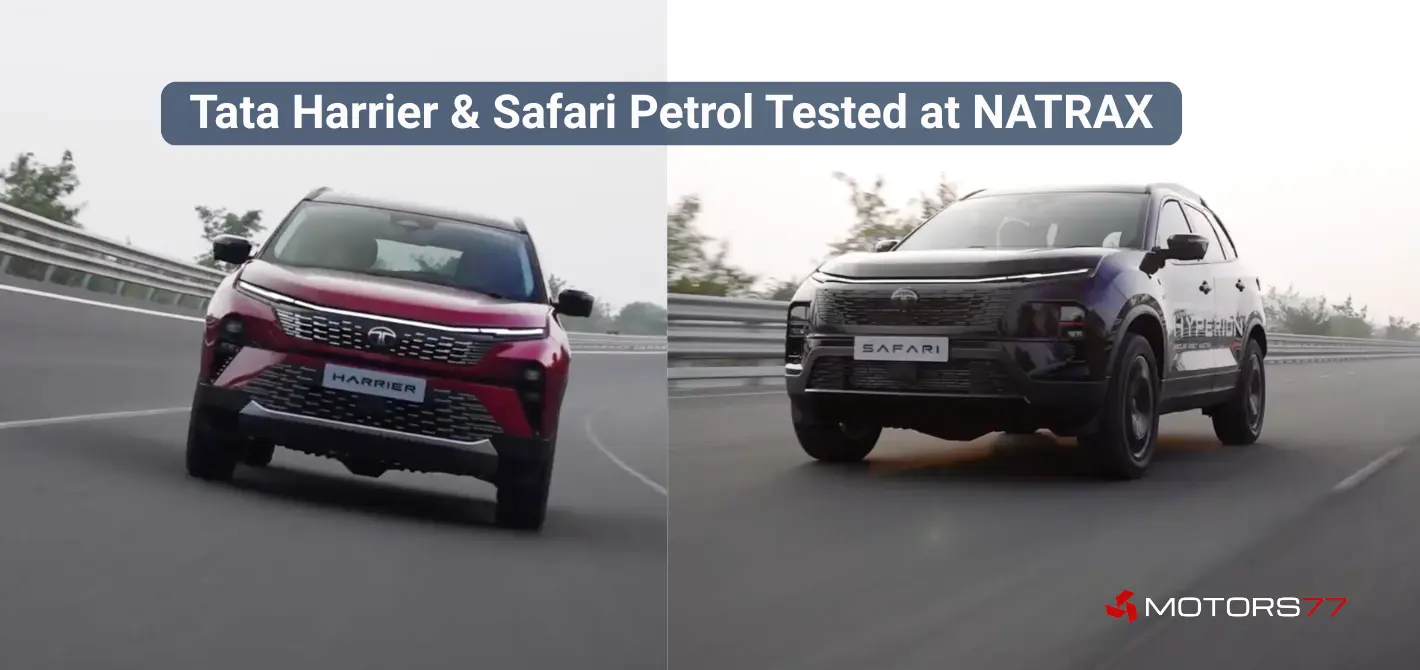
Tata Harrier and Safari Petrol Hyperion Engine Tested, Tata Motors has revealed the performance credentials of its petrol-powered Harrier and Safari SUVs through controlled testing conducted at the National Automotive Test Tracks (NATRAX) in Indore. According to the manufacturer, the petrol Harrier achieved a fuel efficiency figure of 25.9 kmpl, while the Safari recorded a top speed of 216 kmph during these tests. Both results were achieved using Tata’s newly developed Hyperion Turbo GDi petrol engine, which marks a significant shift in the brand’s powertrain strategy for its flagship SUVs.
While the headline numbers have generated considerable attention, they also warrant a closer examination to understand what they truly represent for buyers and how much of this performance is likely to translate into everyday driving conditions.
Tata Harrier and Safari Petrol Hyperion Engine Tested at NATRAX: Detailed Analysis
The Hyperion Turbo GDi engine represents Tata Motors’ most serious investment in petrol engine development for its larger SUVs to date. The unit is a 1.5-litre turbocharged direct-injection petrol engine producing around 170 bhp, placing it in the same performance bracket as key rivals in the segment.
Designed and engineered in-house, the Hyperion engine has been developed to address long-standing concerns around drivability, efficiency, and refinement that have traditionally placed Tata’s petrol offerings at a disadvantage compared to competitors. With diesel engines gradually losing favour in certain urban markets due to cost and regulatory pressures, Tata’s move to introduce a strong petrol alternative reflects a deliberate strategic pivot. The Hyperion engine is also positioned as a foundation for future hybridisation, extending its relevance as emission norms tighten further.
Interpreting the NATRAX Fuel Efficiency Claim
The claimed 25.9 kmpl fuel efficiency figure for the petrol Harrier is undeniably impressive on paper. However, it is important to understand that NATRAX tests are conducted under highly controlled conditions designed to evaluate a vehicle’s technical potential rather than simulate real-world usage.
Such tests typically involve constant speeds, optimised driving cycles, minimal payload, and ideal road conditions. As a result, real-world fuel efficiency figures in city traffic or mixed driving conditions will be significantly lower. That said, the result does indicate that Tata has achieved meaningful improvements in combustion efficiency, thermal management, and drivetrain optimisation compared to its earlier petrol engines.
For buyers comparing the Harrier and Safari petrol variants with competitors such as the Hyundai Creta 1.5 Turbo or the Kia Seltos 1.5 TGDi, this efficiency claim signals that Tata is now approaching the petrol segment with far greater intent than before.
What the Safari’s 216 kmph Top Speed Tells Us
The Safari’s reported 216 kmph top speed figure is less about practical usage and more about demonstrating the engine’s performance ceiling. In everyday conditions, few owners will ever approach such speeds, but the ability to do so indicates strong mid-range and top-end performance along with mechanical stability at sustained highway speeds.
This has direct implications for highway cruising, an area where petrol SUVs are often criticised for feeling strained or noisy. The test result suggests that Tata has focused on improving refinement and power delivery consistency, aspects that matter far more to buyers than outright top speed figures.
Why These Results Matter for Tata Motors
For years, Tata Motors relied heavily on diesel engines to drive sales of the Harrier and Safari, largely due to the limitations of its petrol portfolio. With the launch of the Hyperion-powered petrol variants and the subsequent NATRAX test results, Tata has clearly attempted to rebalance this equation.
This move aligns with changing buyer preferences, particularly in urban markets where petrol SUVs are gaining acceptance due to smoother driving characteristics, lower NVH levels, and reduced complexity compared to diesel powertrains. It also positions Tata more competitively against established turbo-petrol rivals in the mid-size SUV segment.
Real-World Expectations Going Forward
While the controlled test results are encouraging, real-world performance will ultimately shape buyer perception. Factors such as city fuel efficiency, drivability in traffic, long-term reliability, and service experience will determine how well the petrol Harrier and Safari perform in everyday ownership.
Independent road tests and owner feedback over time will provide a clearer picture of how closely the Hyperion engine’s promise aligns with reality.
Motors77 Verdict
The NATRAX performance showcase highlights a meaningful evolution in Tata Motors’ petrol SUV strategy. The Hyperion Turbo GDi engine addresses several long-standing weaknesses associated with Tata’s petrol powertrains, particularly in terms of efficiency, refinement, and highway performance.
While real-world figures will naturally be lower than controlled test results, the engineering progress is evident. If this translates into consistent everyday drivability and reliability, the petrol Harrier and Safari strengthen Tata’s position in a segment that has long been dominated by turbo-petrol rivals.
Stay tuned to Motors77 for our detailed real-world road test analysis and ownership insights.