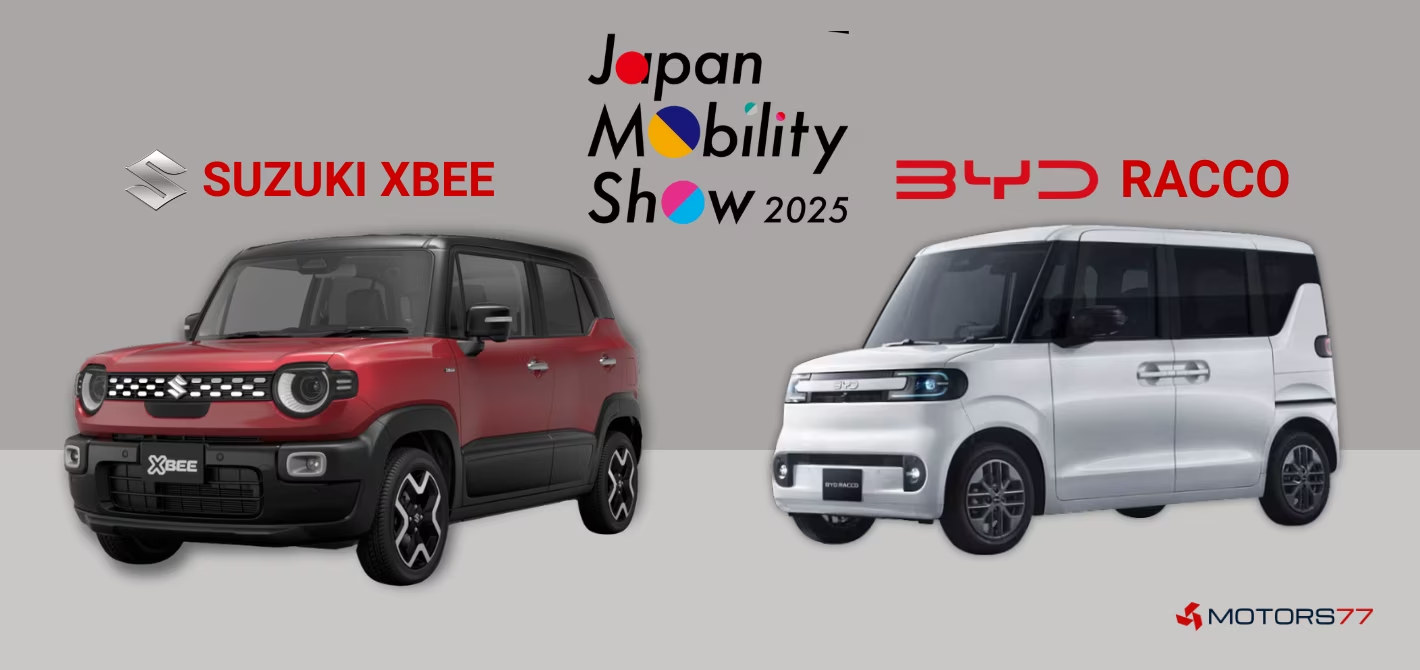
The Japan Mobility Show 2025 at Tokyo Big Sight has unveiled some fascinating compact crossovers that showcase different approaches to urban mobility. While these models are designed exclusively for the Japanese market, they offer intriguing insights into future design directions and technologies that could eventually influence India-bound vehicles. Here’s an in-depth look at two standout models the refreshed Suzuki XBEE and BYD’s groundbreaking Racco kei car.
Suzuki XBEE 2025 Facelift: The Quirky Compact Gets Smarter
The Suzuki XBEE (pronounced “Crossbee”) has received a comprehensive mid-life update at the Japan Mobility Show 2025, bringing fresh styling, updated features, and a significant powertrain change. First launched in 2017 as a Japan-exclusive model, the XBEE combines the practicality of a tall-boy hatchback with SUV-inspired design elements, creating a unique proposition in the compact crossover space.
Design Evolution with Familiar Cues
The 2025 XBEE retains its distinctive boxy silhouette that makes it instantly recognizable on Japanese roads. The facelift introduces new round LED headlamps that add character to the front fascia, complemented by a refreshed grille featuring prominent silver accents. The lower body gets chunkier plastic cladding that enhances its rugged SUV-like presence, while new dual-tone color combinations add visual appeal. The model showcased at Tokyo wears the striking Mystic Blue Metallic Black Tough 2-tone finish, highlighting Suzuki’s focus on lifestyle-oriented color schemes.
The XBEE measures 3,750mm in length, 1,670mm in width, and 1,705mm in height, with a wheelbase of 2,435mm (Note: XBEE is not a kei car) dimensions that make it comparable to the Maruti Celerio sold in India, though with significantly taller proportions. The upright stance maximizes interior volume while maintaining a compact footprint ideal for congested urban environments. New alloy wheels with a sportier design complete the exterior refresh, giving the XBEE a more premium appearance than before.
Interior Modernization with Indian Maruti DNA
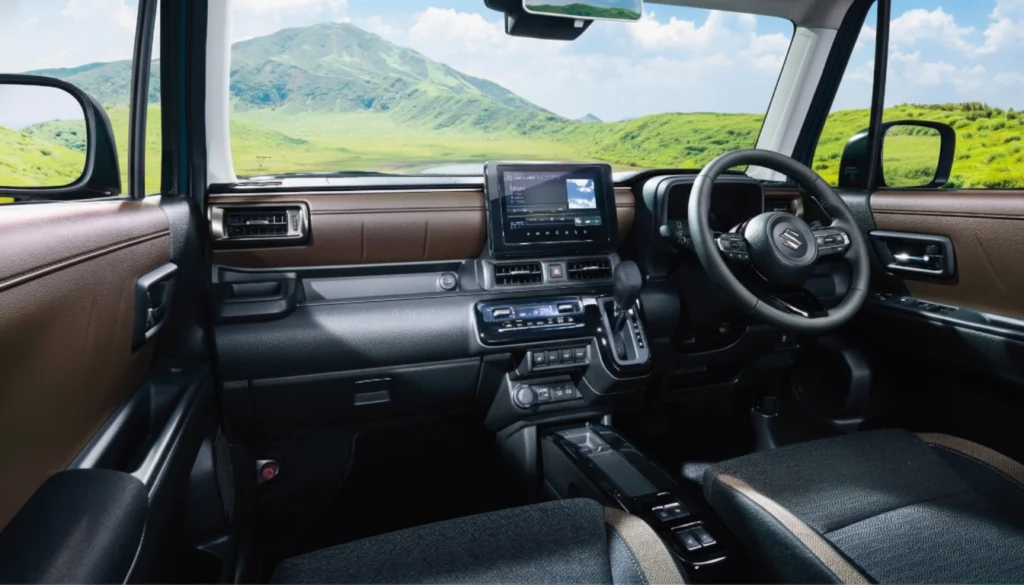
Step inside, and the cabin reveals its connection to Maruti Suzuki’s global parts bin. The XBEE gets a new steering wheel design identical to the one found in the Maruti Victoris in India, along with a fresh 7-inch digital instrument cluster that replaces the older analog setup. The center console features updated switchgear and controls, many of which will look familiar to anyone who’s been inside recent Maruti vehicles like the new Swift or Dzire.
The infotainment setup comprises a 9-inch touchscreen positioned high on the dashboard, similar in execution to the Maruti Jimny’s layout. This high-mounted screen improves visibility and reduces the need to look down while accessing navigation or audio controls. Suzuki Connect integration provides comprehensive connectivity features including remote vehicle diagnostics, smartphone app control, and telematics services.
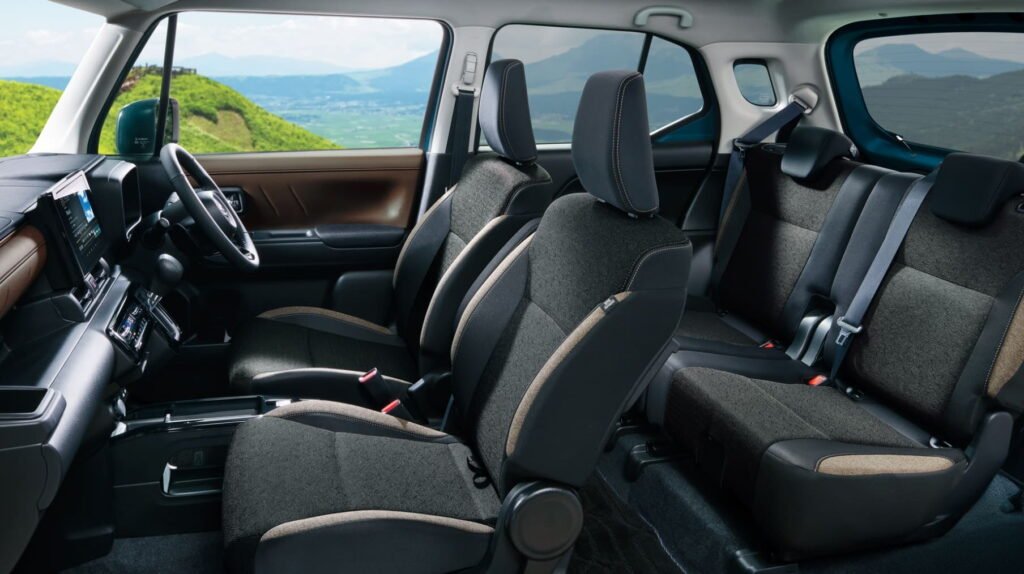
Despite its compact exterior dimensions, the XBEE impresses with clever space utilization. The dashboard-mounted gear lever is a distinctive touch that frees up floor space, while multiple storage cubbies throughout the cabin maximize practicality. The two-tier center console provides separate storage areas for small items, and the overall layout prioritizes functionality without compromising comfort.
Feature-Rich Equipment for Japanese Standards
The XBEE comes loaded with features that justify its premium positioning in the Japanese market. Standard equipment includes paddle shifters for manual gear control, premium UV and IR cut glass that blocks harmful rays and reduces cabin heat, heated front seats for winter comfort, heated steering wheel, heated electrically adjustable ORVMs, Type-C USB charging ports, and an electric parking brake with brake hold function.
Safety equipment includes Suzuki Safety Support with features like Dual Sensor Brake Support (collision mitigation), lane departure warning, adaptive cruise control, and a comprehensive 360-degree camera system. These features align with increasingly stringent Japanese safety regulations and consumer expectations for even small vehicles.
Powertrain Transformation: Goodbye Turbo, Hello Efficiency
The most significant change lies under the hood. The pre-facelift XBEE featured a peppy 1.0-liter K10C Boosterjet turbocharged petrol engine producing 99PS and 150Nm, mated to a 6-speed automatic transmission. This same engine powered the Maruti Baleno RS in India and delivered spirited performance with mild-hybrid assistance.
The 2025 facelift switches to the naturally aspirated 1.2-liter Z12E three-cylinder petrol engine with mild-hybrid technology the same unit that powers the latest Swift and Dzire in India. This engine produces 80PS at 5,700rpm and 108Nm of torque at 4,600rpm, paired exclusively with a CVT automatic transmission. The focus has clearly shifted from performance to efficiency and smoothness, with the Z12E known for its refined operation and impressive fuel economy in Indian Maruti models.
The mild-hybrid system uses a belt-driven Integrated Starter Generator (ISG) that provides torque assist during acceleration, enables idle start-stop functionality, and facilitates regenerative braking. This setup contributes to claimed fuel efficiency figures of around 22-24 km/l under Japanese test cycles. Power is sent to the front wheels only in the standard configuration, though an AllGrip 4WD variant with hill descent control remains available for buyers seeking enhanced traction in snowy conditions.
Platform and Positioning
Built on Suzuki’s lightweight yet rigid Heartect platform the same architecture underpinning the Ignis, Baleno, Swift, and Solio—the XBEE benefits from improved crash safety, reduced weight, and enhanced handling dynamics. This modular platform’s versatility allows Suzuki to create varied body styles while maintaining manufacturing efficiency and cost-effectiveness.
In Japan, the XBEE is positioned as a lifestyle crossover targeting young professionals and small families who want SUV style with hatchback practicality. Pricing starts at ¥2,157,100 (approximately ₹12.47 lakh) for the 2WD variant and ¥2,333,100 (approximately ₹13.50 lakh) for the AllGrip 4WD version, placing it as a premium alternative to conventional Kei cars.
India Prospects: Unlikely but Interesting
While Suzuki has no confirmed plans to bring the XBEE to India, its platform, powertrain, and size make it a potential contender in the micro-SUV segment currently dominated by the Tata Punch and Hyundai Exter. The XBEE’s quirky styling might find appeal among buyers seeking something different, though its premium positioning could prove challenging in price-sensitive Indian conditions.
The biggest hurdle remains India’s preference for aggressive value propositions. At its Japanese pricing equivalent, the XBEE would need to undercut significantly to compete with established players. However, if Maruti could leverage local manufacturing, shared components with existing models, and strategic feature positioning, a sub-₹8 lakh starting price might make it viable. The S-Presso’s styling shares some DNA with the XBEE, suggesting Maruti has already tested this design language in India, albeit with mixed commercial success.
BYD Racco: China’s Bold Kei Car Gamble
In a move that signals serious commitment to the Japanese market, Chinese EV giant BYD unveiled the Racco its first-ever kei car and a model developed exclusively for Japan with no plans for global export. This represents BYD’s direct entry into the heart of Japanese automotive culture, challenging domestic manufacturers like Suzuki, Honda, Nissan, and Daihatsu in a segment that accounts for nearly one-third of all vehicle sales in Japan.
Understanding Kei Cars and BYD’s Strategy
Kei cars (keijidōsha or “light automobiles”) are Japan’s unique vehicle category with strict dimensional and engine displacement regulations. Vehicles must measure no more than 3,400mm in length, 1,480mm in width, and 2,000mm in height, with engine displacement capped at 660cc for internal combustion engines. These regulations emerged in post-war Japan to encourage car ownership and remain popular today due to tax benefits, lower insurance costs, easier parking regulations, and cheaper highway tolls.
BYD’s decision to create an all-electric kei car is audacious. While the 660cc engine limit doesn’t apply to EVs, the dimensional constraints present packaging challenges for battery placement, thermal management, and achieving acceptable range. The Racco prototype showcased at Tokyo adheres strictly to kei car regulations, measuring 3,395mm long, 1,475mm wide, and 1,800mm tall making it a “super-height wagon,” the tallest kei car body style that maximizes interior space.
Design Philosophy: Friendly Tech Meets Japanese Sensibilities
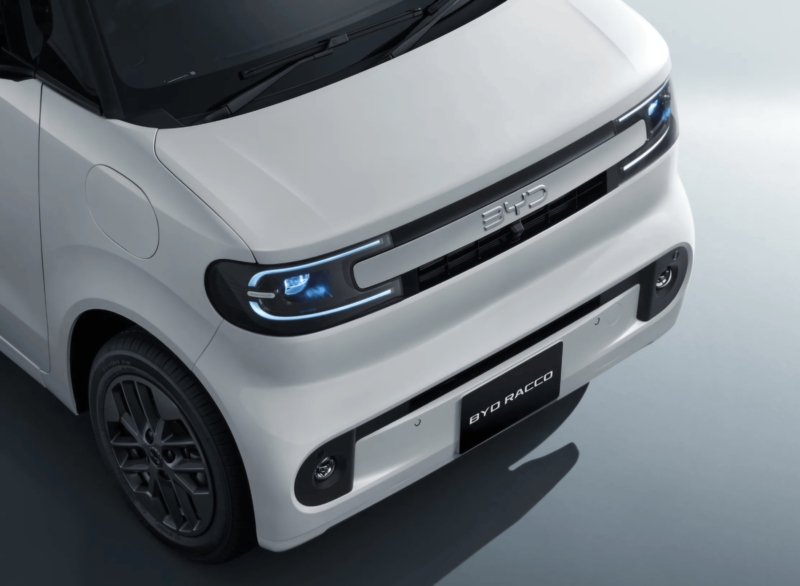
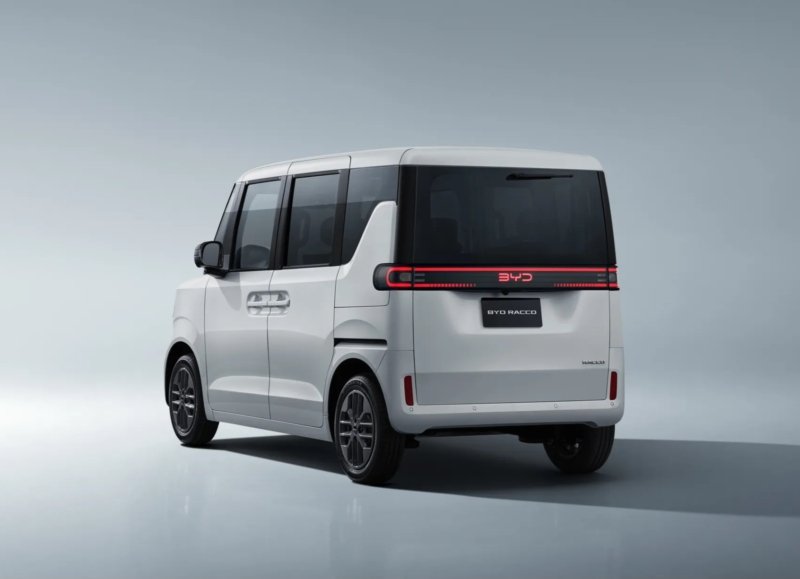
The Racco’s design balances BYD’s modern EV aesthetic with the practical requirements of Japanese urban life. The boxy proportions are quintessentially kei car, optimizing interior volume within strict size constraints. However, BYD’s execution adds contemporary flair through rounded design elements that convey approachability—visible in the headlamps, fog lamps, charging port, door handle indentation, mirrors, and tail lamps.
The front end is almost fully enclosed save for two slim air intake openings, signaling its EV identity and improving aerodynamics. Where traditional kei cars have busy grilles and vents, the Racco features clean surfacing that emphasizes its electric powertrain. Four-spoke alloy wheels give it a playful character, while the all-white body with contrasting black trim on pillars, ORVMs, and fog lamp surrounds adds visual sophistication.
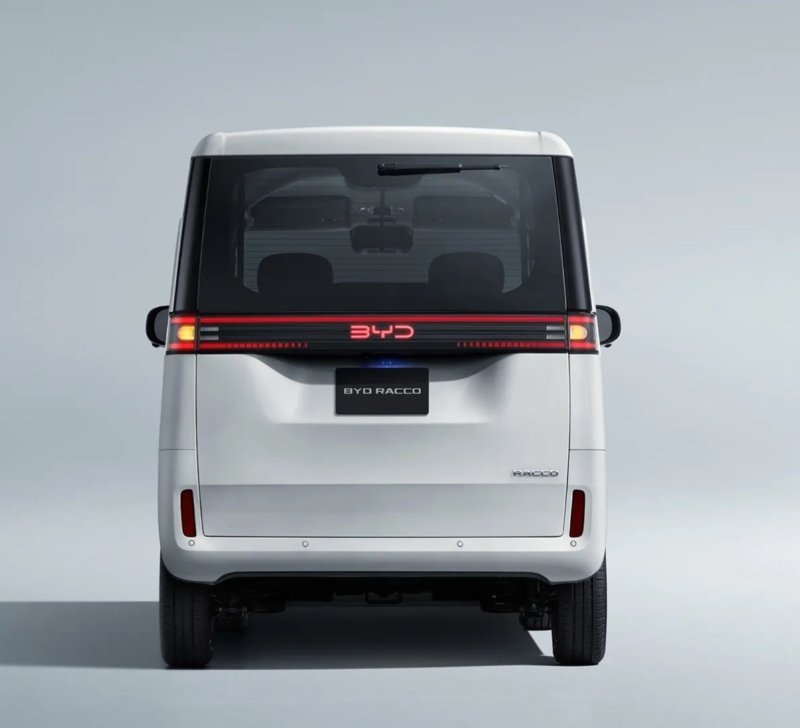
At the rear, connected LED tail lamps a signature design element of modern Chinese EVs give the Racco a high-tech appearance uncommon in the traditionally conservative kei car segment. An illuminated BYD logo completes this premium look, suggesting BYD wants to position the Racco above typical budget kei cars despite its compact dimensions.
Practical Innovation: Sliding Doors and Interior Space
The Racco features sliding rear doors on both sides a critical feature for Japanese buyers navigating tight parking spaces. Sliding doors prevent the risk of door dings and allow easier access in narrow spots where conventional doors would struggle to open fully. This makes the Racco particularly suitable for families and urban dwellers who frequently park in cramped conditions.
The interior accommodates four occupants with expected features including a digital driver’s display and a touchscreen infotainment system with smartphone connectivity. While BYD hasn’t released detailed interior specifications, the super-height wagon format suggests generous headroom and a flexible seating arrangement typical of Japanese kei cars. Expect clever storage solutions, foldable rear seats, and practical touches like umbrella holders and shopping bag hooks—features Japanese buyers consider essential.
Powertrain and Range: BYD’s Blade Battery Technology
The Racco will utilize BYD’s proprietary Blade Battery technology based on Lithium Iron Phosphate (LFP) chemistry. Blade batteries feature a distinctive cell-to-pack design that eliminates traditional modules, improving space utilization, structural rigidity, and thermal safety. BYD claims these batteries are virtually un-pierceable and exceptionally resistant to thermal runaway critical safety advantages for a vehicle designed to navigate crowded Japanese cities.
Two battery configurations will be offered: Short Range and Long Range. While BYD hasn’t officially disclosed specifications, industry reports suggest the Long Range version will pack approximately 20kWh of battery capacity, delivering an estimated 180km of range on a full charge under Japanese WLTC test cycles. The Short Range variant will likely offer 12-15kWh and around 120-140km of range, sufficient for daily urban commuting.
A single electric motor drives the front wheels, with expected power outputs around 40-50PS to comply with kei car performance norms while still offering adequate acceleration for city driving. Charging capabilities will likely include AC charging (3.3kW or 6.6kW) for overnight home charging and DC fast charging for quicker top-ups, though specific charging times haven’t been revealed.
Manufacturing and Market Strategy
In an unusual decision for a kei car, BYD will manufacture the Racco in China rather than establishing local Japanese production. This contrasts with traditional kei car manufacturers who build domestically to control costs and maintain tight quality control. BYD’s choice suggests confidence in its manufacturing efficiency and perhaps limited initial volume projections that wouldn’t justify the investment in Japanese production facilities.
BYD has built over 100 prototypes so far, rigorously testing crash performance, driving dynamics, and charging behavior to meet Japanese safety and quality standards. President of BYD Auto Japan, Atsuki Tofukuji, emphasized that the Racco represents the brand’s first model developed exclusively for an overseas market—highlighting how seriously BYD takes the Japanese opportunity.
The Racco is scheduled to launch in summer 2026, giving BYD approximately 18-20 months to finalize production specifications, establish charging partnerships, expand its Japanese dealer network, and build consumer confidence in Chinese EV technology. Pricing hasn’t been announced, but analysts expect the Racco to position competitively against established kei cars, likely starting between ¥1.5-2 million (approximately ₹8.6-11.5 lakh), potentially undercutting internal combustion kei cars while offering lower running costs.
Naming and Brand Philosophy
The name “Racco” derives from the Japanese word for sea otter (rakko/ラッコ), aligning with BYD’s Ocean Series naming convention that includes marine animals like Dolphin, Seal, and Atto (a play on “ocean”). This naming strategy emphasizes harmony with nature, environmental consciousness, and warmth—values that resonate strongly with Japanese consumers. The sea otter association also conveys playfulness, intelligence, and adaptability, characteristics BYD wants consumers to associate with the vehicle.
Competitive Landscape and Challenges
The Japanese kei car market is intensely competitive and dominated by domestic brands with decades of expertise. Suzuki alone commands over 30% of kei car sales with models like the Alto, Wagon R, Hustler, and Spacia. Honda’s N-Box has been Japan’s bestselling vehicle for years, while Daihatsu (owned by Toyota) and Nissan round out the major players.
BYD faces significant challenges beyond just building a compliant vehicle. Japanese consumers are notoriously loyal to domestic brands and skeptical of Chinese quality despite BYD’s global EV leadership. The company will need to establish trust through exceptional after-sales service, comprehensive warranties, and proven reliability. Additionally, kei car buyers are extremely price-sensitive, and BYD’s China-manufactured approach might not deliver the cost advantages needed to compete aggressively on price.
However, BYD has advantages too. The Racco’s EV powertrain offers significantly lower running costs than gasoline kei cars—potentially 60-70% cheaper per kilometer when factoring in electricity versus fuel costs. Government incentives for EVs, including purchase subsidies and tax breaks, could further narrow the price gap. Environmental consciousness is growing among younger Japanese buyers, potentially opening a market segment receptive to electric kei cars.
India Connection: Lessons and Possibilities
While the Racco is Japan-exclusive, its development offers insights for India’s evolving mobility landscape. The success of micro-SUVs like the Tata Punch and Hyundai Exter demonstrates Indian buyers’ appetite for compact yet practical vehicles with SUV styling. An electric micro-SUV positioned around ₹7-9 lakh (post-subsidies) with 150-200km real-world range could find acceptance in tier-1 cities where charging infrastructure is developing.
BYD already operates in India with models like the Atto 3 and e6, though positioned in premium segments. The Racco’s packaging solutions—particularly its space-efficient design, LFP battery technology, and focus on urban practicality could inform a future India-specific compact EV if BYD chooses to target the mass market.
Conclusion: Japan as Innovation Laboratory
Both the Suzuki XBEE and BYD Racco demonstrate how the unique Japanese market drives automotive innovation in unexpected directions. The XBEE shows Suzuki’s continued evolution of the practical-yet-quirky crossover formula with updated technology and efficiency focus, while the Racco represents BYD’s bold ambition to crack one of the world’s most challenging automotive markets with a ground-up EV designed specifically for local needs.
For Indian enthusiasts, these vehicles offer a glimpse into alternative mobility solutions that prioritize efficiency, packaging innovation, and lifestyle appeal over traditional metrics like power and size. While neither model is confirmed for India, the technologies, design approaches, and market strategies they represent will undoubtedly influence future products from their respective manufacturers.
Which approach resonates more with you Suzuki’s evolutionary refinement of an established formula, or BYD’s revolutionary entry into new territory with purpose-built electric mobility? Share your thoughts in the comments below!
Discover more innovations from Tokyo read our detailed coverage of India-bound EVs and green technology showcased at the Japan Mobility Show 2025. Click here to read »