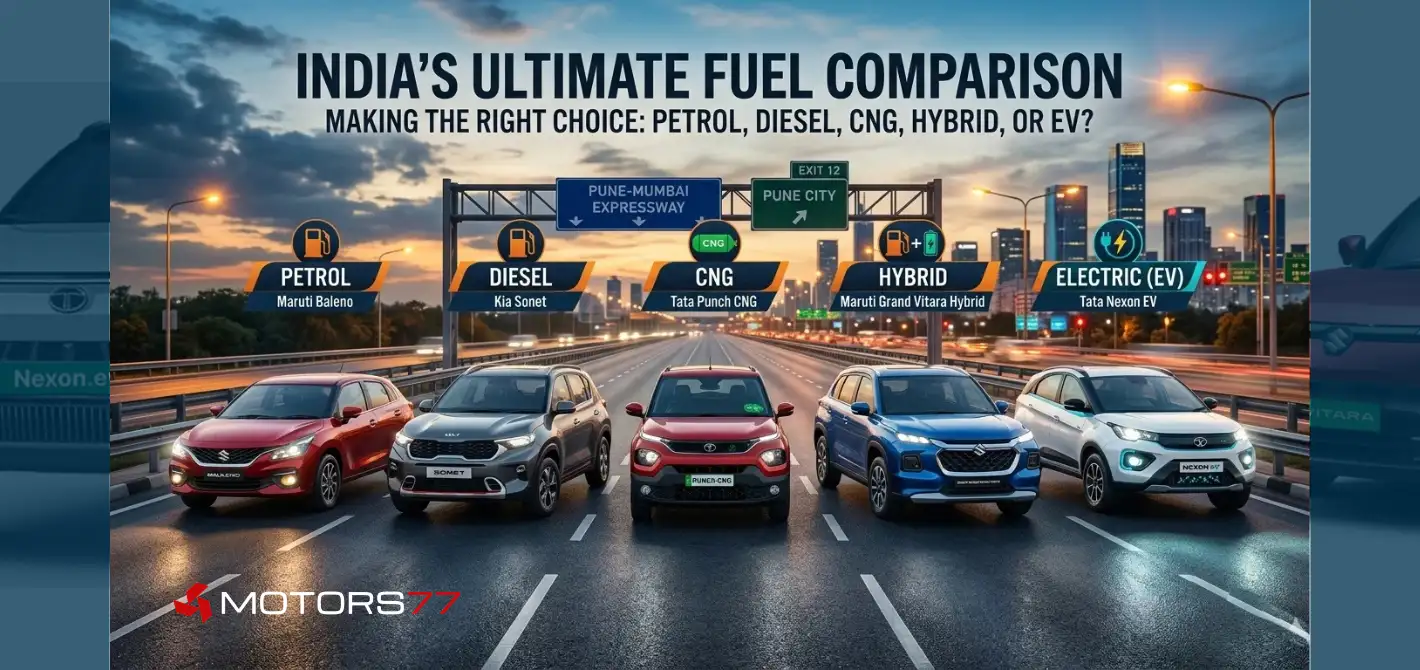
Petrol vs diesel vs CNG vs hybrid vs EV has become the most debated question among Indian car buyers in 2026. With fuel prices fluctuating, CNG infrastructure expanding, and electric vehicles gaining momentum, choosing the right fuel type directly impacts your monthly budget and long-term ownership costs. This comprehensive analysis breaks down every fuel option with verified data, real-world calculations, and practical guidance for buyers running 1500 km monthly.
Why Fuel Type Selection Matters More Than Ever in 2026
Indian automotive buyers face an unprecedented choice matrix. The conventional petrol vs diesel debate has expanded to include CNG, self-charging hybrids, and pure electric vehicles. For buyers covering 1500 km monthly, the fuel choice can result in annual savings ranging from ₹50,000 to over ₹1,00,000.
Current Fuel Prices in India (March 2026)
Before analysing running costs, understanding current fuel rates across India provides essential context for the petrol vs diesel vs CNG vs hybrid vs EV comparison.
| Fuel Type | Price (Delhi) | Price (Mumbai) | Price (Bangalore) |
|---|---|---|---|
| Petrol | ₹94.77/litre | ₹103.54/litre | ₹100.01/litre |
| Diesel | ₹87.67/litre | ₹90.03/litre | ₹86.46/litre |
| CNG | ₹77.09/kg | ₹76.50/kg | ₹79.00/kg |
| Electricity (Home) | ₹5-8/kWh | ₹5-8/kWh | ₹5.75/kWh |
Petrol and diesel prices have remained stable despite global crude oil volatility, while CNG prices offer significantly lower per-kilometre costs. Home electricity rates for EV charging range between ₹4 and ₹8 per unit across states, with dedicated EV tariffs available in Maharashtra, Delhi, and Gujarat.
Vehicle Acquisition Cost Comparison
The upfront investment varies substantially across fuel types. Understanding these price differences is crucial for calculating the break-even period in any petrol vs diesel vs CNG vs hybrid vs EV evaluation.
| Segment | Petrol | Diesel | CNG | Hybrid | EV |
|---|---|---|---|---|---|
| Compact Hatchback | ₹5.99-9.10 lakh | N/A | ₹7.70-8.60 lakh | N/A | ₹9.69 lakh onwards |
| Compact SUV | ₹7.32-14.15 lakh | ₹9.01-14.15 lakh | ₹8.79-11.50 lakh | ₹16.50-19.72 lakh | ₹12.49-17.49 lakh |
Key observations reveal that CNG variants command a premium of approximately ₹90,000 to ₹1.20 lakh over petrol equivalents. Hybrid vehicles carry the highest acquisition cost at ₹4 to ₹6 lakh more than petrol counterparts.
Popular Models by Fuel Type
Petrol: Maruti Baleno (₹5.99 lakh), Hyundai i20 (₹7.04 lakh), Tata Nexon (₹7.32 lakh)
Diesel: Tata Nexon Diesel (₹9.01 lakh), Hyundai Venue Diesel (₹10.65 lakh), Kia Sonet Diesel (₹10.79 lakh)
CNG: Maruti Baleno CNG (₹7.70 lakh), Tata Punch CNG (₹7.37 lakh), Maruti Brezza CNG (₹9.54 lakh)
Hybrid: Toyota Hyryder Hybrid (₹16.71 lakh), Maruti Grand Vitara Hybrid (₹16.50 lakh), Honda City eHEV (₹20 lakh)
EV: Tata Punch EV (₹9.69 lakh), Tata Nexon EV (₹12.49 lakh), MG ZS EV (₹18.98 lakh)
Real-World Fuel Efficiency Specifications
Claimed mileage figures rarely match real-world performance. The following table presents verified efficiency data considering mixed driving conditions typical in Indian cities and highways.
| Fuel Type | ARAI Claimed | Real-World City | Real-World Highway | Combined Average |
|---|---|---|---|---|
| Petrol (Turbo 1.2L) | 17-18 kmpl | 13-15 kmpl | 17-19 kmpl | 15-17 kmpl |
| Diesel (1.5L) | 23-24 kmpl | 18-20 kmpl | 22-25 kmpl | 20-22 kmpl |
| CNG | 30.61 km/kg | 22-25 km/kg | 26-28 km/kg | 24-26 km/kg |
| Strong Hybrid | 27.97 kmpl | 20-24 kmpl | 18-22 kmpl | 20-23 kmpl |
| Electric Vehicle | 6-7 km/kWh | 5.5-6.5 km/kWh | 6-7 km/kWh | 6-6.5 km/kWh |
Diesel engines excel on highways with consistent efficiency, while hybrids perform best in city traffic where regenerative braking maximises efficiency. Electric vehicles maintain consistent efficiency across conditions, making them predictable for budget planning.
Monthly Running Cost Analysis at 1500 km
The core calculation for petrol vs diesel vs CNG vs hybrid vs EV break-even analysis requires accurate monthly expense projections based on real-world efficiency and current fuel prices.
| Fuel Type | Monthly Fuel/Energy Consumption | Cost per Unit | Monthly Running Cost |
|---|---|---|---|
| Petrol | 1500 km ÷ 16 kmpl = 93.75 litres | ₹94.77 | ₹8,885 |
| Diesel | 1500 km ÷ 21 kmpl = 71.43 litres | ₹87.67 | ₹6,262 |
| CNG | 1500 km ÷ 25 km/kg = 60 kg | ₹77.09 | ₹4,625 |
| Hybrid | 1500 km ÷ 22 kmpl = 68.18 litres | ₹94.77 | ₹6,461 |
| EV (Home) | 1500 km ÷ 6 km/kWh = 250 kWh | ₹6.50 | ₹1,625 |
Monthly savings compared to petrol baseline reveal compelling differences. CNG saves ₹4,260 monthly, hybrid saves ₹2,424, diesel saves ₹2,623, and EV delivers the maximum savings at ₹7,260 monthly.
Cost Per Kilometre Comparison
| Fuel Type | Cost per KM |
|---|---|
| Petrol | ₹5.92 |
| Diesel | ₹4.17 |
| CNG | ₹3.08 |
| Hybrid | ₹4.30 |
| EV (Home Charging) | ₹1.08 |
This cost-per-km breakdown demonstrates why EVs are gaining momentum among budget-conscious Indian buyers.
Break-Even Period Calculations
The critical question in any petrol vs diesel vs CNG vs hybrid vs EV comparison centres on when higher acquisition costs get recovered through fuel savings.
CNG Break-Even Analysis
Price premium over petrol: ₹1,00,000 (average) Monthly savings: ₹4,260 Break-even period: 23.5 months (approximately 2 years)
Diesel Break-Even Analysis
Price premium over petrol: ₹1,50,000 (average) Monthly savings: ₹2,623 Break-even period: 57.2 months (approximately 4.8 years)
Hybrid Break-Even Analysis
Price premium over petrol: ₹5,00,000 (average) Monthly savings: ₹2,424 Break-even period: 206 months (approximately 17 years)
EV Break-Even Analysis
Price premium over petrol: ₹5,00,000 (average) Monthly savings: ₹7,260 Break-even period: 68.9 months (approximately 5.7 years)
The break-even analysis reveals CNG as the fastest-recovering investment, followed by EV and diesel. Strong hybrids struggle to justify their premium through fuel savings alone at 1500 km monthly usage, requiring either higher monthly running or valuation of environmental benefits.
Quick Pros and Cons
Understanding the advantages and limitations of each fuel type helps buyers make informed decisions beyond pure financial calculations.
Petrol Vehicles
| Pros | Cons |
|---|---|
| Lowest acquisition cost | Highest fuel prices |
| Widest variant and feature availability | Poorest fuel efficiency in segment |
| Refined engine performance | Maximum running cost per kilometre |
| Universal service availability | Volatile fuel price exposure |
| Strong resale value | Environmental impact concerns |
Diesel Vehicles
| Pros | Cons |
|---|---|
| Best highway fuel efficiency | Higher acquisition cost |
| Strong torque for loaded driving | Declining availability in new models |
| Lower fuel cost per kilometre | Higher maintenance costs |
| Proven long-term reliability | Potential future regulatory restrictions |
| Good resale in commercial markets | Noise and vibration characteristics |
CNG Vehicles
| Pros | Cons |
|---|---|
| Lowest fuel cost among ICE options | Reduced boot space |
| Fastest break-even period | Limited refuelling infrastructure outside metros |
| Government incentives and subsidies | Slight power reduction in CNG mode |
| Cleaner emissions than petrol or diesel | Periodic cylinder recertification required |
| Dual-fuel flexibility | Longer refuelling times |
Hybrid Vehicles
| Pros | Cons |
|---|---|
| Excellent city fuel efficiency | Highest acquisition cost |
| No charging infrastructure dependency | Long break-even period |
| Seamless power transitions | Battery degradation concerns |
| Lower emissions than pure ICE | Complex powertrain maintenance |
| Premium driving experience | Limited variant availability |
Electric Vehicles
| Pros | Cons |
|---|---|
| Lowest running cost | Range anxiety for long trips |
| Zero tailpipe emissions | Charging infrastructure gaps |
| Minimal maintenance requirements | Higher acquisition cost |
| Government subsidies and incentives | Longer charging times |
| Superior acceleration and refinement | Battery replacement costs |
Total Cost of Ownership Over 5 Years
A comprehensive 5-year projection incorporating fuel, maintenance, insurance, and depreciation provides the complete picture for petrol vs diesel vs CNG vs hybrid vs EV evaluation.
| Cost Component | Petrol | Diesel | CNG | Hybrid | EV |
|---|---|---|---|---|---|
| Acquisition Cost | ₹10,00,000 | ₹11,50,000 | ₹11,00,000 | ₹15,00,000 | ₹15,00,000 |
| 5-Year Fuel/Energy | ₹5,33,100 | ₹3,75,720 | ₹2,77,500 | ₹3,87,660 | ₹97,500 |
| 5-Year Maintenance | ₹75,000 | ₹90,000 | ₹80,000 | ₹85,000 | ₹40,000 |
| Insurance (5 Years) | ₹1,20,000 | ₹1,35,000 | ₹1,25,000 | ₹1,60,000 | ₹1,50,000 |
| Total Cost | ₹17,28,100 | ₹17,50,720 | ₹15,82,500 | ₹21,32,660 | ₹17,87,500 |
The 5-year analysis positions CNG as the most economical choice, with EV and petrol competing for second place. Diesel and hybrid options carry higher total costs due to acquisition premium.
Infrastructure and Practical Considerations
Petrol and Diesel: Universal availability with 5-10 minute refuelling.
CNG: Over 4,500 stations operational, concentrated in Gujarat, Maharashtra, Delhi-NCR, and UP. Highway coverage expanding.
Hybrid: No infrastructure dependency with self-charging systems.
EV: Approximately 12,000 public charging stations. Home charging covers 95% of daily requirements.
Environmental Impact Comparison
| Fuel Type | CO2 Emissions | Air Quality Impact |
|---|---|---|
| Petrol | High | Significant |
| Diesel | Medium-High | Particulate concerns |
| CNG | Low | Minimal |
| Hybrid | Very Low | Reduced |
| EV | Zero Tailpipe | Cleanest option |
Who Should Choose Which Fuel Type
Choose Petrol If: Running less than 800 km monthly, prioritising lowest acquisition cost, or planning to upgrade within 3 years.
Choose Diesel If: Running over 2500 km monthly, predominantly highway usage, or commercial applications.
Choose CNG If: Running 1200-2000 km monthly, urban commuting focus, and CNG stations accessible on daily routes.
Choose Hybrid If: Primarily city driving, environmental consciousness, and premium feature requirements.
Choose EV If: Running 1000-1800 km monthly, home charging available, and intercity travel infrequent.
Frequently Asked Questions
Q1. Which fuel type offers the lowest running cost for 1500 km monthly? Electric vehicles deliver the lowest running cost at approximately ₹1,625 monthly compared to ₹8,885 for petrol, representing savings exceeding ₹7,000 monthly.
Q2. How long does CNG take to break even against petrol? CNG vehicles typically break even within 23-24 months at 1500 km monthly running, making them the fastest-recovering alternative fuel investment.
Q3. Are diesel cars still worth buying in 2026? Diesel remains viable for high-mileage users exceeding 2000 km monthly or those requiring highway efficiency. Break-even extends to approximately 5 years at 1500 km monthly.
Q4. Do hybrid vehicles justify their premium price? At 1500 km monthly running, strong hybrids require over 15 years to break even on fuel savings alone. The premium is better justified by environmental benefits and driving refinement.
Q5. What is the real-world range of electric vehicles? Modern EVs like Tata Nexon EV deliver 280-320 km real-world range on the 40.5 kWh battery, sufficient for weekly charging cycles at 1500 km monthly usage.
Q6. How much does home EV charging cost monthly? At 1500 km monthly and ₹6.50 per unit electricity rate, home charging costs approximately ₹1,625, representing 80% savings over petrol.
Q7. Is CNG infrastructure sufficient for highway travel? CNG highway coverage remains limited outside Gujarat-Delhi-Mumbai corridors. Dual-fuel capability allows petrol backup for areas without CNG stations.
Q8. Which fuel type has the best resale value? Petrol vehicles currently command the strongest resale values, followed by diesel in commercial applications. EV resale market is developing, with hybrid and CNG vehicles showing stable demand.
Q9. What maintenance costs differ across fuel types? EVs require approximately 40% lower maintenance than petrol vehicles due to fewer moving parts. Diesel and hybrid powertrains carry marginally higher maintenance costs.
Q10. How do government subsidies affect EV and CNG economics? State incentives reduce EV acquisition costs by ₹1-2 lakh in several states. CNG vehicles benefit from lower road tax and registration fees in multiple states.
Motors77 Verdict
After comprehensive analysis of petrol vs diesel vs CNG vs hybrid vs EV options for Indian buyers running 1500 km monthly, our recommendations prioritise practical economics.
Best Value Choice: CNG Factory-fitted CNG vehicles offer the fastest break-even at under 2 years and lowest running cost among ICE options. Monthly savings of ₹4,260 over petrol translate to ₹51,000 annually.
Best Long-Term Investment: EV Despite higher upfront costs, EVs deliver unmatched savings at ₹1,625 monthly. The 5.7-year break-even combined with minimal maintenance makes EVs compelling for long-term ownership with home charging access.
Best Balanced Option: Petrol Buyers uncertain about alternative fuels or planning vehicle changes within 3-4 years should prefer petrol for lowest acquisition cost and universal flexibility.
Conditional Recommendation: Diesel Diesel makes financial sense only for buyers exceeding 2000 km monthly. Declining model availability reduces diesel’s long-term appeal.
Premium Preference: Hybrid Strong hybrids suit buyers prioritising refinement over pure economics. The extended break-even means hybrid ownership is a lifestyle choice at 1500 km monthly usage.
Last Updated: March 2026 Data verified from official manufacturer specifications, government fuel price portals, and real-world ownership reports.