Sub-4 meter SUVs launch announcements have dominated Indian automotive news throughout 2025 and into 2026. What looks like brand cannibalization is actually one of the smartest strategic plays in the Indian auto market today.
Every major automaker now appears determined to offer not just one, but multiple compact SUVs under their brand umbrella. Tata has the Nexon yet plans the Mini Sierra. Mahindra sells the XUV 3XO while developing the Vision S and Vision X. Renault already offers the Kiger and now prepares a rugged Mini Duster. Maruti runs both Brezza and Fronx simultaneously. Hyundai operates Venue and Exter side-by-side while preparing the Bayon.
This strategic shift raises an important question: why would brands willingly compete against themselves?
The ₹22 Billion Market That Demands Diversity
India’s SUV market stands at $22.24 billion in 2025, projected to reach $30.26 billion by 2030 at a 6.35% CAGR. The sub-4 meter segment alone commands roughly half of all utility vehicle sales, making it the most fiercely contested battleground in Indian automotive history.
What makes this segment particularly compelling is the tax advantage. Vehicles measuring under four meters attract lower GST rates, enabling manufacturers to offer feature-rich products at aggressive price points. This regulatory structure has transformed compact SUV launch strategies into boardroom priorities.
However, the real driver behind multiple model launches goes deeper than taxation.
Understanding Different Customer Personas
Modern Indian SUV buyers do not represent a monolithic group. Within the subcompact segment, distinct customer personas have emerged:
The Style-Conscious Urban Professional prioritizes sleek crossover aesthetics, smooth powertrains, and connected features. They want vehicles that look sophisticated in corporate parking lots while navigating city traffic effortlessly.
The Adventure-Seeking Family desires rugged styling, high ground clearance, and durability that can handle weekend getaways. Visual toughness matters as much as actual capability.
The Value-Maximizing First-Time Buyer seeks maximum features per rupee spent, willing to compromise on brand perception for tangible benefits.
A single model cannot authentically serve all three personas without appearing inconsistent in its positioning.
Maruti & Hyundai: Proof That Cannibalization Is a Myth
Before examining upcoming launches, consider that Maruti Suzuki and Hyundai already operate multiple sub-4 meter SUVs within overlapping price bands—and both brands continue to grow market share.
Maruti Suzuki: Brezza + Fronx Strategy
| Parameter | Brezza | Fronx |
|---|---|---|
| Length | 3,995 mm | 3,990 mm |
| Engine Options | 1.5L Petrol (102 PS), CNG | 1.2L NA Petrol (90 PS), 1.0L Turbo (100 PS) |
| Transmission | 5-speed MT, 6-speed AT | 5-speed MT, 5-speed AMT, 6-speed AT, CVT |
| Price Range | ₹8.26 – ₹13.01 Lakh | ₹6.85 – ₹11.98 Lakh |
| Target Buyer | Family-oriented, practical | Style-conscious, youthful |
| Channel | Arena | NEXA |
Despite overlapping prices, both sell well because Brezza buyers want solidity and trust while Fronx buyers want style and urban appeal. No cannibalization problemonly persona separation.
Hyundai: Venue + Exter + Bayon Strategy
| Parameter | Exter | Venue 2025 | Bayon (Expected 2026) |
|---|---|---|---|
| Length | 3,815 mm | 3,995 mm | Under 4,000 mm |
| Engine Options | 1.2L NA Petrol (83 PS) | 1.2L NA, 1.0L Turbo, 1.5L Diesel | 1.0L/1.2L Turbo Petrol |
| Power (Top Spec) | 83 PS | 120 PS (Turbo) | ~120 PS (Expected) |
| Price Range | ₹5.64 – ₹9.61 Lakh | ₹7.90 – ₹15.69 Lakh | ₹8 – ₹13 Lakh (Expected) |
| Target Buyer | Entry-level, first-time | Feature-rich, tech-forward | Design-first, coupe-style |
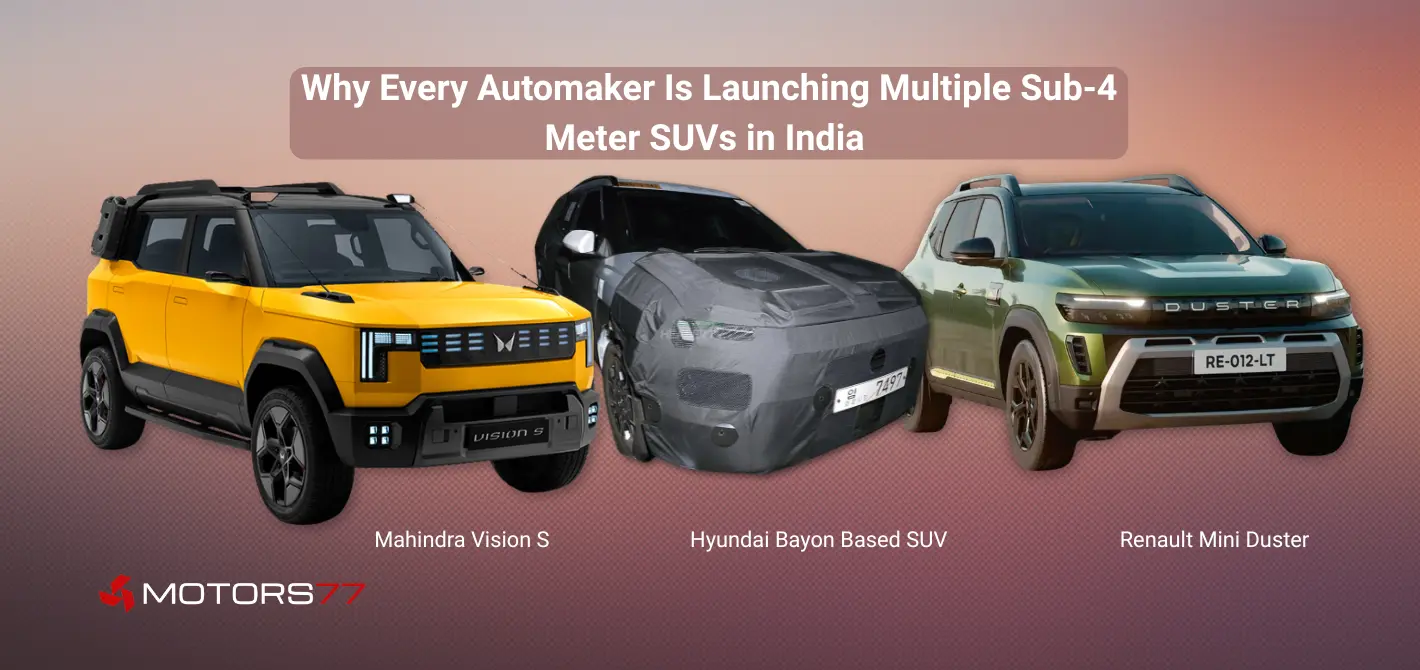
Hyundai’s upcoming Bayon-based SUV will introduce coupe-inspired styling into the under-4m space without replacing the Venue or Exter. This mirrors Mahindra’s Vision X approach and validates the multi-model compact SUV playbook across the industry.
Brand-Wise Upcoming Sub-4 Meter SUVs Launch Analysis
Tata Motors: Nexon Plus Mini Sierra (Scarlet)
Tata dominates with the Nexon, consistently selling over 20,000 units monthly with its 5-star Bharat NCAP rating.
Tata Nexon Key Specifications
| Parameter | Specification |
|---|---|
| Length | 3,995 mm |
| Engine Options | 1.2L Turbo Petrol (120 PS), 1.5L Diesel (115 PS), CNG |
| Transmission | 5-speed MT, 6-speed MT, 6-speed AMT, 7-speed DCT |
| Price Range | ₹7.32 – ₹14.15 Lakh |
| Safety Rating | 5-Star (Bharat NCAP, Global NCAP) |
Yet Tata recognizes that the Nexon’s curvaceous design does not appeal to buyers seeking classic SUV aesthetics. Enter the Tata Scarlet (Mini Sierra), expected during festive season 2026. This lifestyle SUV will feature boxy proportions inspired by the iconic original Sierra—targeting an entirely different emotional response from adventure-seeking buyers.
Mahindra: XUV 3XO Plus Vision S Plus Vision X
Mahindra presents the most aggressive subcompact SUV launch roadmap.
Mahindra XUV 3XO Key Specifications
| Parameter | Specification |
|---|---|
| Length | 3,995 mm |
| Engine Options | 1.2L Turbo Petrol (111/131 PS), 1.5L Diesel (117 PS) |
| Key Feature | Level 2 ADAS (segment-first) |
| Price Range | ₹7.28 – ₹14.40 Lakh |
The XUV 3XO serves urban families seeking modern tech integration. However, Mahindra’s Vision series reveals different ambitions:
Vision S – A lifestyle SUV with unmistakable Land Rover Defender influences. This boxy, rugged vehicle targets adventure enthusiasts. Expected launch: 2027. Anticipated price: ₹10.5 – ₹17.5 Lakh.
Vision X – A premium compact crossover with coupe-inspired styling. Positions above the XUV 3XO in visual sophistication. Expected launch: Late 2026 or 2027.
Both Vision concepts utilize Mahindra’s new NU_IQ modular platform, supporting petrol, diesel, hybrid, and electric powertrains.
Renault: Kiger Plus Mini Duster
Renault demonstrates this strategy across segments simultaneously.
Renault Kiger Key Specifications
| Parameter | Specification |
|---|---|
| Length | 3,990 mm |
| Engine Options | 1.0L NA Petrol (72 PS), 1.0L Turbo (100 PS) |
| Ground Clearance | 205 mm |
| Boot Space | 405 litres |
| Price Range | ₹5.76 – ₹10.34 Lakh |
The Kiger performs adequately but lacks the rugged character that made the original Duster legendary. Renault has confirmed internal discussions regarding a Mini Duster—a sub-4 meter SUV borrowing the Duster’s squared-off design language while retaining Kiger mechanicals. Expected arrival: 2027-2028.
Quick Pros & Cons: Multiple Sub-4 Meter Models Per Brand
| Advantages | Disadvantages |
|---|---|
| Broader customer coverage without alienating existing buyers | Higher development and manufacturing costs |
| Different design languages attract distinct personas | Risk of internal cannibalization (though evidence suggests minimal) |
| Platform sharing reduces per-vehicle engineering expenses | Dealer network complexity increases |
| Better competitive positioning against rivals | Marketing budget fragmentation |
| Flexibility to offer ICE, hybrid, and EV variants | Service parts inventory management challenges |
Why Platform Sharing Makes This Viable
The economics behind multiple compact SUV launches depend heavily on platform sharing. Tata’s ALFA architecture, Mahindra’s NU_IQ, and Renault’s CMF-B enable manufacturers to create visually distinct vehicles while sharing engines, transmissions, and electrical systems.
Platform sharing can reduce development costs by 30-40% compared to bespoke vehicle programs. Manufacturing flexibility means production lines can build different models based on demand fluctuations.
The Electrification Dimension
Sub-4 meter SUVs launch plans increasingly incorporate electric variants. The Mahindra XUV 3XO EV arrives in early 2026, while Tata already sells the Nexon EV.
Industry analysts project that 30-40% of new subcompact SUV launches will be electric by 2027. This further justifies multiple-model strategies—brands can offer petrol variants for range-anxious buyers and EVs for environmentally conscious urbanites without forcing a single model to represent both philosophies.
What This Means for Indian Buyers
The proliferation of under-4m SUVs benefits consumers through intensified competition. Manufacturers must continually enhance features, improve safety standards, and maintain aggressive pricing to protect market share.
Consider how rapidly safety equipment has improved: six airbags, electronic stability control, and ADAS features that were segment-firsts in 2024 have become expected by 2026.
Motors77 Verdict
The era of one sub-4 meter SUV per brand has conclusively ended. Maruti and Hyundai have proven this works, and now Tata, Mahindra, and Renault are following suit with dedicated products for distinct customer personas.
This strategy makes both business and consumer sense. Brands capture previously unreachable customer segments without abandoning existing loyal buyers. Consumers receive purpose-built vehicles rather than compromised all-rounders attempting to please everyone.
Our Recommendation: Identify which persona you genuinely belong to before visiting showrooms. The adventure-seeking buyer should wait for the Vision S or Mini Sierra rather than settling for crossover styling that does not resonate emotionally. The tech-forward urbanite will find the XUV 3XO or Nexon perfectly suited to their lifestyle. The style-conscious buyer should evaluate the Fronx, upcoming Bayon, or Vision X.
Understanding why automakers launch multiple compact SUVs ultimately helps you identify which variant truly deserves your consideration—and your hard-earned money.