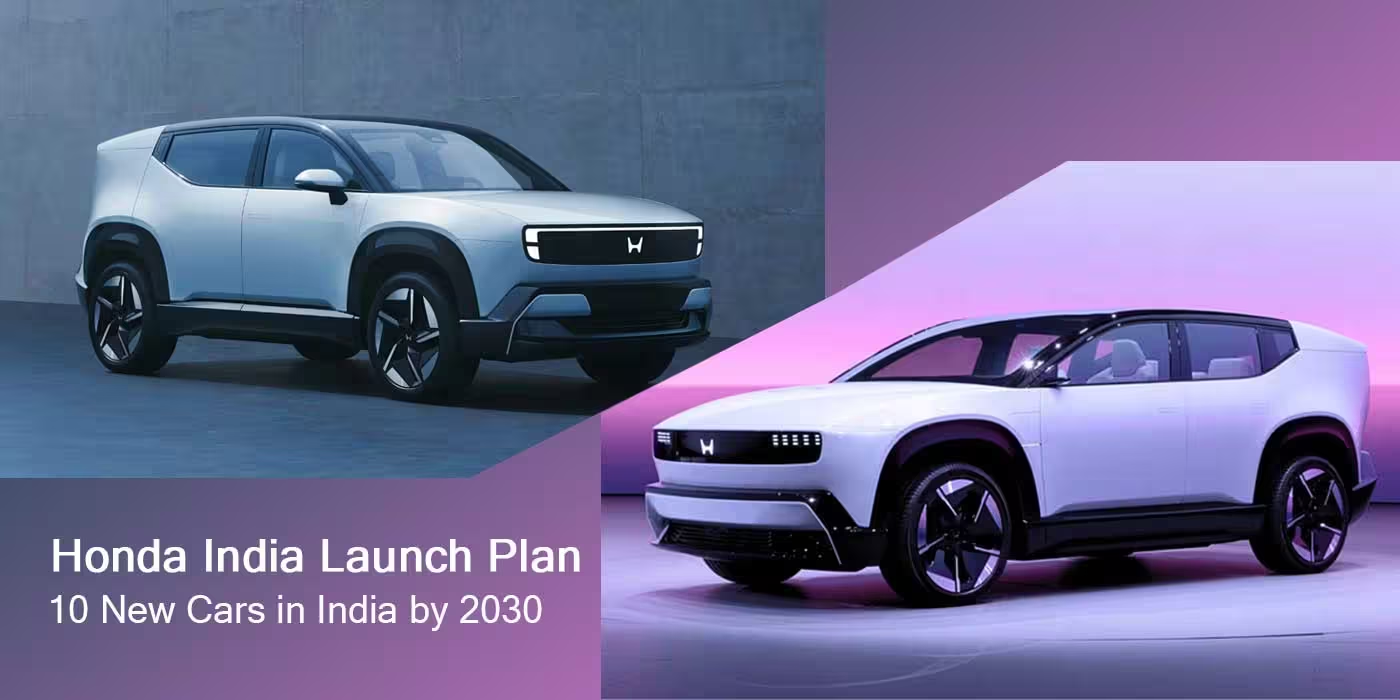
Can Honda really claw back from just 2% market share? Here’s why their audacious 10-model plan might actually work this time.
Let’s be brutally honest. Honda has been bleeding market share in India for years. While their 2024 total sales showed 20% growth to 1.32 lakh units, domestic sales actually dropped 18.5%. When a legendary carmaker is pushing barely over 5,000 units monthly in a market selling 3.5 lakh passenger vehicles, something’s gone seriously wrong.
But here’s the thing: Honda knows it. And they’re finally doing something about it.
At the Japan Mobility Show 2025, Honda dropped a bombshell. Ten new models by 2030, with seven of them being SUVs. Not facelifts. Not badge engineering. Entirely new products targeting segments where Honda has been completely absent or embarrassingly late. India now ranks alongside the US and Japan as Honda’s priority growth markets.
That’s a complete 180 from the company that spent the last decade watching Hyundai, Kia, Maruti, and Mahindra eat their lunch. The question isn’t whether this strategy is ambitious it obviously is. The question is whether Honda can genuinely execute what could be the most dramatic automotive comeback India has seen in years.
Why Honda Failed (And They’re Finally Admitting It)
The math is brutal. Indian buyers have shifted massively toward SUVs they now account for over 50% of all passenger vehicle sales. Honda? They had exactly one SUV until 2023. While competitors were launching multiple SUVs, Honda was making sedans nobody wanted anymore.
In 2024, Honda sold just 68,650 units domestically. Their current lineup? City sedan, Amaze sedan, and the Elevate SUV. That’s it. Three models. Meanwhile, Maruti has 17. Hyundai has 13. Even Kia, which entered India just six years ago, has seven models and higher market share.
Honda got comfortable. They assumed Indian buyers would keep buying sedans because of “premium positioning.” They were wrong. Dead wrong.
The Centerpiece: Honda 0 Alpha Electric SUV (2027 Launch)
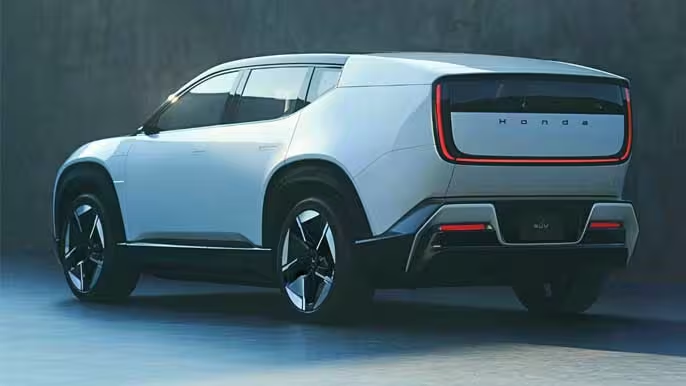
Honda’s trump card: the 0 Alpha, launching in 2027 as India’s first locally-manufactured Honda EV.
The production model ditches Honda’s traditional styling completely. Low, wide stance. Minimalist surfaces. A digital front fascia with seamless LED elements and that distinctive U-shaped rear light bar. The wheelbase measures approximately 2,750mm, maximizing interior space that’s about 100mm longer than the Elevate despite similar overall dimensions.
What’s Under the Skin
Two battery pack options are expected around 65 kWh and 75 kWh using LFP (Lithium Iron Phosphate) chemistry. Smart choice. LFP batteries are cheaper, safer, and handle heat better than the NMC chemistry most competitors use. They’re also more durable we’re talking 4,000+ charge cycles versus maybe 2,000 for typical NMC packs.
Battery cells will be supplied by CATL from Indonesia, then assembled in India. Range is expected to hit 400-500 kilometers under real Indian driving conditions. That’s realistic not the wildly optimistic numbers some manufacturers throw around.
The powertrain? Single motor, front-wheel drive setup, with estimated output around 140-180 hp. Fast charging capability suggests 15-80% charge in approximately 15 minutes, which would beat most current competitors. If true, that eliminates one of the biggest EV adoption barriers.
Pricing Reality Check
Industry estimates suggest ₹17-30 lakh ex-showroom, though Honda hasn’t officially confirmed pricing yet. That positions the 0 Alpha directly against serious competition. The Hyundai Creta Electric starts at ₹17.99 lakh, the Tata Curvv EV at ₹17.49 lakh, and the Mahindra BE 6 at ₹18.90 lakh.
Can Honda justify a premium? Maybe. The Honda badge still carries weight with Indian buyers who remember when their cars were bulletproof reliable. But Honda needs to bring serious value not just badge engineering and hoping the logo sells cars.
My take? If Honda prices the base 0 Alpha around ₹20-24 lakh with the smaller battery, and the loaded variant with the larger pack at ₹26-30 lakh, they’ve got a shot. Any higher and they’re dead on arrival.
The Full Product Offensive: What Else Is Coming
The Sub-4-Meter Compact SUV (2026-27)
This is massive. Honda confirmed they’re re-entering the sub-4-meter SUV segment, which accounts for over 500,000 annual sales. This segment alone Nexon, Brezza, Venue, Sonet is where Honda abandoned ship years ago.
Industry estimates suggest pricing around ₹8.5-13 lakh range, with petrol and possibly hybrid options. If Honda prices this aggressively and loads it with features, it could genuinely be a volume driver. The sub-4-meter segment is where market share gets won or lost in India.
Next-Generation Honda Elevate (2026 Facelift)
The current Elevate is fine. Not bad, not exceptional. Just fine. The facelift should bring updated design, ADAS features, possibly a strong hybrid option to compete with the Grand Vitara and Hyryder, and better infotainment.
Honda needs the Elevate to genuinely compete with the Creta, Seltos, and Grand Vitara. Right now, it’s just there. Not offensive, but not compelling either.
Honda BR-V Return (Expected 2028-29)
Honda discontinued the BR-V in 2023. Bad timing. The seven-seater segment is booming now with Ertiga, Carens, XL6, and Rumion. Families want space, and three-row vehicles are the answer.
Expect Honda to bring back a redesigned BR-V on an updated platform. If they can undercut the Carens on price while matching features, they’ve got a winner.
Honda CR-V Premium Comeback (Expected 2028-29)
The CR-V used to be Honda’s flagship SUV before they pulled it. Now they’re bringing it back, likely as a hybrid. This targets buyers who want something premium but aren’t quite ready for German luxury brands.
Competition: Jeep Meridian, Skoda Kodiaq. Estimated price range: ₹40-50 lakh. This is a low-volume, high-margin play to establish premium credentials.
Honda 0 SUV (Premium EV, Mid-2027)
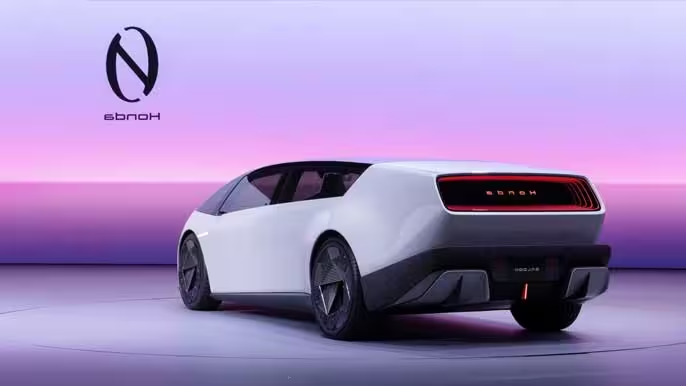
The bigger, badder brother to the 0 Alpha. This will come as an import by mid-2027, targeting luxury EV buyers. Think Level 3 autonomous driving capability, dual-motor setup, massive battery pack, premium materials.
Industry estimates suggest pricing above ₹60 lakh. This competes with luxury EVs not a volume driver, but it establishes Honda’s EV credentials and technology leadership.
The Sedans: Next-Gen City and Amaze (2027-2028)
Honda’s not abandoning sedans entirely. The next-generation City and Amaze will likely feature updated designs, strong hybrid variants (at least for City), better tech and safety features, and more aggressive pricing.
The City remains a respected nameplate in India. The Amaze is Honda’s most affordable entry point they can’t afford to neglect it.
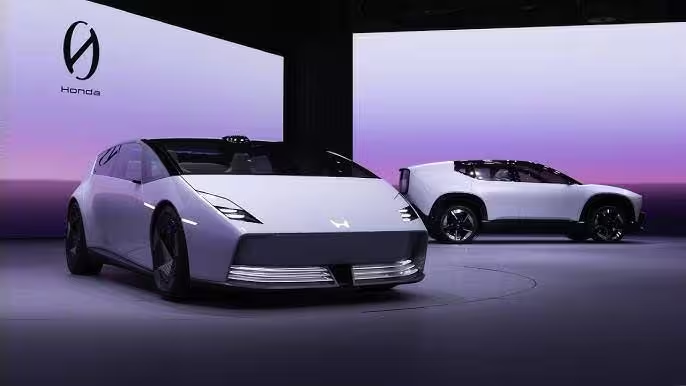
The Technology Play: Not Just Hardware
Honda’s established a significant R&D presence in India, employing around 2,000 software engineers who contribute to Honda’s global software initiatives. That’s genuine localization, not just cost arbitrage.
The 0 Alpha will feature Honda’s ASIMO OS intelligent operating system. Expect over-the-air updates, advanced driver assistance systems, smartphone integration for remote vehicle control, cloud connectivity for predictive maintenance, and natural voice commands.
Manufacturing Strategy: India as a Global Hub
Here’s the really interesting part. The 0 Alpha will be manufactured at Honda’s Tapukara plant in Rajasthan and exported to Japan and other Asian markets. Let that sink in. Honda is making their next-generation EV in India and shipping it to Japan.
That’s a massive vote of confidence in Indian manufacturing quality. It’s also smart business production costs in India are significantly lower, which helps Honda price the 0 Alpha competitively globally.
Honda’s investing around ₹12,000 crore in expanding manufacturing capabilities, including new EV production lines, battery pack assembly facilities, and hybrid powertrain production.
Current capacity at Tapukara is 1.8 lakh units annually, but they’re running at only about 60% utilization. They have room to scale, which is both opportunity and challenge.
The Competition: Who Should Be Worried?
Let’s be real about Honda’s competition. The Indian market isn’t sitting around waiting for Honda to get its act together.
Maruti Suzuki dominates with nearly 40% market share and massive dealership networks. Their upcoming e-Vitara will directly compete with the 0 Alpha.
Hyundai and Kia have basically written the playbook for success in India. Strong products, aggressive pricing, loaded features, extensive networks.
Tata Motors is leading India’s EV revolution. The Curvv EV starts at ₹17.49 lakh, and Tata has the charging infrastructure, manufacturing scale, and brand momentum that Honda lacks.
Mahindra is crushing it with SUVs. The BE 6 offers the largest battery pack in the segment, produces nearly 300hp in higher variants, and is priced competitively.
Where does Honda fit? They need to offer something competitors don’t. Maybe it’s superior build quality and long-term reliability Honda’s traditional strengths. Maybe it’s better real-world range through more efficient powertrains. Maybe it’s industry-leading after-sales service.
But “maybe” isn’t a strategy. Honda needs to nail execution across products, pricing, features, and customer experience. Simultaneously.
Comparison: Honda 0 Alpha vs Current EV Competition
| Specification | Honda 0 Alpha (Expected) | Hyundai Creta Electric | Mahindra BE 6 | Tata Curvv EV |
|---|---|---|---|---|
| Price Range | ₹20-30 lakh | ₹17.99-26.89 lakh | ₹18.90-26.90 lakh | ₹17.49-21.99 lakh |
| Battery Capacity | 65-75 kWh (LFP) | 42 kWh / 51.4 kWh | 59 kWh / 79 kWh | 45 kWh / 55 kWh |
| Range (Claimed) | 400-500 km | 390 km / 473 km | 535 km / 682 km | 430 km / 502 km |
| Power Output | 140-180 hp | 135 hp / 171 hp | 231 hp / 288 hp | 167 hp |
| Fast Charging | 15-80% in ~15 min | 10-80% in 36 min | 20-80% in 20 min | 10-80% in 38 min |
What jumps out? The Mahindra BE 6 is significantly more powerful. The Creta Electric and BE 6 lead on charging times. The Curvv EV offers the most affordable entry point.
Where can Honda win? Battery longevity (LFP advantage), build quality (Honda’s reputation), and potentially lower total cost of ownership through better efficiency and reliability.
Pricing Deep Dive: Can Honda Make the Math Work?
Here’s a realistic estimated pricing structure for Honda’s upcoming lineup based on current market positioning and competition (Note: These are industry estimates, not official Honda announcements):
| Model | Expected Launch | Estimated Price Range (₹ Lakh) | Monthly Target Sales |
|---|---|---|---|
| Sub-4m Compact SUV | 2027 | 8.5-13.5 | 6,000-8,000 |
| Elevate Facelift | 2026 | 12-20 | 3,000-4,000 |
| Honda 0 Alpha | 2027 | 17-30 | 2,000-3,000 |
| Next-Gen City | 2027 | 12-18 | 2,500-3,500 |
| Next-Gen Amaze | 2027 | 7.5-12 | 3,000-4,000 |
| BR-V (7-seater) | 2028 | 12-18 | 2,000-3,000 |
| CR-V Hybrid | 2029 | 40-50 | 300-500 |
If Honda hits these targets across all models by 2030, they’re looking at 225,000-315,000 annual sales. That would represent 5-6% market share if the total passenger vehicle market reaches 60 lakh units by 2030.
The challenge? They need all these products to succeed. One or two hits won’t cut it. And Indian buyers are unforgiving mess up pricing or features on any model, and word spreads fast.
The Honest Assessment: Pros and Cons
What Honda’s Got Going For It:
Brand Reputation: Honda still commands respect. People remember the old City’s reliability, the CR-V’s refinement.
Engineering Credibility: Honda’s hybrid technology is genuinely excellent. Their EVs should be well-engineered too.
Made-in-India Export Hub: Building the 0 Alpha for global markets validates quality and helps achieve economies of scale.
Comprehensive Product Strategy: Unlike previous half-hearted attempts, this covers every major segment simultaneously.
Financial Muscle: Honda has deep pockets and they’re committing serious capital ₹12,000 crore is real money.
What Could Kill This Strategy:
Timing: Honda’s arriving late to almost every segment. First-mover advantage matters.
Pricing Pressure: Indian buyers are ruthlessly price-sensitive. Honda historically prices at a premium. That worked when they had unique products; it won’t work now.
Execution Risk: Launching 10 models in five years is genuinely difficult. Quality control, supply chain management, dealer training it all has to work perfectly.
Brand Perception: Honda’s seen as boring and conservative now. They need to shake that image fast.
Network Gaps: Honda has fewer dealerships than Maruti, Hyundai, Tata. That matters when buyers want convenient service.
Competition Isn’t Sleeping: By the time Honda’s products arrive, competitors will have next-gen versions ready.
Who Should Buy What (When It Actually Launches)
Real talk: should you wait for these Honda products, or buy what’s available now?
If you’re buying an EV in 2027, the Honda 0 Alpha deserves serious consideration if you value long-term reliability and build quality over cutting-edge tech, want LFP battery chemistry for durability (especially in hot climates), and you’re willing to pay a small premium for the Honda badge.
Skip the 0 Alpha if you want the most range or power (BE 6 wins), you need the lowest price (Curvv EV), you want the most established EV ecosystem (Tata), or you’re impatient (it’s still two years away).
For the sub-4-meter compact SUV: This could be Honda’s volume homerun if priced competitively under ₹10 lakh for base variants. Wait for reviews first-gen Honda products in India recently have been just okay, not exceptional.
The BR-V comeback: If you need seven seats and don’t want an Innova (too expensive), this fills a real gap. But it’s 3-4 years away minimum don’t wait if you need a car now.
The Motors77 Final Verdict: Can Honda Really Pull This Off?
I want Honda to succeed. The automotive industry is better when there’s genuine competition from multiple strong players. Honda’s engineering heritage deserves better than 2% market share.
But wanting success and achieving it are different things. Honda’s strategy is sound on paper comprehensive product lineup, local manufacturing, multiple powertrains, aggressive SUV focus. The execution? That’s where things get real.
They need to price aggressively, load features (panoramic sunroofs, ventilated seats, ADAS, wireless charging), nail quality, build the network (more dealers, more service centers), and market smartly.
If Honda executes well across all these dimensions, 5-6% market share by 2030 is achievable. That’s 250,000+ annual sales versus roughly 70,000 now. Ambitious, but possible.
If they stumble overpricing, quality issues, delayed launches, poor service they’ll be right back where they started. Maybe worse.
My gut feeling? Honda will probably land somewhere in the middle. They’ll launch good products that sell reasonably well without becoming segment leaders. They’ll gain market share, maybe hitting 3.5-4% by 2030, which while better than today, falls short of their ambitions.
But even that outcome represents progress. Honda’s finally in the fight again. They’re not just coasting on the City’s legacy anymore. Whether they win or just avoid losing as badly, Indian buyers benefit from more choices, better products, and fiercer competition.
The countdown to 2027 and Honda’s moment of truth has officially begun.
Frequently Asked Questions
When will the Honda 0 Alpha electric SUV launch in India?
The Honda 0 Alpha launches in 2027, with test production starting in 2026. It will be manufactured locally at Honda’s Tapukara plant in Rajasthan, making India one of the first markets globally alongside Japan.
What will be the price of Honda 0 Alpha in India?
Industry sources estimate ₹17-30 lakh ex-showroom, though Honda hasn’t officially confirmed pricing. The base 65 kWh variant could start around ₹20-24 lakh, while the top-spec 75 kWh version might reach ₹26-30 lakh, positioning it against the Creta Electric, BE 6, and Curvv EV.
How many new cars is Honda launching in India by 2030?
Honda confirmed 10 new models by 2030, with 7 being SUVs. This includes the 0 Alpha EV, sub-4-meter compact SUV, updated Elevate, BR-V seven-seater, CR-V, premium 0 SUV, and next-gen City and Amaze sedans.
Will Honda manufacture the 0 Alpha in India or import it?
The 0 Alpha will be fully manufactured in India at the Tapukara plant with 85% localization by 2028. India serves as Honda’s global production hub for this model, with exports planned to Japan and other Asian markets.
How does Honda 0 Alpha compare to competitors?
The BE 6 leads in performance (288 hp, 682 km range) while the Creta Electric offers faster charging. Honda’s 0 Alpha is estimated to slot in between with 140-180 hp, 400-500 km range, LFP batteries for better heat tolerance, and ultra-fast 15-minute charging capability. Final specifications will be confirmed closer to launch.
What is Honda’s current market share and what are they targeting?
Honda currently holds just 2-2.5% market share with 68,650 domestic sales in 2024. They’re targeting 5-6% by 2030, representing 250,000-300,000 annual sales more than tripling current volumes.
Why did Honda fail in India despite being a global leader?
Honda stuck with sedans while the market shifted to SUVs (now 50%+ of sales). They were late to electrification, priced at a premium without matching value, had limited product portfolio, and completely missed booming segments like sub-4-meter SUVs and seven-seaters.
Is it worth waiting for Honda 0 Alpha or should I buy an EV now?
If you need an EV in 2025-2026, buy now Creta Electric, BE 6, and Curvv EV are excellent proven options. Wait for the 0 Alpha only if you prioritize Honda’s reliability reputation and can hold off until late 2026. Never buy the first production batch let early adopters discover the bugs first.
Also Read: Toyota India Confirms 15 New Launches and Updates by 2030: What It Means for Indian Buyers