A Camera That Saves Your Life Before Steel Even Bends
Imagine a head-on collision that has not happened yet. The steel has not crumpled. The bumper is still intact. Your body has not started moving forward. Yet the airbag inside your car has already begun inflating.
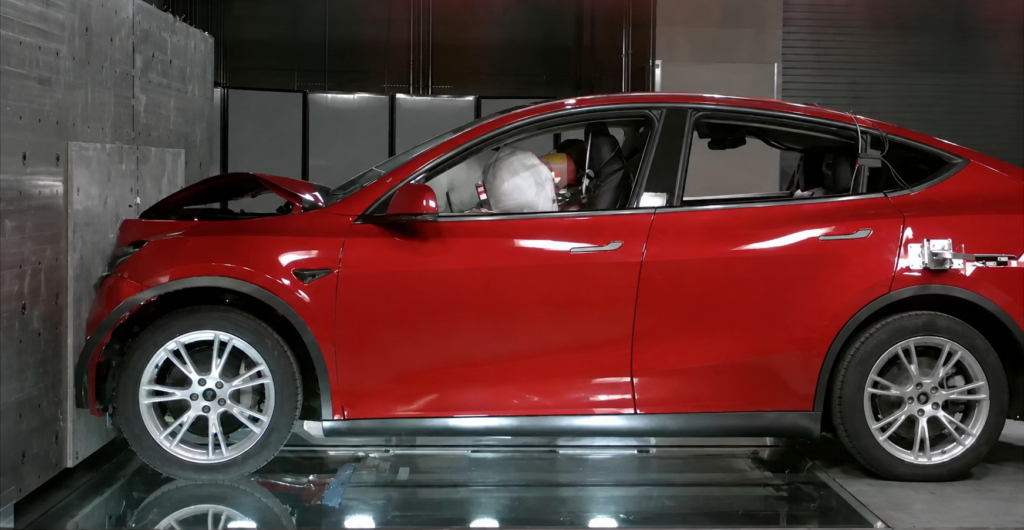
That is not science fiction. That is what Tesla Vision AI Airbags are doing right now on Model 3, Model Y, Model S and Model X cars rolling out worldwide. Tesla has officially confirmed that its camera-based vision system can predict an unavoidable crash and begin restraint deployment up to 70 milliseconds earlier than conventional sensor-only systems would have triggered.
For the Indian buyer who has just started seeing Tesla badges on Mumbai roads after the Model Y launch in July 2025, this is the future of automotive safety arriving in real time. And it is arriving for free, through a software update, on cars that owners have already paid for.
This is the deepest dive you will find on Tesla Vision AI Airbags, the technology, the proof, the limitations, and what it means for the road ahead.
Why 70 Milliseconds Changes Everything
Traditional airbag systems are reactive. They wait. They listen. They confirm. Only then do they fire.
Inside every modern car sit a network of accelerometers and pressure sensors bolted into the bumper and chassis. When a collision occurs, these sensors detect the violent deceleration spike and tell the restraint control module to inflate the airbags. The total time between impact and full deployment is typically 25 to 50 milliseconds. Sounds fast. Until you remember that at 100 km/h, a car covers roughly 28 metres every second. That means in 50 milliseconds, the car has already travelled 1.4 metres into the crash.
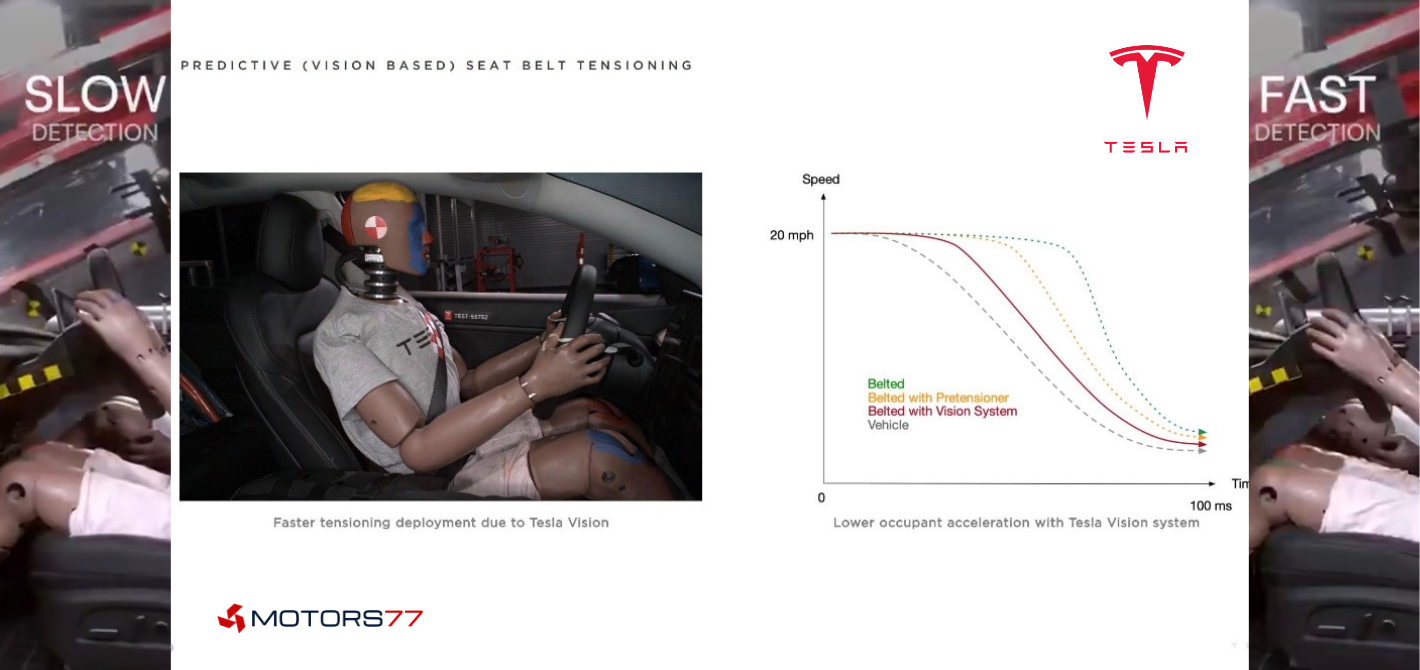
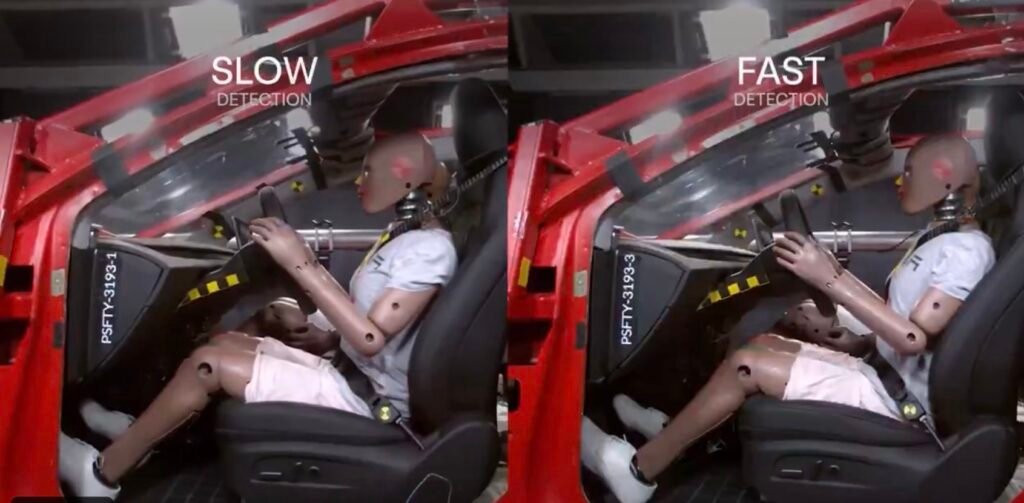
Tesla Vision AI Airbags break that wait time. By using forward-facing cameras and neural networks to identify an unavoidable collision before contact, the system tells the restraint controller to start preparing the airbags and seatbelt pretensioners earlier. Tesla Vision allows airbags to deploy up to 70 milliseconds earlier when the vehicle detects an unavoidable collision. This can be the difference between serious injury and walking away from a crash.
At highway speeds, 70 milliseconds translates to an estimated 1 to 2 metres of additional pre-crash awareness. That is the difference between an occupant being thrown into a half-inflated airbag and being caught by a fully expanded cushion in the correct geometric position.
| Parameter | Traditional Airbag System | Tesla Vision AI Airbags |
|---|---|---|
| Detection Method | Accelerometer (post-impact) | Camera prediction + sensor confirmation |
| Trigger Timing | 25 to 50 ms after impact | Up to 70 ms earlier than traditional trigger |
| Pre-Crash Awareness | None | Estimated 1 to 2 m at highway speeds |
| Seatbelt Pretensioner | After impact | Earlier pre-impact activation |
| False-Positive Filter | High (to avoid pothole triggers) | Reduced (camera confirms threat) |
| Update Mechanism | Hardware-bound | Over-the-air software |
The Software Update That Started It All
The Tesla Vision AI Airbags feature did not arrive overnight. It first rolled out quietly in September 2025 under software version 2025.32.3, labelled as the Frontal Airbag System Enhancement.
The upgrade builds upon the vehicle’s existing crash protection by now using Tesla Vision to deliver cutting-edge airbag performance in the event of a frontal crash. Building on top of regulatory and industry crash testing, the release enables front airbags to begin to inflate and restrain occupants earlier, in a way that only Tesla’s integrated systems are capable of doing, making the car safer over time.
The update reached a defined set of vehicles. It works on 2023 and newer Model 3 and Model Y units, certain late-2022 builds, and newer Model S and Model X cars including 2026 models. The compatibility line is largely hardware. Cars equipped with the HW4 / AI4 computer running on AMD Ryzen are the primary recipients of the feature. The feature has not been confirmed for older HW3-based vehicles in current rollouts, and an official hardware compatibility matrix has not been published. If a Tesla was shipped in or after January 2023, it is running HW4.
| Software Detail | Specification |
|---|---|
| Initial Software Version | 2025.32.3 |
| Initial Rollout Date | September 2025 |
| Public Unveiling | 8 May 2026 |
| Hardware Requirement | HW4 / AI4 (AMD Ryzen MCU) |
| Compatible Models | Model 3 (2023+), Model Y (2023+), select 2022 builds, Model S, Model X (incl. 2026) |
| Delivery Method | Over-the-air update |
| Cost to Owner | Free |
| Geographic Availability | Global rollout in progress |
How Tesla Vision AI Airbags Actually Work
Here is where the engineering gets interesting. Traditional accelerometer-based systems have a built-in safety filter. That filter exists to prevent the airbag from blasting open every time the car hits a pothole or runs over a speed breaker on a bad stretch of Indian National Highway. The filter looks for a sustained deceleration profile, not just any sharp jolt.
The downside of that filter is hesitation. It costs precious milliseconds while the algorithm rules out a false alarm.
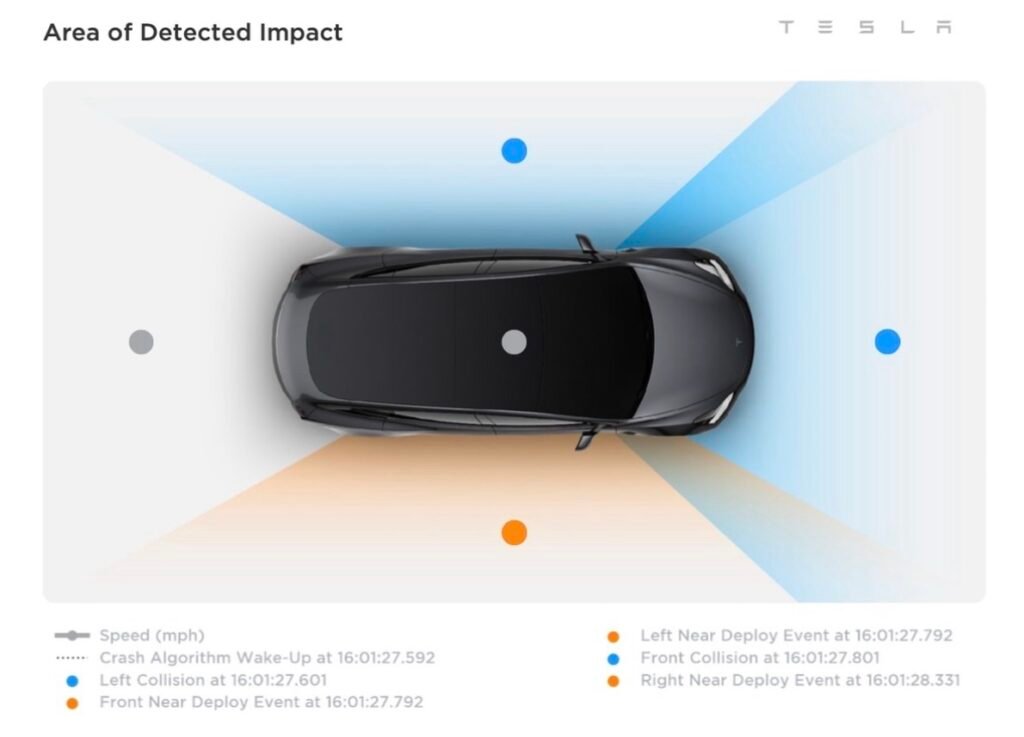
Tesla’s solution is to add a second source of evidence. The forward camera, paired with neural network processing, can see a vehicle, a wall, or a pedestrian closing in at a relative speed and trajectory that no escape manoeuvre can prevent. When the camera and the accelerometer agree that a crash is imminent, the system has the confidence to reduce its filter and act sooner.
The camera sees the impending impact and, together with the sensors, tells the restraint controller to reduce the filter and act sooner. Using vision gives the vehicle confidence to reduce that timing.
Importantly, the system still requires physical impact confirmation before full deployment. The Tesla Vision AI Airbags do not blindly fire on a camera prediction alone. They use the camera signal to begin pre-deployment preparation, including starting seatbelt pretensioning and initiating the early inflation curve of the front airbags, so that by the time impact is physically confirmed, the restraints are already where they need to be.
Real Crash Data, Not Lab Dummies
This is where Tesla’s approach diverges sharply from the rest of the auto industry. Traditional manufacturers calibrate their airbag systems around a few dozen regulatory crash tests conducted in a controlled lab environment. Tesla calibrates its restraint timing against an enormous dataset built from millions of real-world driving miles and thousands of recorded crashes across its global fleet.
Each crash data point represents an actual collision from the fleet, with real-world speeds, real collisions, and real people, not just regulatory test cases. The richness of this dataset is what enabled the result.
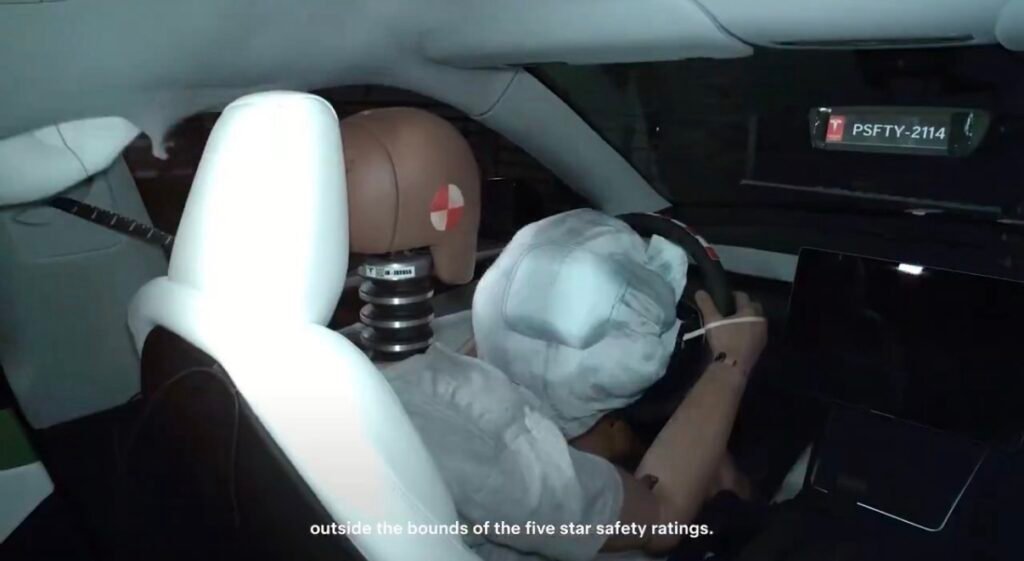
Tesla engineers then replay each of those crashes inside a simulation environment using what is called a human body model. This is a detailed digital representation of a human occupant that responds to forces in physiologically accurate ways. By replaying real crashes against the human body model and adjusting the restraint deployment timing variables, the team measured exactly how earlier deployment changes predicted injury severity.
The result was a dataset that no traditional automaker can match. Tesla effectively crash-tested its airbag timing against thousands of real-world collision profiles fed into a physiologically accurate human body model, not against six standardised test dummies.
What This Means for India
The Indian car buyer has spent the last decade watching airbag count become a marketing metric. Two airbags, then six airbags, then ten airbags. Bharat NCAP and Global NCAP have rightly pushed the conversation forward.
Tesla Vision AI Airbags push the conversation in a different direction. The argument is not how many airbags a car has, but how intelligently those airbags know when to fire.
For the Indian Tesla Model Y owner who took delivery in late 2025 or early 2026, this feature has already arrived through an over-the-air update. No service centre visit. No additional cost. The Model Y sold in India is exported from Tesla’s Shanghai Gigafactory and ships with HW4 hardware, making it eligible for Tesla Vision AI Airbags out of the box.
For the larger Indian market that still drives Marutis, Hyundais, Tatas and Mahindras, the implication is louder. Indian roads are statistically the most dangerous in the world. The country accounted for roughly 11 per cent of global road deaths in recent figures despite holding only 1 per cent of the world’s vehicles. Pre-crash sensing technology has the potential to make a serious dent in that statistic, but only when it filters down to mass-market price points.
History suggests it will. ABS was once exotic. Airbags themselves were once exotic. ESC was once exotic. Today, all three are mandatory in India. Camera-based predictive restraint systems are following the same curve.
The Federal Scrutiny Tesla Faces
The Tesla Vision AI Airbags announcement did not arrive in a clean news cycle. The same week, Tesla was dealing with two separate regulatory issues in the United States. The National Highway Traffic Safety Administration’s Office of Defects Investigation has an open probe covering approximately 2.4 million Tesla vehicles, examining whether the camera-based Full Self-Driving system can properly detect and respond in low-visibility conditions like fog, dust, and sun glare. Tesla has also recalled 218,868 US vehicles over delayed rearview camera images, addressed through an over-the-air software update.
These parallel events highlight the inherent trade-off in Tesla’s camera-first philosophy. The same vision system that enables predictive airbag deployment is also the one being questioned for its performance in adverse conditions. A balanced reading is this: predictive airbag triggering is a low-risk application of computer vision because the worst-case failure mode is a slightly later airbag deployment, equivalent to a traditional system. Autonomous driving is a higher-risk application because the failure mode is direct.
Quick Pros and Cons
Pros
- Begins deploying airbags up to 70 ms earlier than conventional sensor-only systems
- Estimated 1 to 2 m of pre-crash response advantage at highway speeds
- Free over-the-air update, no service centre visit required
- Calibrated using a vast fleet dataset of real-world driving miles and thousands of recorded crashes
- Engages seatbelt pretensioners earlier for better occupant positioning
- Still requires sensor confirmation, eliminating risk of false camera-triggered deployment
- Continuously improves as Tesla’s fleet data grows
Cons
- Primarily targets HW4 / AI4 hardware, with HW3 owners not confirmed for the full feature
- Currently focused on frontal collisions, not rear or side impacts
- Tesla’s broader camera-only philosophy is under federal scrutiny in low-visibility cases
- Limited to Tesla vehicles, no industry-wide adoption yet
- Real-world safety gains will need years of crash data to be independently verified
Specifications At A Glance
| Specification | Detail |
|---|---|
| Technology Name | Frontal Airbag System Enhancement (Tesla Vision AI Airbags) |
| Initial Software Release | Version 2025.32.3 (September 2025) |
| Time Advantage | Up to 70 milliseconds earlier than conventional systems |
| Distance Advantage (at 100 km/h) | Estimated 1 to 2 metres |
| Compatible Hardware | HW4 / AI4 |
| Compatible Models | Model 3 (2023+), Model Y (2023+), select 2022 builds, Model S, Model X (incl. 2026) |
| Activation Trigger | Camera-based prediction of unavoidable frontal collision |
| Confirmation Trigger | Physical impact sensor |
| Pretensioner Activation | Pre-impact |
| Cost to Existing Owners | Free via OTA update |
| Availability in India | Yes, on Model Y delivered post launch |
Motors77 Verdict
The honest read on Tesla Vision AI Airbags is this. It is not a flashy feature you can show off at a dinner party. There is no new screen, no new button, no new sound. It is a software update that quietly rewrites the rules of crash survival inside your car.
What makes it remarkable is not just the 70-millisecond figure. It is the methodology behind it. By using a fleet of millions of cars as a continuous data-gathering platform, then replaying real crashes inside simulation environments, Tesla has built a feedback loop that traditional crash testing simply cannot replicate. The technology is also evidence that a car bought today can become measurably safer tomorrow without changing a single bolt.
For the Indian audience, the practical impact in 2026 is limited to the small number of Model Y owners who have taken delivery so far. But the conceptual impact is much wider. Once this kind of predictive safety logic spreads to mainstream brands, often through suppliers like Bosch, Continental and ZF who serve the entire industry, it will quietly become the new normal. The buyer who once asked how many airbags a car has will eventually ask how smart those airbags are.
Tesla Vision AI Airbags are not a marketing gimmick. They are a real engineering step forward, validated by real fleet data, delivered without a price tag to existing customers. The caveats around camera-based systems in low-visibility conditions remain valid for autonomous driving conversations. They do not undermine the value of this specific safety upgrade.
Motors77 Rating: 9 / 10
A genuine safety advancement with hard data behind it. One point withheld pending wider real-world crash-outcome studies and broader hardware availability for older Tesla owners.
Frequently Asked Questions
Q1. What are Tesla Vision AI Airbags?
Tesla Vision AI Airbags are a software-driven safety feature that uses the car’s forward-facing cameras and AI to predict an unavoidable frontal collision and begin deploying airbags and tightening seatbelts up to 70 milliseconds earlier than conventional sensor-only systems would have triggered.
Q2. Which Tesla models support Tesla Vision AI Airbags?
The feature is available on 2023 and newer Model 3 and Model Y, select late-2022 builds, and newer Model S and Model X including 2026 models. All require HW4 / AI4 hardware.
Q3. Do I have to pay extra for Tesla Vision AI Airbags?
No. The feature is delivered free via over-the-air software update version 2025.32.3 and later builds, on compatible hardware.
Q4. Is the feature available on Tesla Model Y sold in India?
Yes. The Model Y delivered in India ships with HW4 hardware and receives the same global software updates, so eligible Indian cars get the feature through the standard OTA process.
Q5. Can the airbags fire by mistake if the camera misreads a situation?
No. Tesla designed the system so that the camera signal only reduces the deployment filter and starts pre-tensioning. Final airbag deployment still requires confirmation from the physical impact sensors.
Q6. How does Tesla compare to traditional airbag systems?
Traditional systems deploy 25 to 50 milliseconds after impact is detected. Tesla Vision AI Airbags begin preparing up to 70 milliseconds earlier, an estimated 1 to 2 metres of additional response distance at highway speeds.
Q7. Does the feature work on rear or side impacts?
The current rollout focuses on frontal collisions. Tesla previously used fleet data in 2021 to improve side-impact restraint detection through software update 2021.36, but the new vision-based pre-impact deployment is a frontal system as of now.
Q8. Will older Tesla owners with HW3 hardware ever get this feature?
Tesla has not committed to bringing the full Tesla Vision AI Airbags package to HW3 cars. However, the company has a history of pushing fleet-data-driven safety improvements even to older vehicles where the hardware allows.
Q9. How does Tesla validate the safety of Tesla Vision AI Airbags?
Tesla engineers replay actual crashes from the fleet inside simulation environments using a digital human body model. They measure how restraint timing changes affect predicted injury severity, then validate findings through physical crash testing before deployment.
Q10. Will other carmakers follow Tesla’s approach?
Most major suppliers including Bosch, Continental, ZF and Mobileye are already developing similar predictive restraint systems. Industry-wide adoption is expected over the next four to seven years, often filtering down through the supplier ecosystem to mass-market brands.