
Introduction
The Toyota Land Cruiser FJ has officially gone on sale in Japan. After more than two years of teaser images, concept reveals, and global anticipation, Toyota Motor Corporation announced on May 14, 2026 that the smallest, most affordable Land Cruiser ever built is now in dealerships, priced from ¥4,500,100 (roughly US$28,500). The FJ becomes the fourth pillar of the Land Cruiser family, joining the flagship 300, the heavy-duty 70, and the light-duty 250.
For enthusiasts who grew up with the boxy FJ40 of the 1960s and 1970s, or those who watched the FJ Cruiser bow out in 2022, this is the moment the badge truly comes home. The Toyota Land Cruiser FJ is not a soft crossover wearing a famous name. It is a body-on-frame, part-time four-wheel-drive, ladder-chassis SUV built at Toyota Motor Thailand’s Ban Pho plant on the same IMV platform that underpins the Hilux.
Here is everything Toyota has officially confirmed about the new Land Cruiser FJ, sourced directly from the Toyota Global Newsroom press release dated May 14, 2026.Toyota Land Cruiser FJ: Price and Variant Strategy
The Toyota Land Cruiser FJ launches in Japan with a single fully loaded VX grade. There is no entry-level base trim. Toyota has structured the lineup this way to keep the FJ positioned as a desirable lifestyle off-roader rather than a fleet vehicle.
| Variant | Transmission | Drivetrain | Price (Japan, on-road) |
|---|---|---|---|
| VX | 6-speed Super ECT Automatic | Part-time 4WD | ¥4,500,100 |
For buyers who prefer subscription over outright ownership, the FJ is also available through Toyota’s KINTO car subscription service from ¥38,390 per month (taxes included). Toyota is targeting a monthly sales volume of 1,300 units in Japan.
The new Land Cruiser FJ will not be sold in North America or Europe. Toyota’s chief engineer has confirmed the model is intended for Asia, the Middle East, Africa, and Latin America, where emissions regulations and customer demand align with the 2.7-litre naturally aspirated petrol architecture.
Design: Square Cabin, Dice Motif, and FJ40 DNA
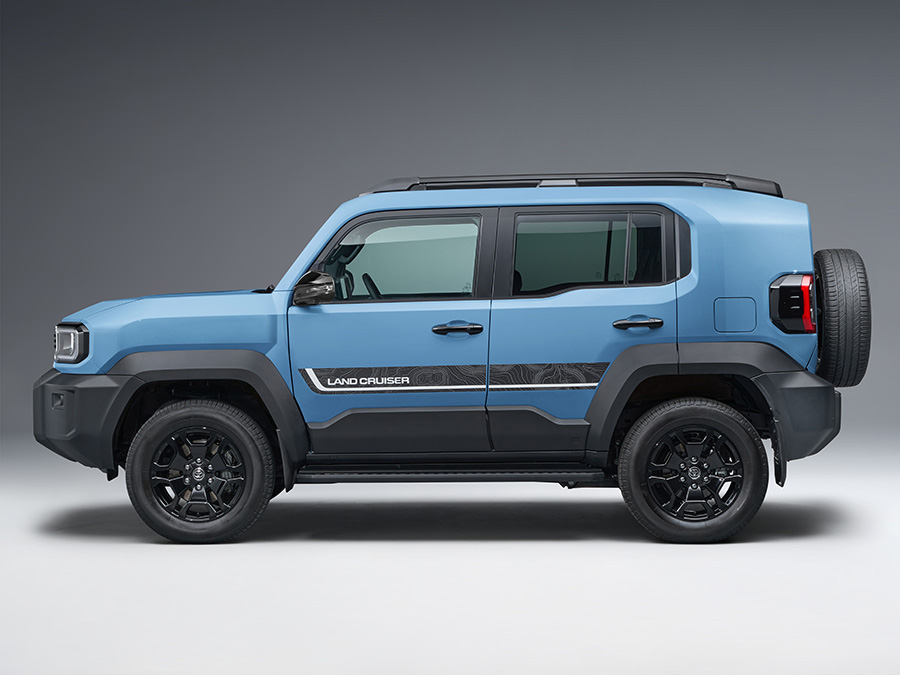
Toyota’s design language for the new Land Cruiser FJ centres on what the company calls a “dice motif.” The body is essentially a rectangle with chamfered edges, short overhangs, and an upright greenhouse that maximises cabin space and visibility.
Key design highlights confirmed by Toyota:
- A square cabin silhouette prioritises headroom, cargo capacity, and the traditional Land Cruiser sense of habitability
- Powerful bumpers and flared fenders give the FJ a planted, stability-focused stance
- Front and rear corner bumpers are segmented and removable, so owners only replace damaged sections rather than the entire bumper assembly
- A lower beltline improves visibility of the road surface during off-road driving
- Round headlights remain available as an overseas customisation option, paying direct homage to the original FJ40
The repairability angle is significant. Off-road damage to bumper corners is one of the most common reasons SUVs end up in body shops, and Toyota’s segmented design dramatically reduces repair cost and downtime. This is the kind of real-world engineering thinking that has defined the Land Cruiser nameplate for seven decades.
Platform and Chassis: Built on Hilux Bones
The Toyota Land Cruiser FJ rides on a heavily modified version of the IMV platform, the same ladder-frame architecture that underpins the Hilux pickup. Toyota has redesigned the platform specifically for the FJ’s smaller footprint.
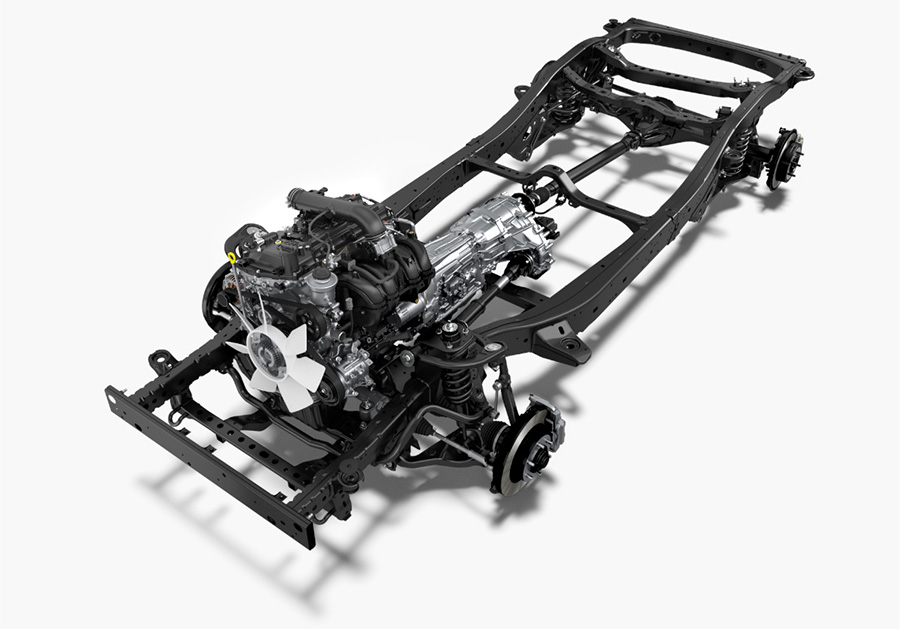
- Wheelbase is 270 mm shorter than the Land Cruiser 250 Series
- Lateral frame rigidity has been improved by the shorter wheelbase and the addition of underfloor braces
- High-tensile strength steel is used throughout the body structure
- Additional spot welding under the floor improves vibration damping and ride comfort
- The minimum turning radius is just 5.5 metres
Suspension is a high-mount double-wishbone setup at the front and a four-link rigid axle with lateral rod at the rear. This is a classic, proven Land Cruiser layout that prioritises wheel articulation and off-road durability over the on-road comfort that an independent rear setup would offer.
Engine and Transmission
The Toyota Land Cruiser FJ uses the 2TR-FE 2.7-litre naturally aspirated four-cylinder petrol engine, mated exclusively to a six-speed Super ECT automatic transmission. There is no diesel, no hybrid, and no manual gearbox.
| Specification | Detail |
|---|---|
| Engine | 2.7L (2TR-FE) naturally aspirated petrol |
| Cylinders | 4 |
| Max Power | 120 kW (163 PS) |
| Max Torque | 246 Nm (25.1 kgf.m) |
| Transmission | 6-speed Super ECT automatic |
| Drivetrain | Part-time 4WD with rear differential lock |
| Fuel Efficiency (WLTC) | 8.7 km/L |
Toyota’s reasoning for choosing this powertrain is durability over outright performance. The 2TR-FE is one of the most globally proven engines in Toyota’s catalogue, with decades of service in the Hilux, Fortuner, and previous Land Cruiser variants. It delivers smooth low-speed manners for daily driving and predictable engine braking on downhill descents, which matters far more in off-road conditions than peak horsepower figures.
Off-Road Capability
This is where the Toyota Land Cruiser FJ earns its badge. Toyota has confirmed the following off-road credentials:
- Ground clearance and approach/departure angles equivalent to the Land Cruiser 250 Series
- Wheel articulation equivalent to the Land Cruiser 70 Series (the legendary heavy-duty model)
- Approach angle reportedly 15 degrees greater than the 250 Series, thanks to the FJ’s shorter overhangs
- Part-time four-wheel-drive system with rear differential lock as standard
- Minimum turning radius of 5.5 metres for tight technical sections
The combination of 70 Series-grade articulation with a turning radius better than most compact SUVs gives the FJ a unique value proposition. It is small enough for narrow forest trails and city lanes, but capable enough to handle the kind of terrain that would stop a Fortuner or Hilux in its tracks.

Dimensions
| Dimension | Measurement |
|---|---|
| Length | 4,575 mm |
| Wheelbase | 2,580 mm |
| Min Turning Radius | 5.5 m |
| Compared to LC 250 | 350 mm shorter overall, 270 mm shorter wheelbase |
To put that in perspective, the Toyota Land Cruiser FJ is 185 mm shorter than the Fortuner with a 170 mm tighter wheelbase. That makes it the most manoeuvrable body-on-frame Toyota SUV in modern memory.
Interior and Technology
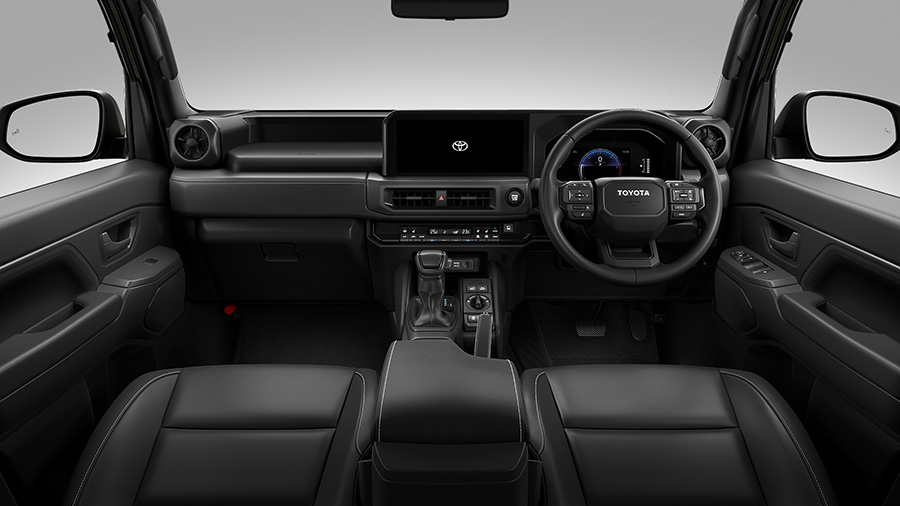
Toyota has built the FJ’s cabin around a function-first ethos. Key features:
- Horizontal instrument panel for easy reading of vehicle attitude on uneven terrain
- 12.3-inch display audio system with navigation
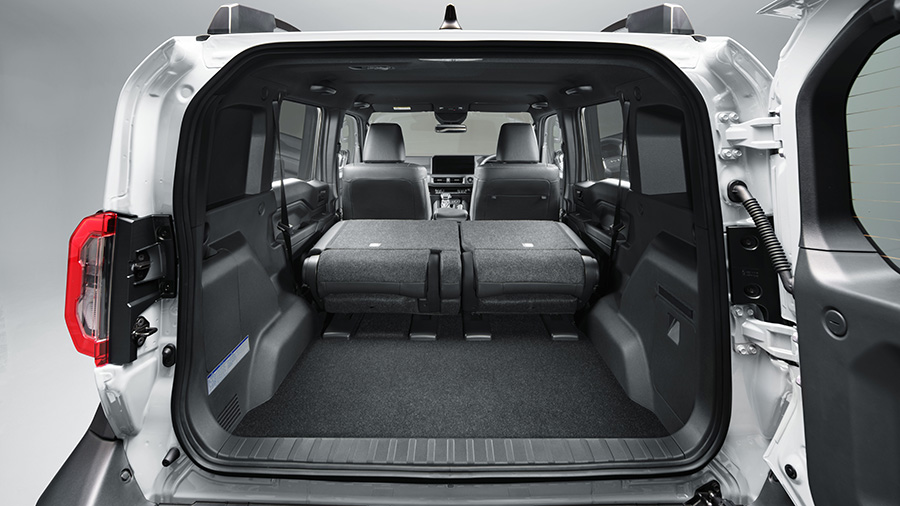
- Square cabin design that yields 795 litres of cargo space with rear seats up
- Lower beltline for improved outward visibility
- Functional cockpit layout designed for instant recognition across diverse driving conditions
The interior philosophy is closer to a modern Defender or G-Class than a luxury crossover. Controls are tactile, materials are hardwearing, and the ergonomics are tuned for gloved hands and trail use rather than touchscreen-first urban living.
The Land Hopper Companion
Alongside the Land Cruiser FJ launch, Toyota also confirmed the Land Hopper, a foldable electric three-wheeler designed to be stored inside the FJ’s luggage area and ridden on trails too narrow for the vehicle itself. The Land Hopper is scheduled to launch in spring 2027 and can be ridden without a licence by users aged 16 or older.
This is genuinely novel thinking. The Land Hopper extends the FJ’s range of adventure beyond where four wheels can physically travel, turning the SUV into a mobile basecamp for solo or two-person exploration.
Quick Pros and Cons
Pros
- Genuine body-on-frame Land Cruiser DNA at the lowest price point ever
- 70 Series-level wheel articulation with 250 Series approach angles
- Best-in-class 5.5 m turning radius for a ladder-frame SUV
- Modular, segmented bumpers reduce off-road repair costs significantly
- Proven 2TR-FE engine and 6-speed Super ECT combination
- KINTO subscription option lowers entry barrier in Japan
Cons
- Only 163 PS from a 2.7L petrol feels modest for the FJ’s likely kerb weight
- WLTC fuel efficiency of 8.7 km/L is on the thirsty side
- No diesel or hybrid option at launch
- Not confirmed for India, North America, or Europe
- Single VX grade leaves no room for budget buyers
Will the Toyota Land Cruiser FJ Come to India?
This is the question every Indian Land Cruiser enthusiast wants answered. Toyota has officially confirmed the FJ for Asian, African, Middle Eastern, and Latin American markets, but has not specifically announced an India launch. Given that Toyota Kirloskar Motor already sells the Fortuner and the Hilux on a similar platform, the manufacturing and parts ecosystem to support an Indian FJ launch certainly exists.
The pricing math is more complicated. A Japan ex-showroom of ¥4,500,100 translates to roughly ₹24 lakh, but CBU import duties would push the on-road price well past ₹50 lakh, putting the FJ uncomfortably close to the Land Cruiser 250 Series. Local CKD assembly at Toyota’s Bidadi plant would be the only way to achieve a competitive India price, and that decision will depend on volume projections.
For now, the Toyota Land Cruiser FJ remains an aspirational global product for Indian buyers. We will update Motors77 readers the moment Toyota Kirloskar Motor makes any official announcement.
Frequently Asked Questions
Q1. What is the launch price of the Toyota Land Cruiser FJ in Japan?
The Toyota Land Cruiser FJ is priced from ¥4,500,100 (approximately US$28,500) in Japan, available in a single fully loaded VX grade.
Q2. When did the Toyota Land Cruiser FJ go on sale?
Toyota announced the launch on May 14, 2026, with sales commencing the same day in Japan. The Thailand launch took place earlier on March 21, 2026, and the South African launch followed on May 10, 2026.
Q3. What engine powers the Toyota Land Cruiser FJ?
The Land Cruiser FJ uses a 2.7-litre naturally aspirated 2TR-FE petrol engine producing 120 kW (163 PS) and 246 Nm of torque, paired with a six-speed Super ECT automatic transmission.
Q4. Is the Toyota Land Cruiser FJ a body-on-frame SUV?
Yes. The Land Cruiser FJ uses a traditional ladder-frame chassis based on a modified IMV platform shared with the Toyota Hilux pickup, ensuring genuine off-road capability and durability.
Q5. Will the Toyota Land Cruiser FJ be sold in India?
Toyota has not officially confirmed an India launch. The FJ has been confirmed for Asian, African, Middle Eastern, and Latin American markets, so an India introduction remains possible but unannounced.
Q6. Will the Toyota Land Cruiser FJ be sold in the USA or Europe?
No. Toyota’s chief engineer Masaya Uchiyama has officially confirmed there are no plans to sell the Land Cruiser FJ in North America or Europe due to emissions and powertrain alignment.
Q7. Where is the Toyota Land Cruiser FJ manufactured?
The Land Cruiser FJ is produced at Toyota Motor Thailand’s Ban Pho plant, the same facility that builds the Hilux pickup.
Q8. What is the Land Hopper that Toyota announced alongside the FJ?
The Land Hopper is a foldable electric three-wheeler designed to fit inside the Land Cruiser FJ’s luggage area. It is intended as an off-road companion for trails too narrow for the FJ and is scheduled to launch in spring 2027.
Q9. How does the Land Cruiser FJ compare to the Toyota Fortuner?
The Toyota Land Cruiser FJ is 185 mm shorter than the Fortuner with a 170 mm tighter wheelbase, making it more nimble in tight terrain. It also offers Land Cruiser 70 Series-level wheel articulation, which the Fortuner cannot match.
Q10. Does the Toyota Land Cruiser FJ have a rear differential lock?
Yes. The Land Cruiser FJ comes with a part-time four-wheel-drive system and a rear differential lock as standard equipment, ensuring proper low-traction performance off-road.
Motors77 Verdict
The Toyota Land Cruiser FJ is exactly the vehicle the world has been asking Toyota to build for the past decade. It is honest, mechanically simple, properly capable, and priced in a way that genuinely democratises the Land Cruiser badge. The decision to use the proven 2TR-FE engine instead of chasing a hybrid is pragmatic. The decision to share the IMV platform with the Hilux is brilliant for serviceability across emerging markets. And the decision to keep modular bumpers and a real rear differential lock proves Toyota understands what Land Cruiser owners actually need.
The compromises are real but predictable. Performance is modest, fuel economy is not class-leading, and the lack of a diesel or hybrid will frustrate some buyers. But none of these flaws undermine the core mission. The Toyota Land Cruiser FJ is built to go where other SUVs cannot, and to do so reliably for decades. That is the Land Cruiser promise, and the FJ honours it.
For Indian enthusiasts, the wait continues. But the global story is clear. After more than 12.15 million Land Cruisers sold across 190 countries, the family has finally welcomed a fourth member that brings the legend within reach.
| Motors77 Rating | Score |
|---|---|
| Design | 9/10 |
| Powertrain | 7/10 |
| Off-Road Capability | 9.5/10 |
| Practicality | 8.5/10 |
| Value | 9/10 |
| Overall Motors77 Rating | 8.6/10 |
Recommendation: A genuine modern Land Cruiser experience for under thirty thousand US dollars is something the global SUV market has never seen before. If Toyota brings it to India through CKD assembly at the right price, this could become the most desired compact off-roader in the country. Until then, the Toyota Land Cruiser FJ stands as proof that Toyota still knows how to build the kind of SUV that defines a generation.