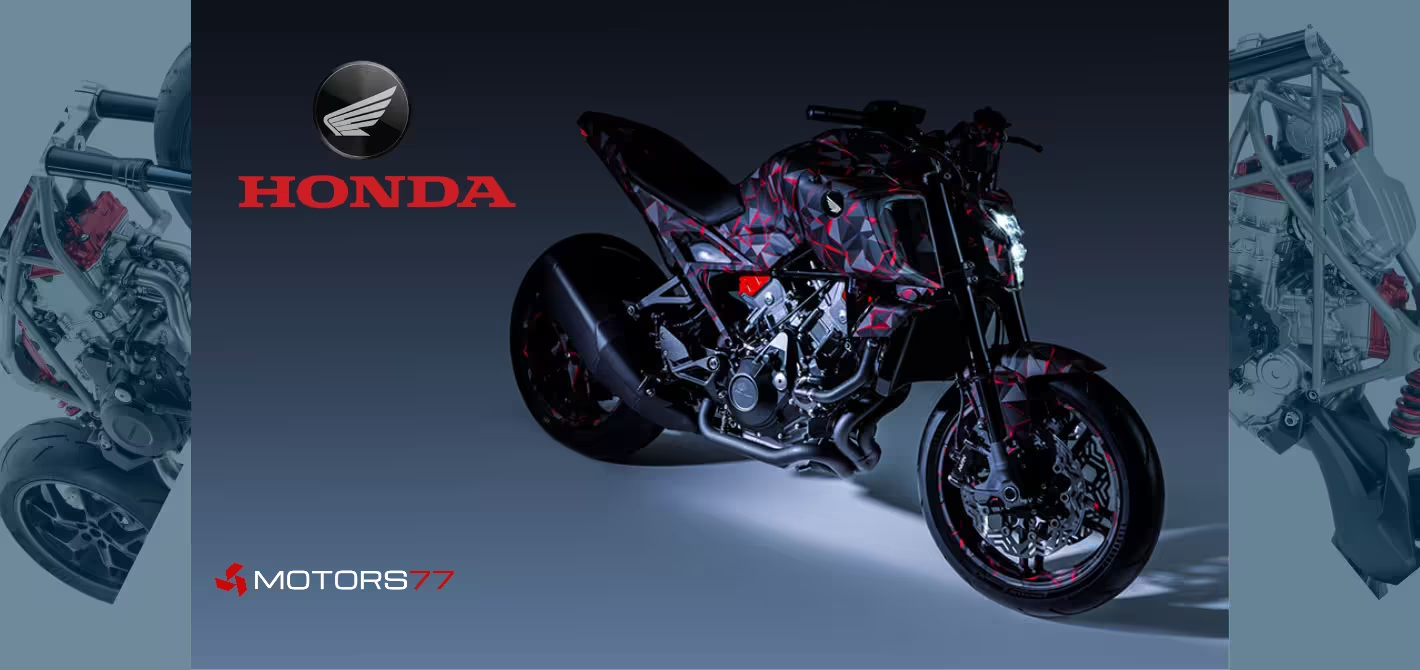
Honda V3R 900 E-Compressor prototype motorcycle showcased at EICMA 2025 with distinctive geometric camo design.
Honda has officially unveiled one of the most technologically groundbreaking motorcycles in recent history at EICMA 2025 in Milan, Italy. The V3R 900 E-Compressor Prototype represents a bold fusion of cutting-edge engineering, intelligent forced-induction technology, and unmistakable Honda heritage. This revolutionary machine is set to redefine performance motorcycling with its world-first electronically controlled compressor system paired with an innovative 900cc V3 engine.
About Honda V3R 900 E-Compressor prototype
Revolutionary E-Compressor Technology: A World-First Innovation
At the heart of the V3R 900 lies Honda’s groundbreaking electronically controlled compressor – the first of its kind ever fitted to a production motorcycle. Unlike traditional turbochargers that depend on exhaust gas flow or mechanical superchargers driven by the engine’s crankshaft, Honda’s electric compressor operates completely independently of engine speed.
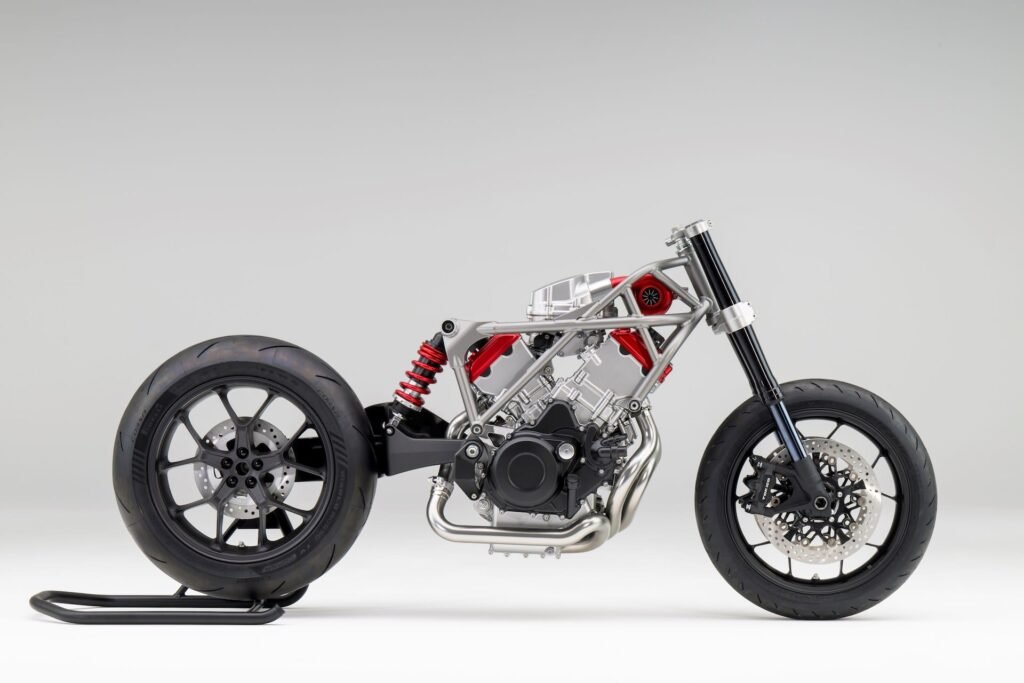
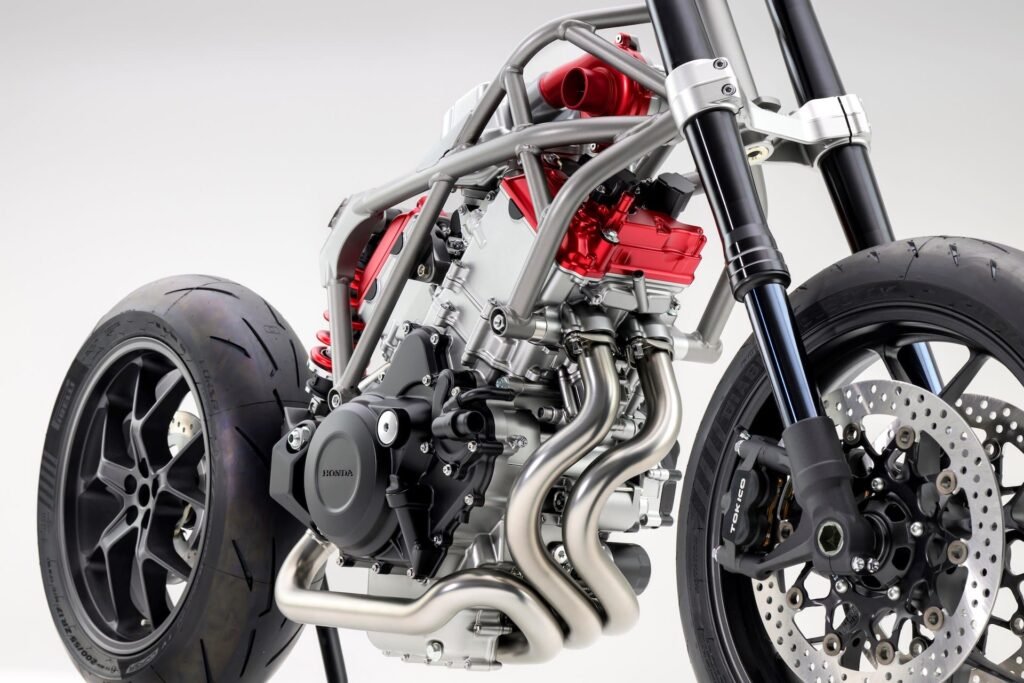
Close-up of Honda’s V3 engine mounted in a motorcycle frame, highlighting the mechanical and technological design features
This independence delivers several critical advantages. The system eliminates turbo lag entirely, providing instant throttle response and delivering high-response torque even from low RPM. The electric compressor can force air into the intake manifold precisely when needed, controlled by the ECU to optimize performance across the entire rev range. Honda’s engineers have programmed this system to deliver power equivalent to a naturally aspirated 1,200cc engine while maintaining the compact dimensions and efficiency of a 900cc powerplant.
The technology also eliminates the need for an intercooler, which traditional forced-induction systems require to cool compressed air. This saves valuable space and weight on a motorcycle where every millimeter and kilogram matters. The compressor sits neatly above the front cylinder bank, contributing to optimal mass centralisation and improved handling dynamics.
The 900cc V3 Engine: Compact Power in a Unique Configuration
The liquid-cooled, 75-degree V3 engine represents another engineering masterpiece in the V3R 900’s arsenal. The unique cylinder layout features two cylinders positioned forward and a single cylinder at the rear, creating an extremely slim profile – barely wider than a traditional parallel-twin engine while delivering three-cylinder performance.
Honda’s decision to use a 75-degree bank angle rather than the conventional 90-degree V-configuration was deliberate. The narrower angle reduces the overall width and length of the engine, enabling a more compact wheelbase and better aerodynamics without sacrificing space for the performance-oriented intake system. This configuration also allows for efficient mass centralization, improving balance and handling characteristics.
The engine features dual overhead cams (DOHC) with what appears to be four valves per cylinder and chain-driven camshafts. The distinctive V3 layout produces an uneven, throaty exhaust note characteristic of V-configuration engines and based on the teaser videos Honda released, it sounds absolutely spectacular.
Design Philosophy: The “Non-Rail Roller Coaster” Concept
Honda developed the V3R 900 E-Compressor Prototype under the concept of “Non-Rail Roller Coaster” – a vision that represents freedom, fluidity, and adrenaline without the predictability of a fixed track. This philosophy embodies two contrasting qualities: “guaranteed thrill” and “reassuring peace of mind”.
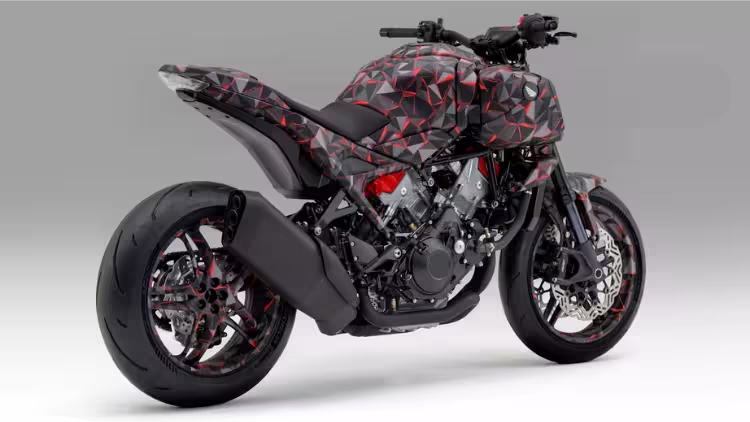
The streetfighter-style design showcases asymmetrical side cowls and fairings wrapped in an aggressive camouflage livery featuring geometric patterns in black, gray, and red. The vertical LED headlamp at the front provides a bold, modern face, while the compact proportions emphasize the bike’s agile character.
Honda V3R 900 E-Compressor motorcycle prototype with distinctive geometric camo pattern and modern design
The chassis features a trellis-style steel frame – an unusual choice for Honda, which typically favors twin-spar or twin-beam designs. This open frame design provides a better view of the revolutionary V3 engine and electric compressor system, making the engineering itself a visual centerpiece. At the rear, a single-sided swingarm derived from the CB1000R adds to the bike’s premium, performance-focused aesthetic.
The New Honda Flagship Wing: A Symbol of Evolution
Three variations of the Honda Wing logo and brand name representing Honda’s motorcycle heritage
The V3R 900 debuts the new “Honda Flagship Wing” logo on its fuel tank a modernized emblem that will gradually be introduced on Honda’s top-tier models starting in 2026. This updated design evolution maintains the brand’s iconic wing motif, which has represented Honda’s global ambitions and “soaring spirit” since the 1950s.
The original wing design was inspired by Nike’s wings from the Greek Samothrace sculpture and the eagle, symbolizing Honda’s determination to succeed globally and the strong movement of motorcycles. The new Flagship Wing continues this heritage while signaling Honda’s evolution toward next-generation performance motorcycles.
Performance That Punches Above Its Weight
While Honda hasn’t released official power and torque figures, the company claims the 900cc V3 with E-Compressor technology delivers performance comparable to a 1,200cc naturally aspirated engine. This represents approximately 33% more displacement equivalent, showcasing the effectiveness of the electronic boost system.
The electric compressor ensures consistent power delivery across the powerband, providing smooth throttle response and predictable acceleration. Unlike traditional turbocharged motorcycles that can suffer from sudden power surges or lag, the V3R 900’s electronically managed boost creates a flat torque curve with responsive power at any RPM.
The system works intelligently to balance performance with environmental efficiency. By delivering boost precisely when and where it’s needed, the engine can maintain strong fuel economy and lower emissions compared to a larger-displacement naturally aspirated engine producing equivalent power.
Engineering Excellence: How E-Supercharging Works
The distinction between Honda’s electric compressor and traditional forced-induction systems is fundamental to understanding this motorcycle’s innovation. Traditional superchargers are mechanically driven by belts, gears, or chains connected to the engine’s crankshaft. They provide instant throttle response with no lag but create parasitic drag on the engine, reducing overall efficiency.
Turbochargers operate by capturing exhaust gas energy to spin a turbine connected to a compressor. They’re highly efficient because they use waste energy, but they suffer from “turbo lag” – a delay between throttle input and boost delivery, especially at lower RPMs.
Honda’s electric compressor combines the best characteristics of both systems while eliminating their drawbacks. The electrically powered impeller spins independently of engine speed or exhaust flow, providing instant boost at any RPM without turbo lag. Unlike mechanical superchargers, it doesn’t create parasitic drag on the engine. And unlike turbochargers, it doesn’t require complex exhaust plumbing or generate excessive heat.
The system draws power from the motorcycle’s electrical system, likely through an upgraded starter/alternator unit. While Honda hasn’t disclosed the exact power requirements, modern electric motors capable of driving superchargers for engines under 2.5 liters typically require 15-30 kW – well within the capabilities of motorcycle electrical systems.
Chassis and Components: Built for Performance
The V3R 900 E-Compressor Prototype features performance-oriented components throughout. The front suspension uses an inverted fork design with radially mounted fixed calipers gripping wave-type brake rotors. The single-sided swingarm at the rear, derived from the CB1000R, not only looks spectacular but also facilitates easy wheel changes and maintenance.
The prototype rides on Pirelli Diablo Rosso IV tires and features an aggressive riding position with clip-on handlebars, bar-end mirrors, and what appears to be a sizable TFT instrument cluster. A substantial exhaust unit sits on the right side, hinting at the engineering required to manage emissions while maintaining that distinctive V3 soundtrack.
The Road to Production: What We Know
Honda has confirmed that the V3R 900 E-Compressor Prototype is being developed for mass production, marking a significant commitment beyond a mere concept bike. However, the company hasn’t announced specific timelines for when this groundbreaking motorcycle will reach dealerships or what the final production specifications will be.
Industry observers suggest this could represent a new chapter for Honda’s performance motorcycles whenever it makes its market debut. The technology could potentially be adapted to multiple platforms and different styles of motorcycles, from naked bikes to sport bikes and beyond.
Sound and Fury: The Aural Experience
One of the most exciting aspects of the V3R 900 is its sound. The combination of the V3 engine’s uneven firing order and the high-pitched whine of the electric compressor creates a distinctive, mechanical symphony. Teaser videos released by Honda showcase the throaty, gruff exhaust note characteristic of V-configuration engines, complemented by the compressor’s intake whine.
Unlike turbocharged motorcycles where the exhaust note is often muffled by the turbocharger and associated plumbing, the V3R 900’s sound is raw and immediate. The electric compressor adds a futuristic overlay to the traditional internal combustion soundtrack – a perfect audio representation of Honda’s blend of heritage and innovation.
Environmental Responsibility Meets Performance
The V3R 900 E-Compressor Prototype aligns with Honda’s 2030 Vision, which emphasizes both performance and environmental responsibility. By achieving 1,200cc-level performance from a 900cc engine, Honda reduces overall fuel consumption and emissions while maintaining the thrilling riding experience enthusiasts demand.
The electric compressor’s ability to deliver boost precisely when needed means the engine can operate more efficiently across various riding conditions. This intelligent power management represents a significant step toward sustainable performance motorcycling without compromising the emotional connection between rider and machine.
A Milestone in Motorcycle Innovation
The Honda V3R 900 E-Compressor Prototype represents more than just another new motorcycle – it’s a technological statement from one of the world’s most respected manufacturers. By pioneering the world’s first electronically controlled compressor for motorcycles, developing an innovative 75-degree V3 engine configuration, and combining these technologies in a cohesive package designed for mass production, Honda is charting a bold course for the future of performance motorcycling.
This motorcycle demonstrates that internal combustion engines still have significant room for innovation and development, even as the industry transitions toward electrification. The V3R 900 proves that with clever engineering, traditional powertrains can be made more efficient, more powerful, and more exciting than ever before.
For motorcycle enthusiasts who love the sound, feel, and visceral connection of internal combustion engines but want modern efficiency and instant throttle response, the Honda V3R 900 E-Compressor Prototype might just represent the perfect compromise – a machine that looks to the future while honoring motorcycling’s thrilling past.
As Honda continues development toward mass production, the motorcycling world watches with anticipation. If the production version delivers even close to what this prototype promises, it could become one of the most significant motorcycles of the decade – a true game-changer that redefines what’s possible when traditional engineering meets cutting-edge innovation.
Also Read
Honda WN7 Electric Motorcycle Unveiled at EICMA 2025 – Honda’s Futuristic EV Platform
Discover how Honda’s all-new WN7 Electric Motorcycle sets the stage for next-gen EV performance with advanced aerodynamics, lightweight construction, and a bold futuristic design showcased at EICMA 2025.