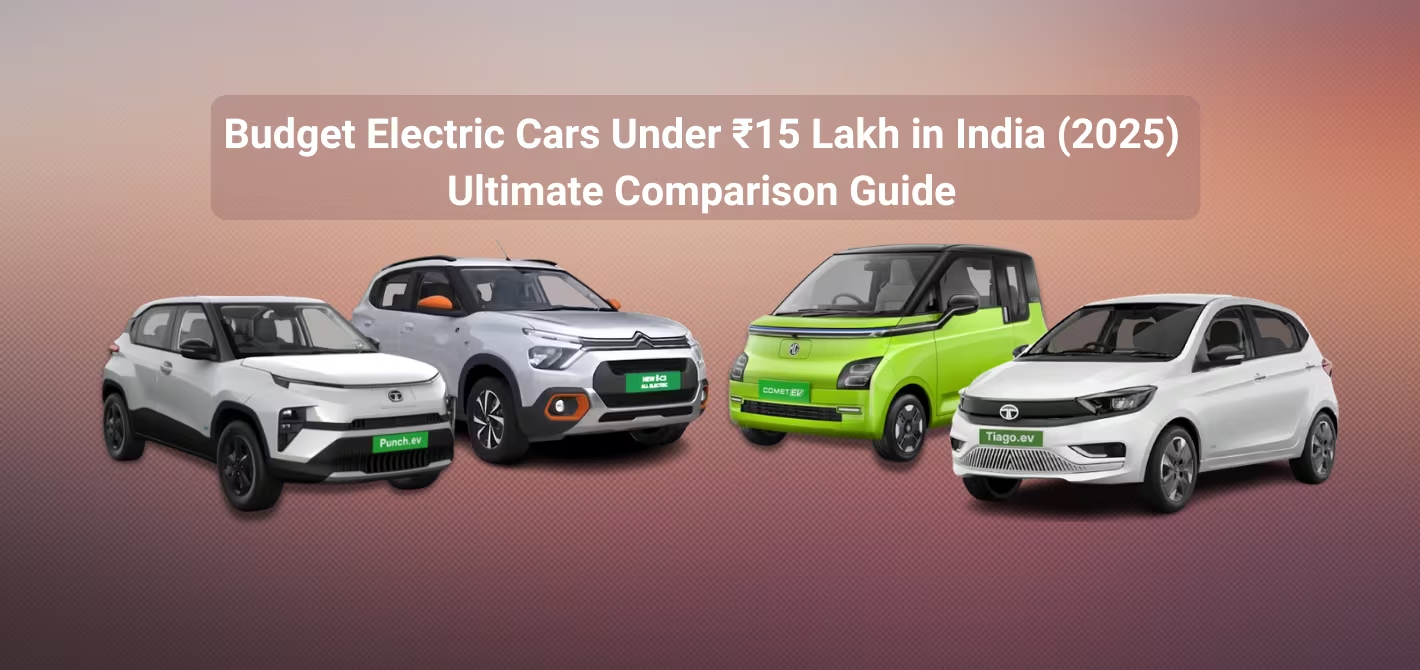
Budget Electric Cars Under 15 Lakh: India’s electric vehicle revolution has finally reached the mainstream buyer, with four compelling electric cars now available starting under ₹15 lakh ex-showroom. These aren’t compromised city runabouts anymore today’s budget EVs deliver genuine practicality, verified safety credentials, and running costs that fundamentally change the economics of car ownership. The standout performer is the Tata Punch EV, which achieved the highest safety score ever recorded in Bharat NCAP testing with a perfect five-star rating, while offering up to 421 kilometers of manufacturer-claimed range from its larger battery option.
The landscape has transformed dramatically since early electric vehicles struggled with range anxiety and sparse charging networks. Today’s budget segment spans from the compact MG Comet EV at ₹7.50 lakh to the feature-rich Tata Punch EV topping out at ₹14.44 lakh for its most capable variant. Running costs average ₹1 to ₹1.50 per kilometer when charging at home, compared to ₹5.50 to ₹7.40 per kilometer for equivalent petrol hatchbacks. This translates to genuine savings of ₹48,000 to ₹62,000 annually for someone driving 1,000 kilometers monthly, making the premium over petrol alternatives recoverable within six to seven years for high-mileage users.
Budget Electric Cars Under 15 Lakh : Understanding what budget really means in electric vehicles
The pricing structure for electric vehicles differs fundamentally from conventional cars, requiring buyers to look beyond the sticker price. Some manufacturers like MG Motor offer Battery-as-a-Service schemes that reduce the initial purchase price but add ongoing per-kilometer charges for battery usage. The MG Comet EV, for instance, can be purchased for ₹4.99 lakh plus ₹3.10 per kilometer in battery rental, or ₹7.50 to ₹10.00 lakh with the battery included in the purchase price. The all-inclusive ex-showroom price represents true ownership without recurring payments, making it the clearer metric for budget comparisons.
Understanding these pricing models matters because they affect the total cost of ownership calculation. A vehicle purchased through Battery-as-a-Service might seem affordable initially, but someone driving 1,500 kilometers monthly would pay ₹4,650 in battery rental charges alone, adding ₹55,800 annually to their ownership costs. This guide focuses on ex-showroom prices with batteries included, ensuring buyers understand the complete financial commitment upfront rather than discovering ongoing obligations later.
The four contenders transforming affordable electric mobility
The MG Comet EV establishes the segment’s entry point at ₹7.50 lakh ex-showroom, though buyers should note the widely advertised ₹4.99 lakh price applies only to the Battery-as-a-Service model with ongoing per-kilometer charges. This ultra-compact electric car measures just 2,974 millimeters in length with a remarkably tight 4.2-meter turning radius, making it unmatched for congested urban environments where parking spaces shrink daily. The 17.3 kilowatt-hour battery delivers 230 kilometers of manufacturer-claimed range, though professional testing by CarWale recorded 191 kilometers in real-world conditions. The Comet’s 2+2 seating configuration and 150-liter boot space position it clearly as a secondary vehicle for dedicated city use rather than a family’s primary transport.
Tata’s Tiago EV begins at ₹7.99 lakh, offering conventional hatchback practicality that makes the transition to electric ownership less daunting for first-time EV buyers. The familiar five-seat layout and 240-liter boot space match expectations set by decades of hatchback design, while two battery options provide choice between economy and range. The Medium Range variant pairs a 19.2 kilowatt-hour battery with 250 kilometers of manufacturer-claimed range, while the Long Range version’s 24 kilowatt-hour battery provides approximately 293 kilometers according to Tata’s official specifications. Real-world expectations should anticipate 60 to 75 percent of these manufacturer claims depending on driving conditions, suggesting 150 to 185 kilometers for Medium Range and 175 to 220 kilometers for Long Range in typical use. The January 2025 update brought a new 10.25-inch touchscreen with wireless smartphone connectivity, though Tata controversially deleted the eight-speaker Harman audio system and leatherette upholstery in cost-cutting measures.
The Tata Punch EV represents a significant step up at ₹9.99 lakh for the base Smart variant, climbing to ₹14.44 lakh for the range-topping Empowered Plus S with Long Range battery. Built on Tata’s new acti.ev platform designed exclusively for electric vehicles, the Punch EV demonstrates how purpose-built architecture delivers advantages over converted petrol platforms. Two battery options mirror the Tiago EV’s strategy a 25 kilowatt-hour Medium Range pack offering 315 kilometers of manufacturer-claimed range, and a 35 kilowatt-hour Long Range option extending this to 421 kilometers under Modified Indian Driving Cycle testing conditions. The larger battery pairs with a more powerful 90 kilowatt motor (approximately 122 PS in conventional terms) producing 190 Newton-meters of torque, compared to the Medium Range variant’s 60 kilowatt motor (approximately 82 PS) with 114 Newton-meters. These are manufacturer-claimed specifications. The 366-liter boot space and 190 millimeters of ground clearance provide genuine SUV versatility that the lower hatchback alternatives cannot match.
The Citroen eC3 enters at ₹12.90 lakh with the segment’s largest battery at 29.2 kilowatt-hours and a claimed range of 320 kilometers. The French manufacturer’s signature focus on ride comfort translates to a suspension setup that glides over broken pavement where competitors crash and thud, making extended journeys notably more pleasant. However, the eC3 carries a critical safety deficiency that demands serious consideration Global NCAP crash testing in March 2024 awarded it zero stars for adult occupant protection and just one star for child occupant protection. This represents fundamental structural inadequacies in protecting occupants during collisions, raising profound questions about value proposition regardless of the eC3’s other merits in comfort and range.
What the specifications reveal about real-world ownership
All range and charge-time figures presented in this guide are manufacturer-claimed specifications from MIDC (Modified Indian Driving Cycle) or ARAI testing unless explicitly noted otherwise. Real-world test figures are sourced and labeled as such, 191 km” or “professional testing recorded 219 km.” Understanding this distinction helps buyers set realistic expectations for daily ownership.
Translating manufacturer claims into daily reality requires understanding the gap between laboratory testing and actual driving conditions. The Tata Punch EV’s 421-kilometer manufacturer claim for the Long Range variant comes from Modified Indian Driving Cycle testing, which assumes moderate speeds, minimal air conditioning use, and optimal temperatures. Real-world conditions in Indian summers with air conditioning running constantly, mixed city-highway driving, and temperatures exceeding 40 degrees Celsius typically show different results. Independent testing and owner reports typically show 60 to 75 percent achievement of MIDC/ARAI manufacturer claims under challenging conditions including hot weather, hilly terrain, and continuous air conditioning use. Actual real-world range varies significantly by individual vehicle, driving speed, climate conditions, and battery age. Based on these typical achievement rates, buyers should expect approximately 240 to 315 kilometers from the Punch EV Long Range in varied usage, with highway cruising at 90 kilometers per hour potentially reducing this further to 190 to 250 kilometers.
The MG Comet EV’s verified real-world range of 191 kilometers from real world testing against a 230-kilometer ARAI claim shows an 83 percent achievement rate—better than many larger EVs manage. This superior efficiency comes from the Comet’s lightweight construction, compact dimensions reducing aerodynamic drag, and modest motor output of just 41 to 42 bhp. The small 17.3 kilowatt-hour battery charges completely in 3.5 hours using a 7.4 kilowatt AC charger, though buyers should note that DC fast charging capability is completely absent on all Comet variants. This limitation matters significantly for anyone without guaranteed home charging access, as the fastest possible charging remains 7.4 kilowatt AC on equipped variants.
Charging infrastructure planning deserves careful attention before committing to electric ownership. The charging times assume ideal conditions and vary by equipment used. For the Tata Punch EV Long Range, a standard 3.3 kilowatt household socket requires approximately 13.5 hours for complete charging (0-100% state of charge), while installing a dedicated 7.2 kilowatt home wallbox reduces this significantly to approximately 5 hours (0-100%). The Tata Tiago EV and Punch EV both support 50 kilowatt DC fast charging capability, enabling 10 to 80 percent charge in approximately 58 minutes and 40 minutes respectively according to manufacturer specifications. All charging times are manufacturer-claimed under optimal conditions; actual charging may take longer depending on battery temperature, charger compatibility, electrical supply quality, and initial battery state of charge. This emergency top-up capability provides flexibility for occasional longer journeys or when home charging proves unavailable. However, dependence on public charging infrastructure introduces cost penalties commercial charging stations charge ₹15 to ₹22 per kilowatt-hour for AC charging and ₹18 to ₹25 per kilowatt-hour for DC fast charging, compared to home electricity rates of ₹6 to ₹8 per kilowatt-hour in most states. As of late 2024, India’s public charging infrastructure included over 25,000 stations according to government figures, with Karnataka leading at approximately 5,765 installations followed by Maharashtra and Delhi. These numbers continue growing as both government initiatives and private sector investment expand coverage, though home charging remains essential for convenient daily ownership. A buyer charging exclusively at commercial rates would see running costs of ₹2.50 to ₹3.70 per kilometer, still cheaper than petrol but eroding the economic advantage substantially.
The battery warranty terms provide long-term security that addresses the single biggest anxiety prospective EV buyers express. Battery warranty terms vary substantially by manufacturer, sales plan structure (Battery-as-a-Service versus battery-included purchase), and transfer policies between owners. Buyers should always confirm the exact battery warranty period, coverage conditions, degradation thresholds that trigger warranty claims, and transferability policies at the time of purchase rather than relying on general promotional materials.
Tata Motors offers eight years or 160,000 kilometers coverage on battery and motor for both the Tiago EV and Punch EV, whichever milestone arrives first. MG Motor advertises lifetime battery warranty coverage for the first owner under certain purchase plans, though the standard eight years or 120,000 kilometers coverage applies for subsequent owners. Buyers should verify the exact warranty terms applicable to their specific purchase plan and region at the time of sale, as coverage varies by Battery-as-a-Service versus battery-included purchase structures. These warranties protect against battery degradation beyond normal parameters, though buyers should understand that all lithium-ion batteries experience gradual capacity loss over time. A battery retaining 70 to 80 percent of original capacity after eight years of use falls within normal degradation and wouldn’t trigger warranty replacement.
Safety credentials separate serious contenders from false economy
The Tata Punch EV achieved a historic milestone in June 2024 by recording the highest safety scores ever measured in Bharat NCAP testing. The official results show 31.46 points out of 32 possible for adult occupant protection and 45 points out of 49 for child occupant protection, both earning the maximum five-star rating. The testing protocol subjected the Punch EV to frontal offset deformable barrier tests at 64 kilometers per hour and side impact tests at 50 kilometers per hour, with crash test dummies measuring forces experienced by occupants. The Punch EV provided good to adequate protection across all body regions in both test scenarios, demonstrating that affordable electric vehicles need not compromise on structural safety.
This achievement matters profoundly because it proves accessible EVs can deliver world-class protection. The Punch EV comes standard with six airbags across all variants, including front, side, and curtain airbags that work together with seatbelts to protect occupants. Electronic Stability Control maintains vehicle stability during emergency maneuvers, preventing the loss of control that causes many accidents. ISOFIX child seat mounting points allow proper installation of child restraints, critical for families with young children. The combination of structural integrity proven through crash testing and comprehensive safety equipment makes the Punch EV the only genuinely safe choice for buyers prioritizing occupant protection in this price segment.
The Tata Tiago EV inherits a four-star Global NCAP rating from its petrol sibling’s platform, providing reasonable protection though falling short of the Punch EV’s five-star standard. Base variants include just two airbags, with four airbags available on higher trim levels. The absence of Electronic Stability Control across the Tiago EV lineup represents a notable safety equipment gap compared to the Punch EV’s standard provision. Buyers prioritizing absolute safety should recognize this difference and potentially consider upgrading to variants with additional airbags if choosing the Tiago EV.
The MG Comet EV has not undergone testing by any NCAP organization, leaving buyers without independent verification of crash protection capabilities. The standard two airbags and optional Electronic Stability Control on upper variants provide some safety equipment, but the absence of crash test validation means buyers cannot objectively assess occupant protection. The Comet’s unconventional rear-wheel drive layout and compact dimensions create handling characteristics that differ from conventional front-wheel drive hatchbacks, requiring driver adaptation for safe operation.
The Citroen eC3’s zero-star Global NCAP rating for adult occupant protection represents a disqualifying safety deficiency that should give any responsible buyer serious pause. Global NCAP crash testing conducted in March 2024 awarded zero stars for adult occupant protection and just one star for child occupant protection (Global NCAP official test report, March 2024). The testing revealed fundamental structural inadequacies in protecting occupants during crashes, with the test model equipped with front airbags, belt load limiters, and seatbelt reminders still failing to achieve even a one-star rating for adult protection. This safety failure occurs despite a ₹12.90 lakh starting price that exceeds the five-star-rated Punch EV’s base variant by nearly ₹3 lakh, making it impossible to recommend the eC3 to any buyer who values their family’s safety.
Features and technology define the ownership experience
The technology offerings in budget electric vehicles have improved dramatically, with even entry-level variants now providing connectivity features that seemed premium just two years ago. The MG Comet EV’s upper variants deliver dual 10.25-inch displays consisting of a touchscreen infotainment system and fully digital driver instrument cluster, wireless Android Auto and Apple CarPlay connectivity, and MG’s i-SMART connected car system offering over 55 features controlled through smartphone apps or more than 100 voice commands. The LED lighting throughout creates a premium visual presence that belies the Comet’s compact dimensions and affordable pricing.
The Tata Punch EV matches this technological sophistication with its 10.25-inch touchscreen infotainment system, ZConnect connected car technology with smartwatch connectivity allowing remote vehicle monitoring and control, and comprehensive voice assistant integration. The system responds to multiple voice assistants including the native “Hey Tata” assistant supporting numerous commands in six Indian languages, plus Alexa for Amazon ecosystem users, Siri for Apple device owners, and Google Assistant for Android users. Vehicle voice-assistant capabilities vary by trim level; buyers should consult the manufacturer’s specification page for exact supported commands and languages for their chosen variant. This multi-platform approach ensures compatibility regardless of the buyer’s existing technology preferences. Upper variants add conveniences like wireless charging for smartphones, automatic headlamps that activate in low light, rain-sensing wipers that adjust speed to precipitation intensity, and auto-dimming interior rearview mirrors that reduce glare from following vehicles at night.
The ventilated seats on the Punch EV Empowered Plus variants address a genuine comfort need in Indian summers, where leather or leatherette upholstery becomes unbearably hot without active cooling. The electric sunroof provides an airy cabin feel and allows fresh air circulation without running air conditioning, extending range on pleasant days. The air purifier with AQI display actively monitors and improves cabin air quality, increasingly important in cities with deteriorating air pollution levels. The gesture-controlled powered tailgate on the top variant opens with a foot wave under the rear bumper, convenient when carrying groceries or luggage.
The Tata Tiago EV’s January 2025 update introduced the new 10.25-inch floating touchscreen supporting wireless Android Auto and Apple CarPlay, bringing it to parity with competitors in infotainment capabilities. However, Tata controversially removed the eight-speaker Harman audio system and leatherette upholstery previously available on higher variants, replacing them with fabric seats and a standard four-speaker setup. This cost-cutting move drew criticism from existing owners and automotive journalists who viewed it as a step backward in feature content. Base variants still lack any infotainment display, providing only a basic instrument cluster and Bluetooth connectivity through the audio system.
The Citroen eC3 offers a 10.2-inch touchscreen across all variants with wireless Apple CarPlay and Android Auto connectivity, steering-mounted controls, and a height-adjustable driver seat. However, notable feature gaps emerge when comparing against competitors at similar price points. The eC3 lacks automatic climate control across all variants, providing only manual air conditioning even on the ₹13.53 lakh top variant. Push-button start remains absent, requiring traditional key operation. LED headlamps don’t feature in the equipment list, with the eC3 using conventional halogen bulbs that provide inferior illumination. These omissions feel particularly glaring given the eC3’s pricing that exceeds the better-equipped Punch EV base variant.
Matching the right electric car to specific buyer needs
The MG Comet EV serves urban professionals seeking a dedicated city commuter as a household’s second or third vehicle. The compact 2,974-millimeter length and 4.2-meter turning radius excel in congested traffic and tight parking situations where larger vehicles struggle. The verified 191-kilometer real-world range covers typical weekly commuting for most city dwellers with a single weekend charge using home charging infrastructure. The dual 10.25-inch displays, comprehensive connected features, and lifetime battery warranty for the first owner provide technology and peace of mind that enhance daily ownership. However, buyers must accept the negligible 150-liter boot space that accommodates little beyond groceries, the 2+2 seating configuration that prevents carrying more than three passengers, and complete unsuitability for any highway travel beyond occasional short hops between cities.
The Tata Tiago EV appeals to first-time electric vehicle adopters wanting proven technology without the unfamiliarity of radically different vehicle formats. The conventional hatchback layout with five proper seats and a 240-liter boot delivers the space and practicality buyers expect from decades of hatchback experience, reducing the psychological barrier that sometimes prevents people from making the electric transition. The ₹7.99 lakh entry price represents the most affordable pathway to practical electric motoring from an established manufacturer with extensive service infrastructure. Tata Motors operates over 500 electric vehicle service centers across India, providing comprehensive coverage even in tier-two and tier-three cities where newer brands struggle with service accessibility. The four-star Global NCAP safety rating inherited from the petrol Tiago platform provides reasonable occupant protection, though buyers prioritizing maximum safety should opt for variants with four airbags rather than the base two-airbag configuration.
The Tata Punch EV represents the rational choice for most buyers when balancing safety credentials, practical range capability, feature content, and value for money. The five-star Bharat NCAP rating with the highest scores ever recorded eliminates any compromise on occupant protection, critical for families transporting children daily. The 35 kilowatt-hour Long Range battery’s claimed 421-kilometer range translates to realistic expectations of 240 to 300 kilometers in mixed city-highway driving with air conditioning, sufficient for all but the most demanding intercity journeys. The 366-liter boot space accommodates weekly shopping runs and occasional luggage for short trips, while the 190-millimeter ground clearance handles India’s variable road conditions including speed bumps, potholes, and occasional unpaved surfaces that would ground lower hatchbacks.
The acti.ev platform built specifically for electric vehicles delivers refinement advantages over the Tiago EV’s converted petrol architecture, with better weight distribution, lower center of gravity improving handling stability, and packaging efficiency that maximizes interior space despite similar external dimensions. The comprehensive feature set on upper variants including ventilated seats, electric sunroof, 360-degree camera system, and multiple voice assistant options creates a premium ownership experience accessible at prices that undercut the Nexon EV by nearly ₹2.5 lakh. Families prioritizing occupant protection have no comparable alternative in this segment when considering the combination of verified crash test performance and comprehensive active safety equipment.
The Citroen eC3 theoretically attracts buyers prioritizing ride comfort and willing to accept safety compromises for the trademark French suspension tuning that glides over broken pavement. The 29.2 kilowatt-hour battery delivers verified real-world range of 219 kilometers in CarWale testing, and the 315-liter boot space provides generous cargo capacity for a vehicle in this class. The high seating position and SUV-like stance create a commanding driving position that some buyers prefer over conventional hatchback ergonomics. However, the zero-star Global NCAP crash test rating for adult occupant protection makes this an impossible recommendation for any buyer who values their family’s safety. The impending December 2025 facelift may address feature gaps like the absence of automatic climate control and LED headlamps, but structural safety improvements seem unlikely without a fundamental platform redesign requiring far more investment than a typical mid-cycle refresh justifies.
Understanding the total cost equation beyond the price tag
The running cost advantages of electric vehicles fundamentally change the economics of car ownership for high-mileage users. Home charging at typical electricity rates of ₹6 to ₹8 per kilowatt-hour translates to running costs of ₹1 to ₹1.50 per kilometer for these budget EVs. Compare this against petrol vehicles averaging ₹5.50 to ₹7.40 per kilometer at current fuel prices, and the savings compound dramatically over ownership tenure. A buyer driving 1,000 kilometers monthly saves ₹48,000 to ₹62,000 annually on fuel costs alone, recovering the ₹2 to ₹5 lakh premium over equivalent petrol models within six to seven years through operational savings.
Maintenance costs add further advantage to the electric ownership equation. Electric vehicles require approximately ₹3,000 to ₹5,000 annually for routine maintenance including brake inspection, tire rotation, cabin filter replacement, and coolant checks for the battery thermal management system. Comparable petrol vehicles demand ₹10,000 to ₹15,000 annually when accounting for engine oil changes every 10,000 kilometers, air filter replacement, spark plug changes, and more complex drivetrain servicing. The absence of a conventional transmission, clutch, exhaust system, and hundreds of moving parts in internal combustion engines creates mechanical simplicity that reduces both servicing frequency and component replacement costs.
Insurance costs for electric vehicles typically run 10 to 15 percent higher than petrol equivalents due to expensive battery replacement values that insurers must cover. However, several states offer complete road tax waivers for electric vehicles, saving ₹30,000 to ₹80,000 depending on the state and vehicle price at the time of registration. This one-time saving partially or completely offsets the higher insurance premiums over initial ownership years. State-specific incentives vary considerably, making it essential for buyers to research current policies in their state before finalizing purchase decisions.
The charging infrastructure investment requires consideration for buyers without existing electrical capability in their parking location. Installing a dedicated 7.2 kilowatt AC wall box charger costs approximately ₹15,000 to ₹25,000 depending on the distance from the electrical panel, civil work required for conduit installation, and local electrical contractor rates. This upfront investment pays dividends through faster overnight charging the Tata Punch EV Long Range charges completely in five hours with a 7.2 kilowatt charger versus 13.5 hours using a standard household 3.3 kilowatt socket. Apartment dwellers must secure permission from housing society management for dedicated charging point installation, potentially requiring formal proposals, committee approvals, and load allocation from the society’s electrical infrastructure.
Making the confident purchase decision
The verified data and real-world testing results reveal clear winners when buyers prioritize different attributes. For absolute safety without compromise, the Tata Punch EV Long Range stands alone with its five-star Bharat NCAP rating representing the highest scores ever recorded, comprehensive standard safety equipment including six airbags and Electronic Stability Control, and genuine family-car versatility from its 366-liter boot and five-seat capacity. The ₹12 to ₹14 lakh pricing for well-equipped Long Range variants delivers exceptional value when considering the safety credentials, feature content, and practical range capability.
For strict budget adherence while maintaining practicality, the Tata Tiago EV Long Range at approximately ₹10 lakh offers the best balance of affordability, adequate range for urban commuting, and Tata’s extensive service network providing peace of mind for long-term ownership. The four-star Global NCAP rating provides reasonable occupant protection when choosing variants with four airbags, and the conventional hatchback format reduces the learning curve for buyers making their first electric vehicle purchase.
The MG Comet EV serves its specific niche brilliantly for urban professionals needing dedicated city transport without family hauling requirements. The verified 191-kilometer real-world range, compact dimensions enabling parking in spaces impossible for conventional cars, and comprehensive technology features create compelling value at ₹7.50 lakh for buyers accepting its limitations. The lifetime battery warranty for the first owner provides unusual long-term security in the budget segment.
The Citroen eC3’s zero-star Global NCAP crash test rating disqualifies it from serious consideration despite commendable ride quality and verified real-world range performance. No amount of comfort or efficiency justifies placing family members in a vehicle with fundamental structural inadequacies in crash protection, particularly when the five-star-rated Punch EV costs ₹3 lakh less for its base variant. Buyers drawn to the eC3’s spacious cabin and compliance over rough roads should redirect that interest toward vehicles that won’t sacrifice their safety for comfort.
The electric vehicle landscape will continue improving with additional competition expected in 2025 likely driving further price reductions and feature improvements. However, today’s budget segment offers genuinely compelling options for buyers with realistic expectations about range, willingness to invest in home charging infrastructure, and understanding of the long-term cost advantages that make slightly higher purchase prices economically rational. The transformation from petrol to electric represents more than fuel source substitution it fundamentally changes the ownership experience through quieter operation, instant torque delivery creating more responsive acceleration, and minimal mechanical complexity reducing maintenance burdens. For buyers whose daily driving fits within the realistic range capabilities these vehicles deliver, the transition to electric mobility has never been more accessible or financially sensible.
For full crash-test details, you can also check the official Bharat NCAP results here:
https://www.bncap.in/vehicle/tata-punch-ev/
For buyers considering advanced driver assistance systems, you can also read our detailed guide on the Tata Nexon EV with Level 2 ADAS here:
https://www.motors77.com/tata-nexon-ev-with-level-2-adas/