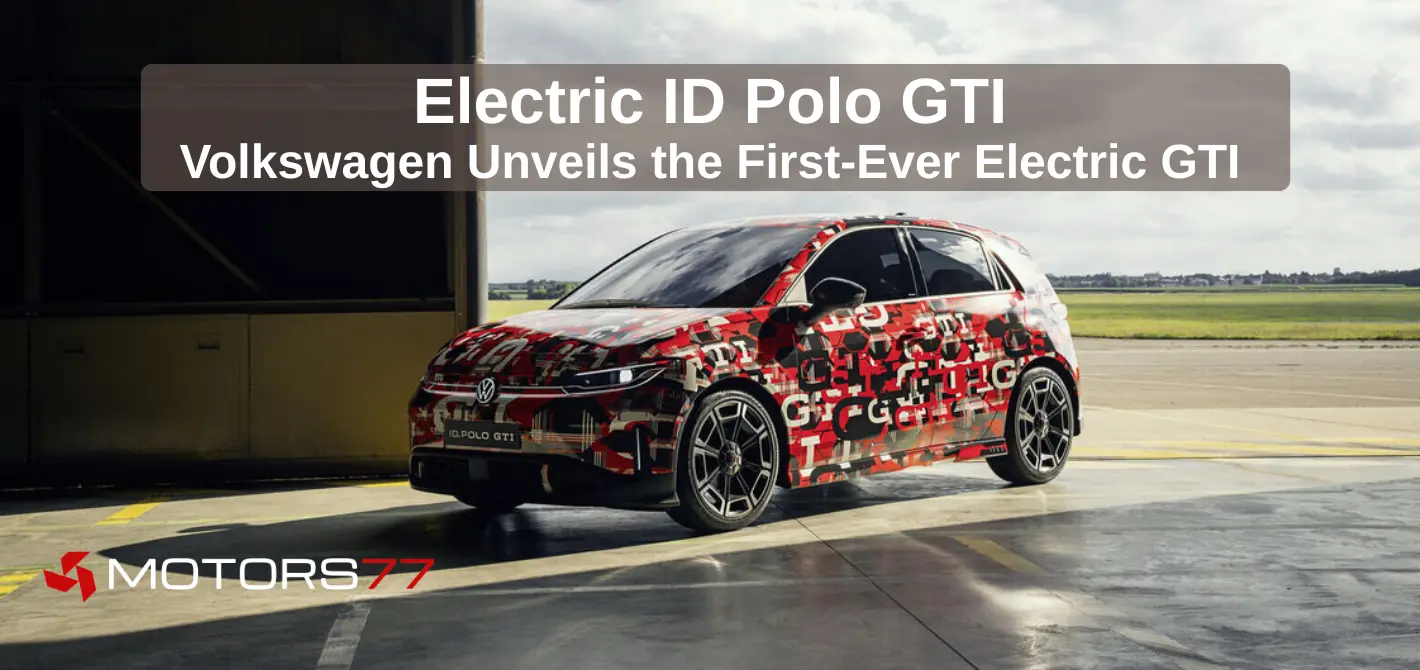
The electric ID Polo GTI has officially made its world premiere at the 24h Nürburgring on 15 May 2026.
This is the most significant moment in GTI history since the original Golf GTI rolled out of Wolfsburg in 1976.
Volkswagen chose the “Green Hell” and an estimated crowd of 280,000 motorsport fans as the stage for a milestone that even diehard GTI loyalists could not have predicted a decade ago. Half a century after the three red letters first appeared on a hot hatch, the badge has found a new home on a battery powered car.
For India’s growing community of EV enthusiasts and Volkswagen fans, the ID. Polo GTI signals where the global hot hatch isheading. It also raises the question every petrolhead is whispering: can an electric GTI still feel like a GTI?
What Makes This a Landmark Moment
For 50 years, the GTI nameplate has meant one thing only. A compact, front wheel drive hot hatch with sharp steering, an honest character, and a price that did not require remortgaging the house.
Every GTI from the original Golf I GTI in 1976 to the latest Golf GTI EDITION 50 has stayed faithful to that formula.
The first electric GTI changes the equation in one stroke. It keeps the compact dimensions, keeps the front wheel drive layout, keeps the red accents, but throws out the combustion engine entirely.
Volkswagen confirmed it officially on 8 May 2026 from Wolfsburg. This is the first all-electric model ever to wear the renowned GTI badge. That is a heavy sentence to read for anyone who grew up watching Golf GTIs tearing down German autobahns or chasing apexes at the Nordschleife.
The Nürburgring Stage
Volkswagen did not pick a sterile showroom in Munich or a polished launch event in Berlin.
The German marque chose the Ring-Boulevard at the Nürburgring on the eve of the 24-hour endurance race. The 24h Nürburgring ran from 14 to 17 May 2026 and remains Germany’s largest motorsport event.
The world premiere happened in front of motorsport fans who genuinely understand what the GTI badge means. The choice of venue is deliberate. Volkswagen wants this car judged by enthusiasts, not by EV early adopters.
Quick Specifications Table
The electric ID Polo GTI has been revealed as a near-production vehicle. The model is not yet available for sale, and final production specifications will be confirmed closer to market launch.
Based on Volkswagen’s official IAA MOBILITY 2025 fact sheet and confirmed press materials, here is what we know.
| Parameter | Details |
|---|---|
| Model | Volkswagen ID. Polo GTI |
| Status | Near-production concept (not yet on sale) |
| Body type | Compact electric hot hatch |
| Platform | MEB+ (evolved Modular Electric Drive matrix) |
| Drivetrain | Front-wheel drive (electric) |
| Production location | SEAT/CUPRA Martorell plant, Spain |
| Powertrain | Single front-mounted electric motor |
| Power output | Approximately 166 kW (223 PS) |
| Sibling model | ID. Polo (entry below €25,000 in Europe) |
| World premiere | 15 May 2026, Nürburgring Ring-Boulevard |
| Market launch | To be confirmed (post-2026) |
Underpinnings: The MEB+ Platform
The EV GTI rides on Volkswagen’s new MEB+ platform, the evolutionary upgrade of the Modular Electric Drive matrix that introduced the ID.3 and ID.4.
MEB+ brings improved hardware and software. More importantly for the GTI, it brings a new electric front wheel drive system developed specifically for Volkswagen’s more compact product lines.
This matters because every GTI from 1976 onwards has been front wheel drive. The MEB+ allows the GTI character to live on electrically without forcing all wheel drive or rear wheel drive on a car that was never meant to have either.
Design and Character
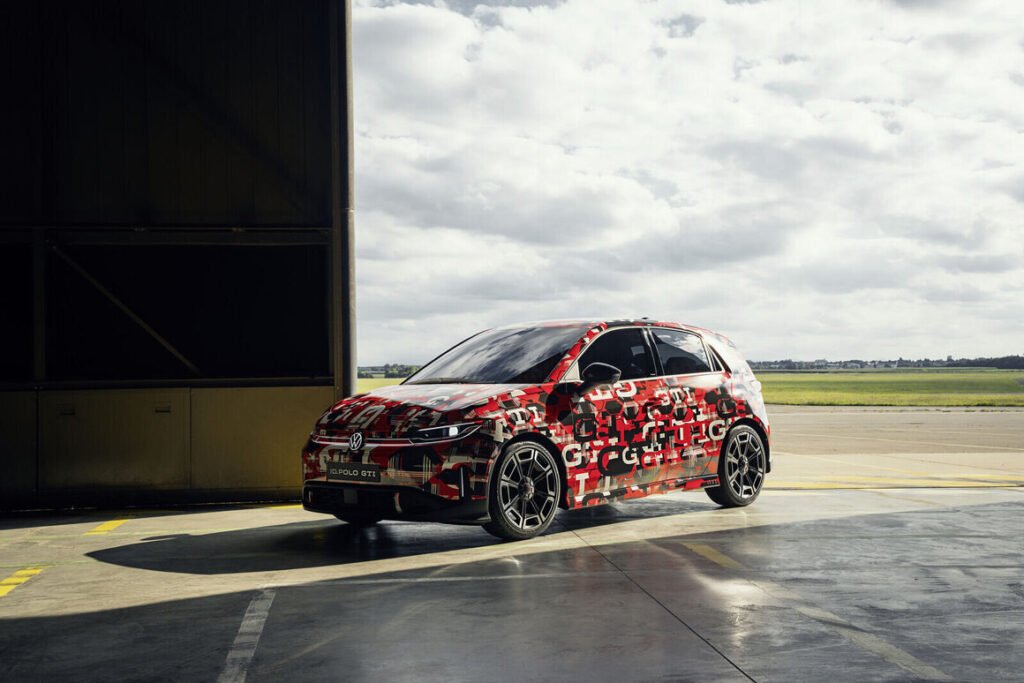
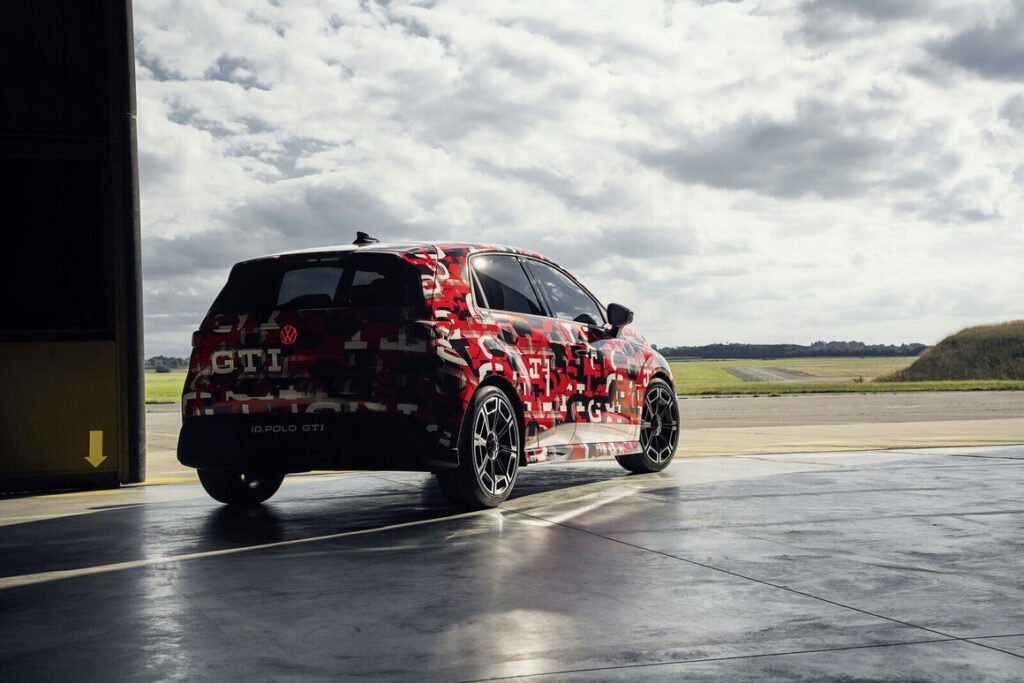
The near-production concept shown at the Nürburgring carries the visual cues every GTI fan recognises instantly.
Red brake calipers. The iconic red accent strip across the front. GTI-specific bumpers with sportier intakes. Honeycomb grille treatment. Unique wheel designs.
The silhouette stays compact and squat, much like the petrol Polo GTI that came before it.
What is striking is how Volkswagen has refused to over-engineer the design with futuristic EV gimmicks. There is no oversized lightbar across the front demanding attention. There are no over-styled aerodynamic flicks.
The ID. Polo GTI looks like a Polo GTI that happens to be electric, not an EV concept that happens to wear a GTI badge. That restraint is what GTI customers have always wanted.
What the Electric GTI Should Feel Like
Specs only tell half the story. The real question is how this car drives.
Instant electric torque should make the ID. Polo GTI feel brutally responsive out of corners, with the front axle hooking up the moment the throttle is mashed. Mid-corner power application, the classic GTI signature move where you balance the car on the throttle and feel the chassis settle, should translate well to electric delivery.
The battery weight will sit low in the floor. That lowers the centre of gravity dramatically compared with a petrol Polo GTI carrying its engine high in the nose. Lower centre of gravity means flatter cornering, sharper turn-in, less body roll.
The trade-off is mass. The EV GTI will weigh more than the petrol car it replaces. Steering feel and weight transfer will need to be engineered carefully so the chassis still feels playful rather than planted into the road like a heavier saloon.
The exhaust note is gone forever. That loss will hurt some GTI fans more than others.
Why Nürburgring Matters
Volkswagen made the GTI anniversary weekend bigger than just one premiere.
Three Golf GTI Clubsport 24h race cars competed in the 24-hour marathon. Car number 50, driven by VW test driver Benjamin Leuchter alongside eight-time FIA World Rallycross champion Johan Kristoffersson, targeted a third consecutive SP4T class win. Car number 76 carried Fabian Vettel, Timo Hochwind and Jonathan Mogotsi. Car number 10, in the SP3T class, included former German national soccer team player Max Kruse among its drivers.
All three race cars now feature a carbon fibre composite boot lid alongside the carbon doors introduced in 2025, bringing total weight to 1,200 kg without driver. Power stands at 397 PS (291 kW), and all three cars run on E20 fuel made from 60 per cent renewable raw materials.
Around 40 Volkswagen GTIs spanning all eight generations took to the Nordschleife in a parade lap before the race. The first electric GTI joined that parade, a symbolic moment where 50 years of combustion history rolled in front of fans alongside the first electric chapter.
A Golf R 24H show car was also revealed at the Ring-Boulevard, previewing Volkswagen R’s planned entry into the 24h Nürburgring in 2027.
Quick Pros and Cons
Pros
- First electric GTI keeps the front wheel drive layout faithful to the original 1976 formula
- Compact dimensions and honest hot hatch silhouette remain intact
- New MEB+ platform brings improved efficiency and packaging
- Battery-low centre of gravity should sharpen handling
- Built in Europe at the Martorell plant ensures quality consistency
- Sibling ID. Polo aims for under €25,000 entry pricing in Europe
- Premiere at Nürburgring signals serious driving intent, not badge engineering
Cons
- No exhaust note for purists who valued the audio drama
- Battery weight adds kilograms compared with petrol predecessors
- Indian launch timeline remains unconfirmed and likely distant
- Final pricing not disclosed, expected higher than petrol GTI equivalents
- Faces stiff competition from MG4 XPower, Cupra Born VZ and Alpine A290 in Europe
- Charging infrastructure remains a real concern for daily GTI driving in many markets
How This Fits Volkswagen’s Electric Future
Volkswagen brand CEO Thomas Schäfer has been clear. The company is moving its iconic combustion-era names into the electric era.
The ID. 2all concept became the ID. Polo. The ID. Polo now spawns the GTI variant.
The naming strategy is intentional. Volkswagen wants buyers to feel emotional continuity between the petrol Golf, Polo and Tiguan they grew up with, and the electric versions they will eventually buy.
This is not just a product launch. It is a brand statement. Volkswagen is telling the world that its electric future will not abandon the names and characters that built the company over five decades.
What This Means for India
The Indian market currently has no confirmed timeline for the electric ID Polo GTI.
Volkswagen India has prioritised Taigun, Virtus and the upcoming Tiguan. Skoda Auto Volkswagen India is yet to commit to a dedicated EV strategy under the Volkswagen brand.
For Indian enthusiasts, this car remains aspirational rather than achievable in the near future.
That said, the global success of an electric GTI formula will influence how Volkswagen approaches India’s EV market. If the EV GTI proves that electrification does not kill driving enjoyment, it may accelerate Volkswagen’s confidence in launching driver-focused EVs globally. India included.
Five Decades of GTI in One Table
| Generation | Year | Key fact |
|---|---|---|
| Golf I GTI | 1976 | The original that started the hot hatch segment |
| Golf II GTI | 1984 | Mainstream success, 16V variant added |
| Golf III GTI | 1991 | Heavier and softer, faced criticism |
| Golf IV GTI | 1998 | Returned to refinement focus |
| Golf V GTI | 2004 | The rebirth of the GTI legend with FSI engine |
| Golf VI GTI | 2009 | Refined the Mk5 formula |
| Golf VII GTI | 2013 | Lightweight MQB platform debut |
| Golf VIII GTI | 2020 onward | Latest petrol GTI, EDITION 50 announced |
| ID. Polo GTI | 2026 | First all-electric GTI in history |
Frequently Asked Questions
Q1. When did Volkswagen unveil the electric ID Polo GTI?
The world premiere took place on 15 May 2026 at the Ring-Boulevard of the Nürburgring, on the opening day of the 24h Nürburgring race weekend that ran from 14 to 17 May 2026.
Q2. Is the ID. Polo GTI available to buy?
No. Volkswagen has confirmed in official communications that the model is a near-production concept and is not yet available for sale. Market launch and pricing details will be announced closer to production start.
Q3. Is the electric GTI front wheel drive or all wheel drive?
The ID. Polo GTI is front wheel drive, staying faithful to the original GTI layout. It uses Volkswagen’s new electric front wheel drive system developed specifically for the MEB+ platform and the brand’s compact product lines.
Q4. What platform does the electric ID Polo GTI use?
It is built on the MEB+ platform, which is the new evolutionary stage of Volkswagen’s Modular Electric Drive matrix. The ID. Polo is the first production model to use MEB+, and the GTI variant builds directly on that base.
Q5. Where will it be manufactured?
The ID. Polo and its GTI variant are produced at SEAT and CUPRA’s Martorell plant in Spain, making them genuinely European-built electric Volkswagens.
Q6. Will the electric ID Polo GTI launch in India?
Volkswagen has not announced an India launch. Given current Volkswagen India strategy focused on Taigun, Virtus and SUV models, an Indian launch in the near term is unlikely. Pricing and timeline for India remain unconfirmed.
Q7. How is it different from a petrol Polo GTI?
The fundamental difference is the powertrain. The EV GTI uses a battery and electric motor instead of a turbocharged petrol engine. It retains front wheel drive, GTI design cues and compact dimensions, but loses the exhaust note, gear shifts and combustion driving feel.
Q8. What is the significance of the Nürburgring world premiere?
Volkswagen chose Germany’s largest motorsport event with around 280,000 spectators, at a venue that carries deep GTI heritage. Premiering the ID. Polo GTI there signals that Volkswagen views the car as a serious driver’s machine, not just a badge engineering exercise.
Q9. How many GTI generations are there now?
With the launch of the first electric GTI, Volkswagen has opened a new chapter. There have been eight Golf GTI generations from 1976 to today, plus several Polo GTI generations. The ID. Polo GTI is the first electric model to wear the badge.
Q10. Will the petrol GTI continue alongside it?
Yes. Volkswagen has stated that vehicles with conventional drives will continue to run under their established names alongside the electric ID family. The petrol Golf GTI EDITION 50 and existing combustion GTI models will coexist with the EV GTI.
Motors77 Verdict
The electric ID Polo GTI is the most important Volkswagen launch of the decade. Full stop.
Five decades after the Golf GTI invented the hot hatch segment, Volkswagen has chosen to take its most precious badge into the electric era rather than letting it quietly fade out with the combustion engine. That decision alone deserves respect.
Premiering at the Nürburgring, alongside three Golf GTI Clubsport 24h race cars and 40 historical GTIs on parade, was not marketing theatre. It was Volkswagen putting its reputation on the line and saying clearly: we believe an electric GTI can earn its place.
Whether the production car delivers the steering feel, the playful chassis, and the on-throttle adjustability that defines a true GTI is a question only road tests will answer. The mass is higher. The exhaust note is gone. But the front wheel drive layout is intact, the centre of gravity is lower, and Volkswagen’s engineers know exactly what they cannot afford to lose.
For Indian enthusiasts, this car is not coming home anytime soon. But its existence matters globally. If the EV GTI succeeds, it will set the template for how legacy performance brands transition into the electric age. If it fails, it will become a cautionary tale studied for the next 50 years.
Either way, history is being written, and Volkswagen has placed its bet boldly.
Motors77 Rating: 4.2 / 5.0 (based on concept stage, subject to revision after production drive)