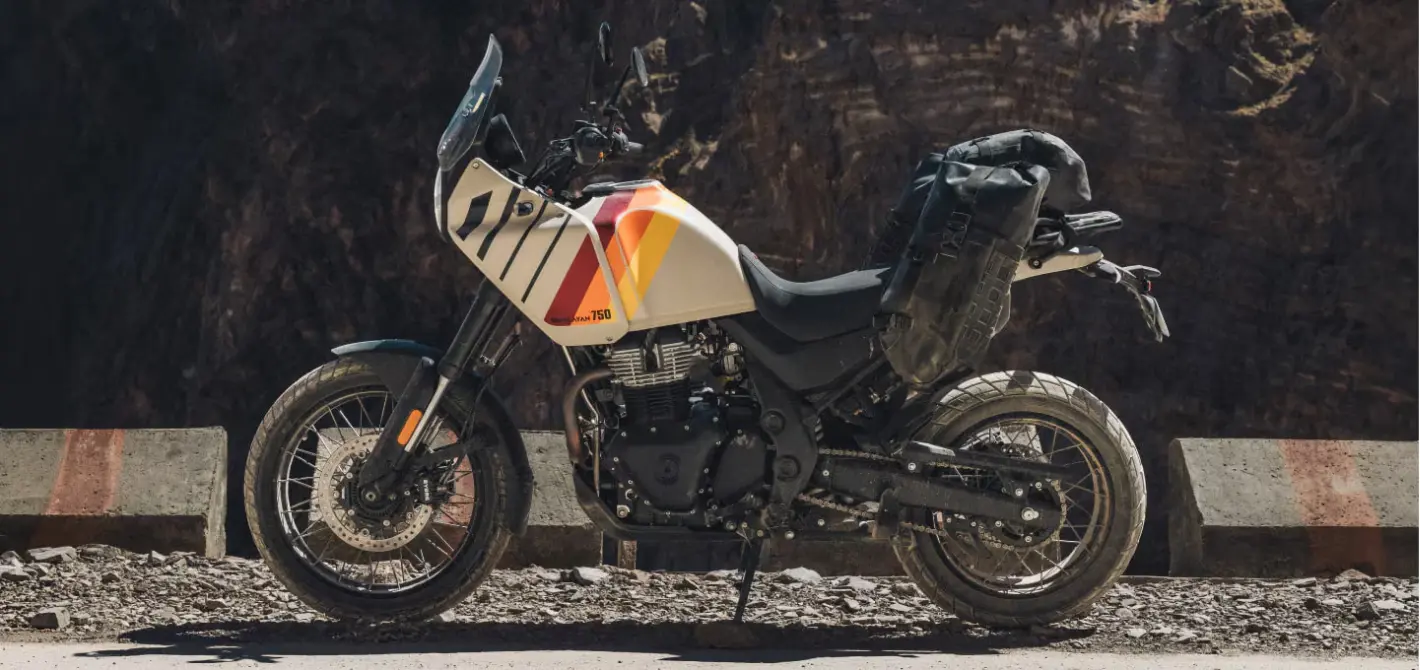
The Royal Enfield Himalayan 750 now has an official India specification, and no Himalayan before it has had this much riding on it. It moves the Himalayan nameplate up from 450cc, gives Royal Enfield its first 750cc model in the current range, and is the brand’s first motorcycle with a six axis IMU. It also enters a class where Honda, Kawasaki and BMW set the benchmarks.
The global reveal came at EICMA in Milan on 3 November. Royal Enfield’s India website now lists the full specification and has opened test ride registrations, while the brand’s Motoverse festival runs from 27 to 29 November in Vagator, Goa. India ex showroom prices had not been announced at the time of writing.
Himalayan 750 at a Glance
| Parameter | Royal Enfield Himalayan 750 |
|---|---|
| Engine | 743cc, air oil cooled, SOHC parallel twin |
| Peak power | 55 PS (40.5 kW) at 7,000 rpm |
| Peak torque | 63 Nm at 5,000 rpm |
| Gearbox | 6 speed, wet multi plate clutch |
| Kerb weight | 224 kg (90% fuel and oil) |
| Seat height | 815 mm |
| Ground clearance | 205 mm |
| Fuel tank | 17.8 litres |
| Wheels | 19 inch front, 17 inch rear, tubeless |
| Colours | Antarctic Silver, Siberia White, Viking Bronze, Aztec Green, Tectonic Black |
Source: Royal Enfield India official website
Why This Motorcycle Matters More Than Its Spec Sheet
Royal Enfield already leads the middleweight market in India with its 648cc twin family, and the Himalayan 450 proved it can build a modern adventure motorcycle that sells. What it lacked was a step up for Himalayan owners who wanted more.
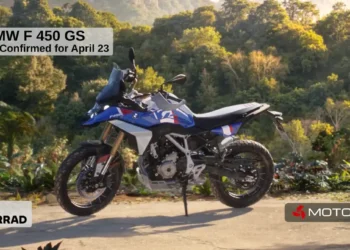
That gap has been real. A rider outgrowing the Himalayan 450 had three options: the BMW F 450 GS, now listed from ₹5.35 lakh, the Honda NX500 at ₹7.44 lakh, or the Kawasaki Versys 650 at ₹8.63 lakh (all ex showroom). Two of them cost well over double the Himalayan 450.
The Himalayan 750 fills that gap: a road biased tourer that still handles broken tarmac and gravel, built to keep loyal Himalayan owners from moving to Japanese and German rivals.
Himalayan 750 Engine: A New Twin, Not a Bored Out 650
The 743cc motor is an all new engine, not an enlarged version of the 648cc unit. Its specification shows where Royal Enfield’s priorities lie.
| Engine Parameter | Specification |
|---|---|
| Configuration | Inline twin cylinder, 4 stroke, SOHC |
| Cooling | Air and oil cooled |
| Bore x stroke | 83.5 mm x 67.8 mm |
| Compression ratio | 9.5:1 |
| Max power | 55 PS at 7,000 rpm |
| Max torque | 63 Nm at 5,000 rpm |
| Torque delivery | 90% of peak available from 3,500 rpm |
| Idle speed | 1,300 rpm |
| Engine oil | Fully synthetic 10W50 (API SL, JASO MA2) |
| Starting | Electric |
Three details stand out. The 90% torque claim means roughly 57 Nm from 3,500 rpm, exactly where a loaded tourer lives on highways and ghat sections. The 9.5:1 compression ratio is conservative, favouring fuel tolerance and longevity over peak output. And Royal Enfield chose air and oil cooling over the liquid cooling of its Sherpa 450 engine.
On paper, that is the most significant engineering trade off. Dropping the radiator, hoses and water pump cuts complexity, cost and vulnerable parts on trails. Ownership will reveal how the twin handles heat in slow summer traffic.
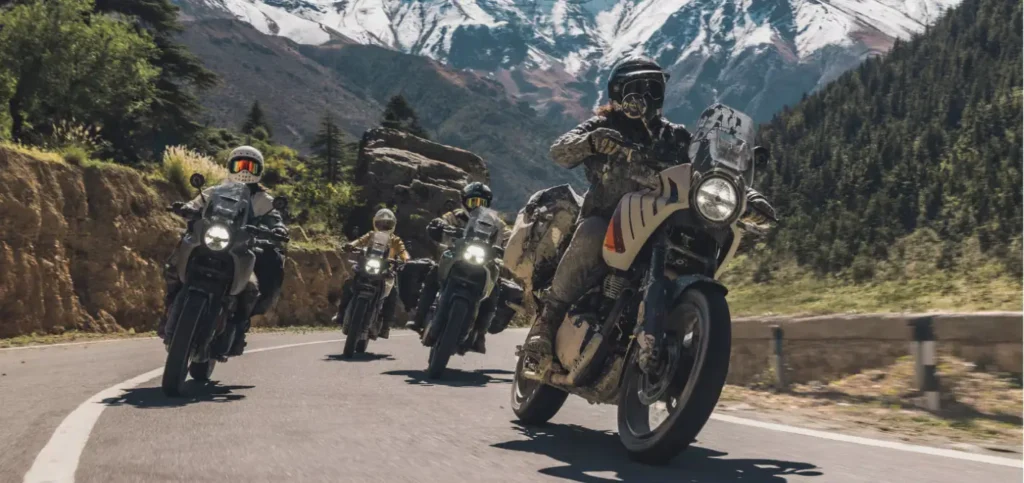
Chassis, Suspension and Brakes Built for Long Distances
| Hardware | Specification |
|---|---|
| Frame | Box section steel spine with pressed steel outriggers, engine as stressed member |
| Front suspension | 43 mm Showa upside down fork, 190 mm travel, adjustable compression and rebound damping |
| Rear suspension | Showa monoshock with linkage, 175 mm travel, adjustable preload and rebound |
| Front brakes | Twin 280 mm floating discs, 2 piston floating calipers |
| Rear brake | 255 mm disc, 2 piston floating caliper |
| ABS | Dual channel cornering ABS, rear switchable |
| Tyres | 110/80 R19 front, 150/70 R17 rear, tubeless |
| Wheelbase | 1,522 mm |
| Rake / trail | 27.9 degrees / 121.5 mm |
| Dimensions (L x W x H) | 2,185 x 840 x 1,450 mm |
| Payload capacity | 194 kg |
The wheel sizes tell the story. The Himalayan 450’s 21 inch front suits deep off road work, while the 750’s 19 inch front sharpens tarmac steering and opens a wide tyre choice, since 110/80 R19 and 150/70 R17 are among the most common adventure touring sizes globally.
The 194 kg payload rating matters in India, where rider, pillion and luggage often travel together, and adjustable Showa suspension lets owners tune for solo or two up riding.
Electronics: The Biggest Technology Leap in Royal Enfield History
Until now, Royal Enfield motorcycles offered only basic rider aids. The Himalayan 750 changes that.
| Feature | Himalayan 750 |
|---|---|
| IMU | Six axis |
| Riding modes | Five (Road, Road Sport, Rain, Trail, Custom), adjusting ABS and traction control |
| Traction control | Lean sensitive, four levels (Low, Medium, High, Off) |
| Cruise control | Standard |
| TPMS | Standard |
| Display | 4 inch circular TFT (Tripper Dash) with full map Google navigation |
| Connectivity | Bluetooth, Wi-Fi, Wingman 2.0 with 4G and GPS |
| Charging | Dual Type-C USB (27 W and 10 W) |
| Lighting | 7 inch LED headlight, self cancelling indicators |
| Security | Key based immobiliser |
| Windscreen | Five positions, 60 mm total adjustment, adjustable while riding |
Cornering ABS, lean sensitive traction control, cruise control and TPMS as standard equipment stand out in this class. Wingman 2.0 adds built in 4G and GPS for remote tracking and vehicle data, though those remote features depend on mobile network coverage and may be limited in remote regions without signal.
The display is the one area that does not move forward. The 4 inch circular TFT looks identical to the Himalayan 450’s unit, while the BMW F 450 GS offers a 6.5 inch screen.
Himalayan 750 vs Himalayan 450: What Actually Changes
| Parameter | Himalayan 750 | Himalayan 450 |
|---|---|---|
| Engine | 743cc air oil cooled twin | 452cc liquid cooled single |
| Peak power | 55 PS | 40 PS |
| Peak torque | 63 Nm | 40 Nm |
| Kerb weight | 224 kg | 196 kg |
| Seat height | 815 mm | 825 mm (adjustable to 845 mm) |
| Ground clearance | 205 mm | 230 mm |
| Fuel tank | 17.8 litres | 17 litres |
| Front wheel | 19 inch | 21 inch |
| Suspension travel (F/R) | 190 / 175 mm | 200 / 200 mm |
| Cornering ABS, IMU, cruise control | Yes | No |
The 750 adds 15 PS and 23 Nm, a 57% torque gain, plus a far richer electronics package. In return it carries 28 kg more and gives up clearance and travel. Going by the published specification, the 450 is the sharper trail tool, while the 750 is built as the stronger long distance machine.
Variants, Colours and the GIVI Touring Pack
At EICMA, Royal Enfield revealed five colours split across three configurations. Aztec Green and Tectonic Black come with cast alloy wheels. Siberia White and Viking Bronze get cross spoke wheels with tubeless tyres. Antarctic Silver is the flagship, carrying a GIVI touring package that includes a top box, hard panniers, heated grips, hand guards and an aluminium skid plate.
| Configuration (UK) | Wheels | UK Price |
|---|---|---|
| Aztec Green | Cast alloy | £6,999 |
| Siberia White / Viking Bronze | Cross spoke, tubeless | £7,299 |
| Antarctic Silver with GIVI pack | Cross spoke, tubeless | £8,699 |
UK prices reflect market specific taxes, including 20% VAT, and market specific equipment, so a currency conversion is not a reliable estimate of an India price. The India kerb weight is about 1 kg above the European figure, mostly due to the mandatory saree guard.
Himalayan 750 Price and Positioning in India
Royal Enfield had not announced India ex showroom pricing at the time of writing. Whatever the final number, the competitive map around it is already fixed.
| Motorcycle | Engine | Peak Power | Peak Torque | Ex Showroom Price |
|---|---|---|---|---|
| Royal Enfield Himalayan 450 | 452cc single | 40 PS | 40 Nm | From ₹3.08 lakh |
| BMW F 450 GS | 420cc twin | 48 PS | 43 Nm | From ₹5.35 lakh |
| Honda NX500 | 471cc twin | 48 PS | 43 Nm | ₹7.44 lakh |
| Kawasaki Versys 650 | 649cc twin | 67 PS | 61 Nm | ₹8.63 lakh |
| Royal Enfield Himalayan 750 | 743cc twin | 55 PS | 63 Nm | Not yet announced |
Power shown in PS, converted from OEM kW or hp ratings and rounded. BMW price as per BMW Motorrad India price list effective 10 November 2026.
The Himalayan 750 outmuscles the BMW and Honda on displacement, power and torque, and matches the Kawasaki’s 61 Nm with 63 Nm of its own. The pricing challenge is to land close enough to the F 450 GS to make the BMW look small, while leaving a sensible gap above the Himalayan 450. Test ride registrations are open on Royal Enfield’s India website.
Quick Pros & Cons
Pros
- 63 Nm twin with 90% of peak torque from 3,500 rpm suits Indian touring
- Six axis IMU, cornering ABS, lean sensitive traction control and cruise control as standard
- Adjustable Showa suspension at both ends and 194 kg payload rating
- Built in 4G connectivity through Wingman 2.0
- 19/17 inch wheel sizes give a wide choice of touring tyres
- Accessible 815 mm seat height for a big adventure tourer
- Backed by Royal Enfield’s nationwide service network
Cons
- 224 kg kerb weight demands care off road and at low speeds
- 205 mm ground clearance is lower than the Himalayan 450’s 230 mm
- 4 inch TFT is small next to the F 450 GS’s 6.5 inch screen
- Air and oil cooling still needs to prove itself in hot city traffic
- Standard seat is not adjustable without accessories
What Buyers Should Weigh Before Booking
Himalayan 450 owners should ride both bikes back to back. The extra 28 kg shows up when parking or picking the bike up on a trail, not on the move. Pillion tourers will value the 750’s torque and payload more than the 450’s clearance. Riders stepping up from a 350 should note that the 815 mm seat is friendly, but the weight is closer to a Versys 650, so check the accessory seat options during the test ride.
Frequently Asked Questions
1. Has the Royal Enfield Himalayan 750 launched in India? Royal Enfield has published the India specification and opened test ride registrations on its website. India ex showroom prices had not been announced at the time of writing. Motoverse 2026 runs from 27 to 29 November in Vagator, Goa.
2. What engine powers the Himalayan 750? It uses an all new 743cc, air and oil cooled, SOHC parallel twin producing 55 PS at 7,000 rpm and 63 Nm at 5,000 rpm, paired with a 6 speed gearbox.
3. What is the kerb weight and seat height of the Himalayan 750? The India specification lists a kerb weight of 224 kg with 90% fuel and oil, and a seat height of 815 mm. Accessory seats can raise or lower the seat.
4. Does the Himalayan 750 get cruise control and traction control? Yes. Cruise control, lean sensitive traction control with four levels, cornering ABS, five riding modes and TPMS are all standard, enabled by a six axis IMU.
5. How does the Himalayan 750 differ from the Himalayan 450? It adds a twin cylinder engine with 15 PS and 23 Nm more, a full electronics suite and a 19 inch front wheel. It weighs 28 kg more and has 25 mm less ground clearance.
6. Which motorcycles will the Himalayan 750 compete with? Its main rivals are the BMW F 450 GS, Honda NX500 and Kawasaki Versys 650, while also sitting above Royal Enfield’s own Himalayan 450.
Motors77 Verdict
On specification, the Himalayan 750 is the most complete motorcycle Royal Enfield has built. It matches or beats its rivals on displacement, torque and standard electronics, and its hardware is chosen with Indian touring in mind: strong midrange torque, a high payload rating, adjustable Showa suspension and a common tyre size. Air and oil cooling and the small TFT will divide opinion, and 224 kg makes it a tourer first and a trail bike second.
The specification makes a strong case. Ride quality, heat management and the India price will decide whether it delivers. If the brand repeats what it did with the 650 twins and prices the Himalayan 750 aggressively, the middleweight adventure class in India will have a new reference point.