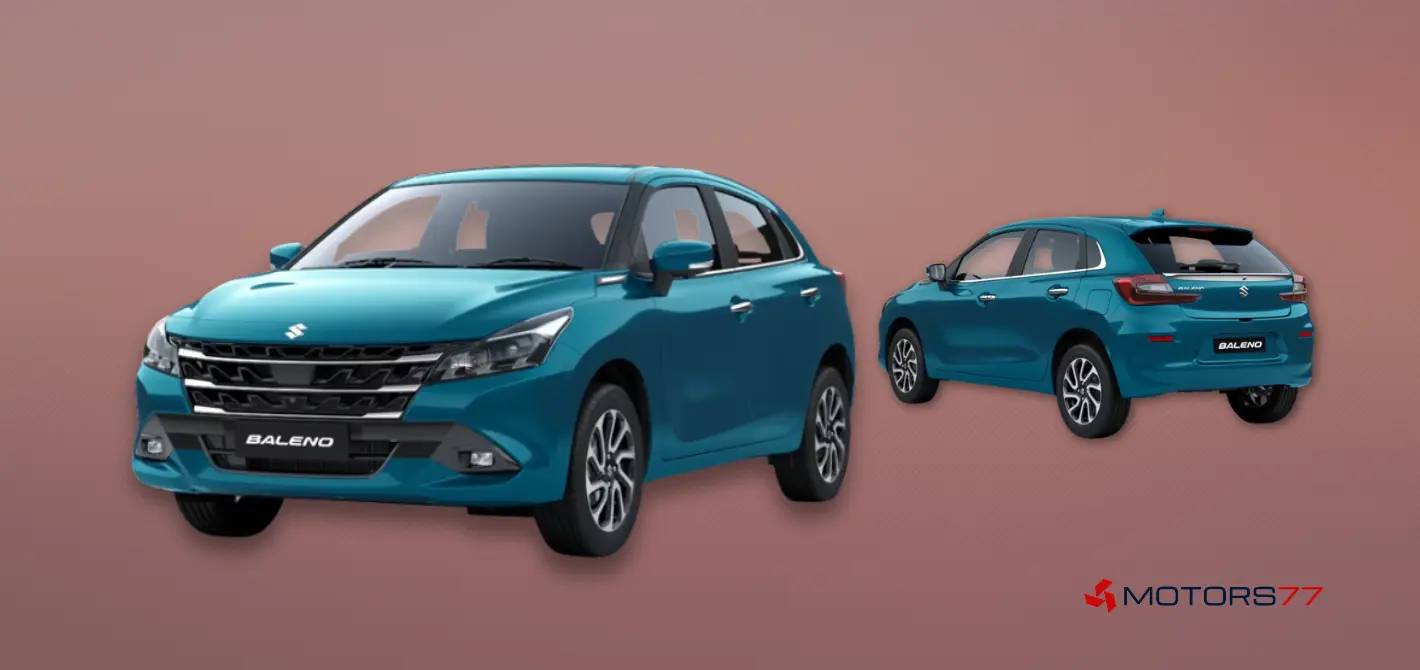
The Baleno facelift has arrived at Rs 6.10 lakh, ex-showroom, and buried inside the launch is a fact Maruti has not dwelt on. The new engine has fewer cylinders and less power than the one it replaces. The outgoing four cylinder made 90 PS. The new three cylinder makes 82.93 PS.
Roughly 7 PS gone from India’s best selling premium hatchback, in a segment where buyers read spec sheets closely. Maruti calls the unit the Advanced Z12E and moves swiftly on to glamour and technology. So the question is whether the Baleno facelift has become a lesser car, or whether that missing power bought something worth having.
It bought quite a lot, and that trade is the story.
Baleno facelift price and variants
The Baleno facelift launched at a festive introductory Rs 6.10 lakh, ex-showroom, for the entry Sigma petrol manual, about Rs 10,000 more than the outgoing base variant. A modest increase given what has been added.
There is a caveat the coverage has glossed over. Maruti has confirmed only the Sigma price. The rest of the ladder is not published at the time of writing, and figures circulating for the top variant are estimates rather than announced prices.
| Baleno facelift variant | Powertrains offered | Price, ex-showroom |
|---|---|---|
| Sigma | Petrol MT | Rs 6.10 lakh, confirmed |
| Delta | Petrol MT and AMT, CNG MT | Not announced |
| Zeta | Petrol MT and AMT, CNG MT | Not announced |
| Alpha | Petrol MT and AMT | Not announced |
| Alpha Optional | Petrol MT and AMT, adds ADAS | Not announced |
Bookings are open at Rs 11,000 through Nexa. Confirm the figure for your variant with a dealer, because this range is largely unpriced.
The engine, and what the missing power actually bought
The centrepiece of the Baleno facelift is Maruti’s 1,197cc Z12E, a naturally aspirated three cylinder petrol familiar from the Swift and Dzire. Maruti states 61 kW, which works out to 82.93 PS at 5,700 rpm, and 112.4 Nm at 4,500 rpm.
Be careful with the numbers elsewhere. Figures of 82 bhp, 83 hp and even 89 hp are circulating for this engine. The 89 hp figure is wrong. Maruti’s stated output is 61 kW, and the correct conversions are 82.93 PS or about 81.8 bhp. Some outlets quote PS while labelling it hp.
| Powertrain | Outgoing K12N | New Z12E | CNG |
|---|---|---|---|
| Configuration | 1.2 litre, 4 cylinder | 1.2 litre, 3 cylinder | 1.2 litre, 3 cylinder |
| Power | 90 PS | 82.93 PS at 5,700 rpm | 70 PS |
| Torque | 113 Nm | 112.4 Nm at 4,500 rpm | 102 Nm |
| Gearbox | 5MT, 5AMT | 5MT or 5 speed AGS | 5MT |
Maruti quotes 23.80 kmpl for the manual and 24.77 kmpl for the automatic, gains of 6.4 and 7.9 percent, while CNG improves 9.8 percent to 33.61 km per kg. The engine adds Dual VVT and idle start stop.
So the Baleno facelift trades about 7 PS for a near 8 percent efficiency gain. The lost peak power matters mainly when the engine is worked hard, during a committed overtake or a long climb. Peak torque barely moved, dropping 0.6 Nm, and now arrives with a tune aimed at low speed usability, the figure that governs how a car feels in traffic.
Set the two side by side and the shape of the trade is clear.
| Outgoing versus Baleno facelift | Outgoing | 2026 |
|---|---|---|
| Efficiency, petrol MT | 22.35 kmpl | 23.80 kmpl |
| Efficiency, petrol AMT | 22.94 kmpl | 24.77 kmpl |
| Efficiency, CNG | 30.61 km/kg | 33.61 km/kg |
| Level 2 ADAS | Not offered | Alpha Optional |
| Ventilated front seats | No | Yes |
| 360 degree camera | No | Yes |
| Airbags | Six | Six |
The outgoing figures are the previous car’s published numbers, consistent with the gains Maruti claims.
Why does this matter?
Here is the gap between the official line and the fuller picture, and it is not really about the Baleno at all.
Maruti’s framing is aspirational, built around a campaign called Dare to go Glam, and Senior Executive Officer Partho Banerjee noted that one in three premium cars sold in India is a Baleno.
The engineering says something more pragmatic. Maruti has decided that in this segment, efficiency and features win buyers and peak power does not. Rather than defend a headline number, it dropped a cylinder, took the paper loss, and spent the savings on equipment that shows up on the showroom comparison sheet. It is a bet that a buyer cross shopping an i20, an Altroz or a Glanza notices a driver assistance suite and an efficiency figure long before they notice 7 PS.
There is a second, quieter consequence. The move gives Maruti engineering commonality, because the Z12E family already serves the Swift and Dzire. Consolidating one petrol engine across three of its highest volume cars could simplify Maruti’s powertrain strategy as emission rules tighten. Maruti has not framed the switch in these terms, so this reads as commercial logic rather than a stated motive.
One caveat sits outside what any specification sheet can settle. Three cylinder engines are inherently less balanced than four cylinder units, and refinement at idle and at higher revs is where they typically give ground. How the Z12E behaves in this tune is a question extended real world use will answer, and it is the variable most worth watching.
Features, and the segment first that matters most
The Baleno facelift makes its biggest leap inside, and the headline is genuine. It becomes the first premium hatchback with a Level 2 ADAS suite, combining radar and camera sensing. Maruti lists eight functions: Advanced Emergency Braking, Lane Keep Assist, Lane Departure Prevention, Lane Departure Warning, Adaptive Cruise Control, High Beam Assist, Vehicle Sway Warning and Forward Collision Warning. It is reserved for the top Alpha Optional variant.
Other additions higher up include ventilated front seats, a cooled wireless charging pad, a Clarion audio system, a 360 degree camera and a tyre pressure monitor. The 9 inch SmartPlay Pro Plus touchscreen carries over higher up, with a 7 inch unit on Delta.
Maruti has resisted digitising everything. The Baleno facelift keeps analogue dials with a colour display between them, physical climate buttons and the head up display. In a market rushing toward screens, leaving the climate controls alone is a decision owners appreciate two years in.
Two omissions persist, both notable at this price: still no sunroof, which rivals offer and Indian buyers want, and still no rear centre armrest.
On safety, six airbags are standard across every variant, with ABS, EBD, ESP and hill hold. The pre facelift Baleno scored four stars at Bharat NCAP, not five, and a rating for the updated car is not published.
Design
The exterior changes are deliberately restrained. The front gets a wider, taller grille with a three dimensional pattern and chrome detailing, a repositioned Suzuki badge and revised LED projector headlamps. The side profile and roofline carry over, and the 16 inch alloys get a reworked design. A new Enigmatic Teal shade joins a seven colour palette. Maruti has not tried to reinvent a car that sells on familiarity, and that restraint is defensible.
Confirmed versus pending
| Item | Status |
|---|---|
| Rs 6.10 lakh Sigma price | Confirmed |
| 61 kW, 82.93 PS, 112.4 Nm | Confirmed |
| Efficiency 23.80, 24.77, 33.61 km/kg | Confirmed |
| Level 2 ADAS on Alpha Optional | Confirmed |
| Five variants, new Alpha Optional | Confirmed |
| Delta, Zeta, Alpha, Alpha Optional prices | Not announced |
| CNG on Delta and Zeta, manual only | Confirmed, no CNG automatic |
| Bharat NCAP rating for the facelift | Not published, previous car four stars |
| Refinement of the three cylinder | To be assessed in extended use |
One point is worth settling, because several outlets have reported a CNG automatic as a Maruti first. Maruti’s own configurator lists the S-CNG in exactly two forms, Delta CNG MT and Zeta CNG MT. There is no CNG automatic in the Baleno facelift range.
Quick Pros and Cons
Pros
- Efficiency up 6.4 to 9.8 percent, a gain owners feel monthly
- Segment first Level 2 ADAS with adaptive cruise and emergency braking
- Six airbags, ABS with EBD and ESP with hill hold on every variant
- Only about Rs 10,000 more than the outgoing base variant
- Ventilated front seats, cooled wireless charger and 360 degree camera
- Physical climate controls and analogue dials retained
Cons
- Down roughly 7 PS on the engine it replaces
- Three cylinder refinement remains to be assessed in extended use
- Still no sunroof and no rear centre armrest
- ADAS locked to the single top Alpha Optional variant
- Most of the variant price ladder remains unannounced
- Previous generation carried four Bharat NCAP stars, not five
Frequently Asked Questions
1. What is the Baleno facelift price in India? The Baleno facelift starts at Rs 6.10 lakh, ex-showroom, for the Sigma petrol manual, a festive introductory price. Maruti has not yet announced prices for the Delta, Zeta, Alpha and Alpha Optional variants.
2. How much power does the new Baleno engine make? Maruti states 61 kW, equal to 82.93 PS, at 5,700 rpm and 112.4 Nm at 4,500 rpm from the 1,197cc Z12E three cylinder petrol. Figures of 89 hp reported elsewhere are incorrect.
3. Is the new Baleno less powerful than the old one? Yes. The outgoing K12N four cylinder made 90 PS and 113 Nm. The new three cylinder makes 82.93 PS and 112.4 Nm, so power drops about 7 PS while torque is nearly unchanged.
4. Then why did Maruti change the engine? Efficiency and commonality. Claimed efficiency improves 6.4 percent on the manual, 7.9 percent on the automatic and 9.8 percent on CNG, and the Z12E is shared with the Swift and Dzire.
5. Does the Baleno facelift get a CNG automatic? No. Maruti lists the S-CNG only as Delta CNG MT and Zeta CNG MT, so CNG comes with a five speed manual. Reports of a CNG automatic are incorrect.
6. Does the Baleno facelift get ADAS? Yes, and it is a segment first. The Level 2 suite uses radar and camera sensing across eight functions including adaptive cruise control, lane keep assist and advanced emergency braking, offered only on the top Alpha Optional variant.
7. Is the Baleno facelift safe? Six airbags, ABS with EBD and ESP with hill hold are standard on all variants, with a 360 degree camera and tyre pressure monitor higher up. The previous generation scored four stars at Bharat NCAP. A rating for the facelift is not published.
8. Does it finally get a sunroof? No. The Baleno facelift continues without a sunroof and without a rear centre armrest, both notable omissions at this price.
Motors77 Verdict
The Baleno facelift looks worse on the spec sheet and is almost certainly better to own, which is a harder thing to sell than a bigger number.
Losing 7 PS reads badly in a comparison table. For most owners, though, an efficiency improvement of this size will register more often than the difference in peak power, because the conditions that expose 7 PS are occasional and fuel costs are not. Maruti also protected the figure that shapes everyday driving by keeping torque essentially intact at 112.4 Nm.
What lifts this beyond a routine mid cycle update is the equipment. Level 2 ADAS in a premium hatchback is a genuine segment first, six airbags on every variant is the right baseline rather than a marketing line, and holding the entry price to roughly Rs 10,000 above the outgoing car makes the package easy to recommend on value. Keeping physical climate controls and real dials, while the industry hides both in touchscreens, is good sense.
The reservations are real. Refinement is where this engine will ultimately be judged. ADAS sitting only on the unpriced flagship limits how many buyers get it. The absent sunroof hands rivals an easy talking point. And with most of the ladder unannounced, the value question cannot be settled today.
The Baleno facelift is a well judged update that spent its budget where owners feel it rather than where spec sheets flatter it. Refinement and real world drivability are the remaining variables, and a detailed driving assessment will follow.