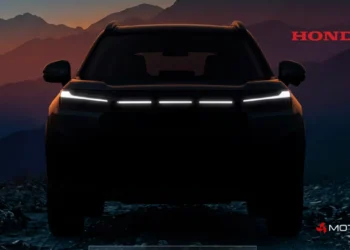
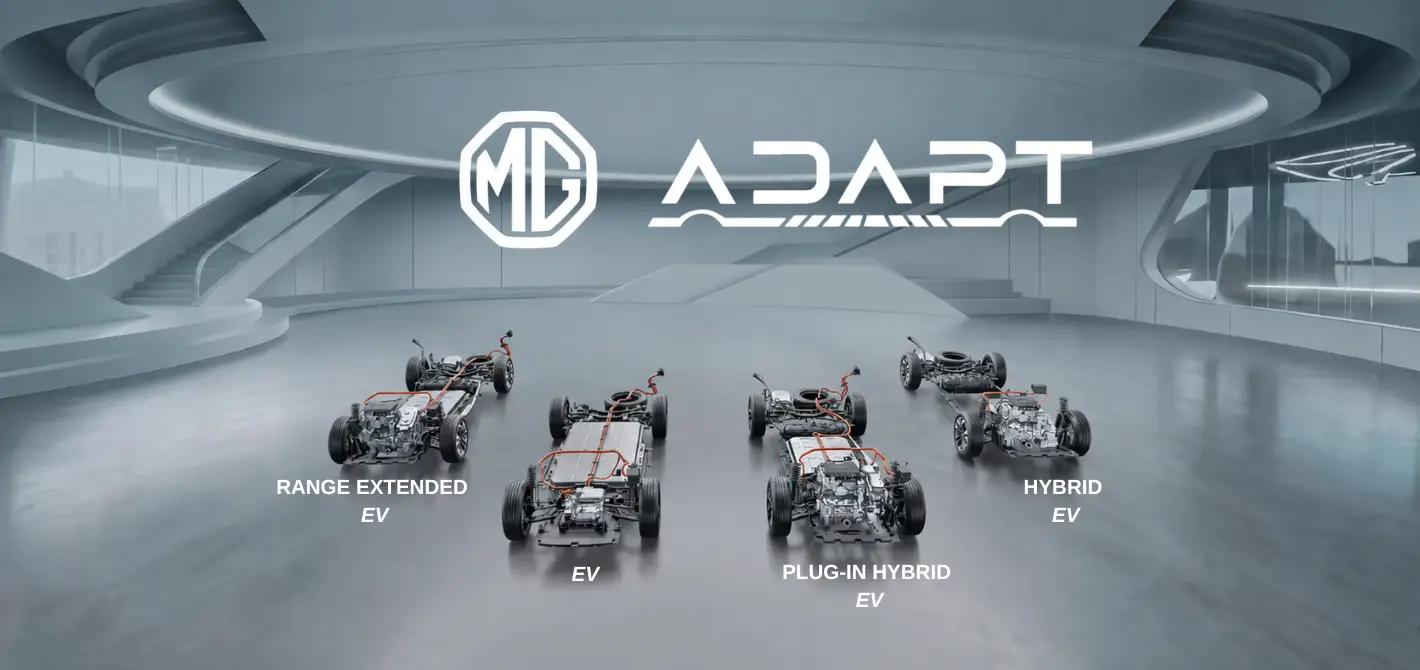
Everyone watching JSW MG Motor India on 16 July 2026 expected a car. Spy shots of the Starlight based EV and plug in hybrid SUVs had circulated for weeks, and the event pointed at a new energy vehicle reveal. What MG put on stage was not a vehicle, but the floor underneath one.
The MG ADAPT platform is the company’s new modular architecture, and revealing the platform before the product is the most telling decision in the announcement. MG had a finished SUV to show, and showed engineering instead. Understanding why tells you how MG intends to fight the next three years in India, a very different plan from the EV only story it has told since the Windsor.
What the MG ADAPT platform actually is
The MG ADAPT platform’s name is an acronym for Advanced Drive Architecture Platform Technology. Some coverage renders it “Advance,” and MG’s naming has not been consistent across markets, so treat the exact wording as the one point worth confirming. The substance is not in doubt.
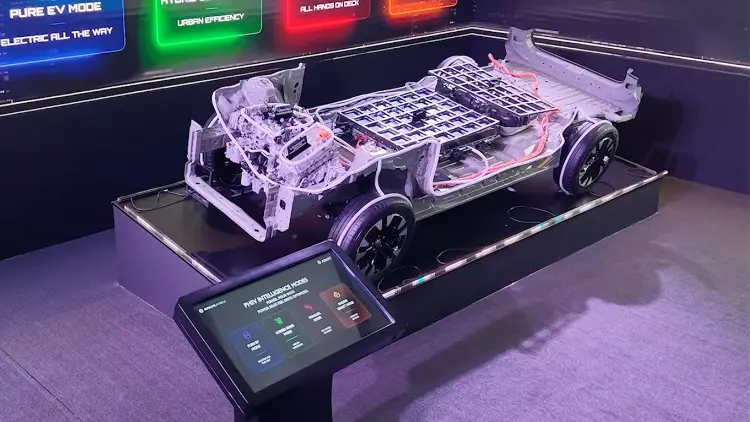
MG calls it India’s first multi new energy vehicle platform. In plain terms, it is one base architecture engineered to carry four powertrain types without redesigning the car beneath each: a pure EV, a strong hybrid, a plug in hybrid, and a range extender electric vehicle. There will seemingly be no pure petrol or diesel car on it at all.
That matters more than it appears. Most carmakers pick a lane. A dedicated EV skateboard does electric brilliantly but cannot take an engine, while a converted combustion platform takes an engine easily and compromises the EV. The MG ADAPT platform is built to do all four, an expensive choice that only makes sense if MG expects Indian demand to fragment across several energy types rather than converging on one.
The hybrid hardware
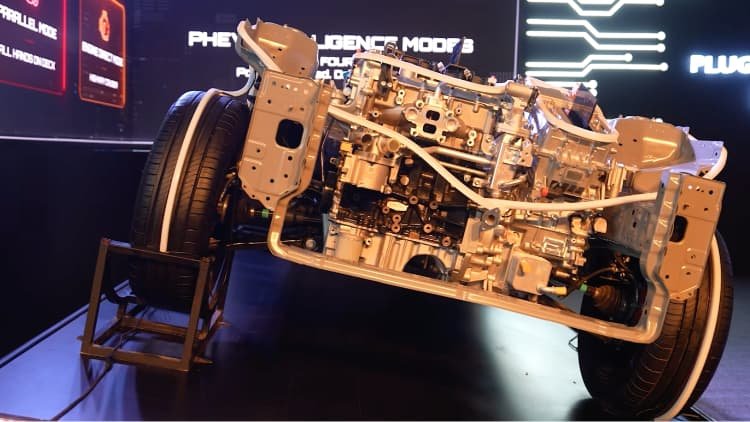
The centrepiece of the MG ADAPT platform is its dedicated hybrid system. MG has detailed the components while holding back the numbers.
| MG ADAPT hybrid system | Detail |
|---|---|
| Engine | New naturally aspirated petrol, hybrid dedicated |
| Thermal efficiency | Up to 43 percent claimed |
| Transmission | Dedicated hybrid transmission with electromagnetic e-clutch |
| e-clutch response | Claimed four times quicker than conventional |
| Drive unit | 10-in-1 unit, permanent magnet synchronous motor plus 2 stage reduction gearbox |
| Driving modes | Parallel, Series, Engine Direct, Pure EV |
The thermal efficiency figure is the one to sit with. A conventional petrol engine converts roughly 20 to 35 percent of its fuel energy into useful work. MG claims up to 43 percent here, achieved by tuning the engine to run only in its efficient band and letting the electric side handle the rest. That is the difference between a hybrid that saves fuel and one that merely carries a battery.
The four drive modes decide what powers the wheels. Pure EV runs on the battery alone for city crawling. Series uses the engine as a generator while the motor drives. Parallel uses both for stronger acceleration. Engine Direct lets the engine drive alone, most efficient at steady highway speeds. An intelligent energy management system switches automatically.
Why does this matter?
Here is the gap between the tidy official line and the fuller picture. MG’s public story is four powertrains, maximum flexibility, future ready. True, but incomplete. The more interesting question is why MG needs this platform now, and the answer is in the sales data.
JSW MG Motor India registered 31,741 electric passenger vehicles in the first half of 2026, up 18 percent year on year, but slower than the broader EV market. The Windsor made MG a serious EV player, yet the segment is expanding faster than MG’s share of it. An EV only strategy in a market where EVs remain a single digit slice of total sales has a ceiling, and MG has evidently decided it is nearing it.
Managing Director Anurag Mehrotra was direct: India’s target of 30 percent new energy vehicles by 2030 will not be reached through battery electric vehicles alone, because the country holds distinct groups of buyers. Some will move to a full EV immediately. Others want to take one step at a time, and a hybrid suits them.
That is the real thesis behind the MG ADAPT platform. MG is betting India’s shift to electrified vehicles will not be a clean switch from petrol to battery, but a messy decade in which strong hybrids, plug in hybrids and range extenders all sell alongside pure EVs to buyers with different anxieties and different access to charging. Rather than build a car for each, MG has built one platform that can become any of them. A hedge against uncertainty, engineered into the chassis.
The range extender is the quiet signal
Buried in the MG ADAPT platform’s four powertrain list is the one that deserves the most attention, because it is the rarest in India. A range extender electric vehicle, or REEV, always drives its wheels with the electric motor. The petrol engine never touches the wheels, existing solely as an onboard generator that recharges the battery when it runs low.
The effect is an EV like drive with the range anxiety removed. You get instant, quiet electric drive, but when the battery depletes on a long trip, the engine tops it up rather than leaving you hunting for a charger. In a country where highway charging is still thin outside the major corridors, that is a clever answer few rivals offer. Including REEV capability shows MG thinking past today’s charging reality, and it is the most forward looking element of the announcement, mostly skipped by headlines.
The connection to MG’s global technology
The MG ADAPT platform does not exist in isolation. In early July 2026, MG’s global arm used its UK technology day to reveal a next generation Plug in Hybrid+ system and a SolidCore semi solid state battery for Europe, with a clear family resemblance to the India tech.
One difference is worth stating precisely. MG’s global Plug in Hybrid+ engines were described as turbocharged 1.1 litre and 1.5 litre units, while the India ADAPT hybrid engine has been described as naturally aspirated. Whether India gets a distinct engine, a detuned version, or the descriptions converge once full specifications appear is not yet clear. We will update when MG confirms the India hardware.
Which car comes first
The first model on the MG ADAPT platform is expected to be the India version of the Wuling Starlight 560, a seven seat SUV sold globally in both EV and PHEV forms. Test mules have run on Indian roads for months and the design was patented here in March 2026. Per MG’s guidance the EV comes first, in roughly a month, followed by the plug in hybrid on an unfixed timeline. The SUV will wear MG branding under a new India name, and MG has committed to one EV and one PHEV within FY2026-27, timed for the Diwali festive season, when much of the year’s car sales are made.
Confirmed versus expected
| Item | Status |
|---|---|
| MG ADAPT platform, four powertrain support | Confirmed by MG |
| Naturally aspirated hybrid engine, up to 43 percent efficiency | Confirmed by MG |
| Dedicated hybrid transmission, electromagnetic e-clutch, 10-in-1 drive unit | Confirmed by MG |
| One EV and one PHEV on the platform in FY2026-27 | Confirmed by MG |
| First model being the Starlight 560 EV and PHEV | Expected, not officially named by MG |
| Starlight 560 EV launch in about a month | Reported timeline, not a fixed date |
| India name for the SUV | Not announced |
| Engine displacement, cylinder count, power, battery specs | Not disclosed |
| Exact acronym wording, Advanced versus Advance | Reported inconsistently, worth confirming |
Quick Pros and Cons
Pros
- One platform genuinely supporting EV, strong hybrid, plug in hybrid and range extender
- Hybrid dedicated engine chasing a strong 43 percent thermal efficiency
- Range extender capability, a rare and practical answer to India’s charging gaps
- A dedicated hybrid transmission promising more natural driving than a typical e-CVT
- A clear multi energy strategy, backed by MG’s global Plug in Hybrid+ development
Cons
- A platform reveal, not a product. No prices, no dates, no full specs
- Engine size, power, battery capacity and range all withheld
- The naturally aspirated versus turbocharged engine question is unresolved
- REEV and strong hybrid derivatives have no confirmed launch timing
- Only the EV and PHEV are committed for FY2026-27, the rest is roadmap
Frequently Asked Questions
1. What is the MG ADAPT platform? MG India’s new modular vehicle architecture, described as India’s first multi new energy vehicle platform. A single base can underpin a pure EV, a strong hybrid, a plug in hybrid, or a range extender electric vehicle, with no pure petrol or diesel derivatives planned.
2. What does ADAPT stand for? Advanced Drive Architecture Platform Technology. Some outlets have rendered it “Advance,” so the exact wording is worth confirming with MG, but the four powertrain capability is not in dispute.
3. Which MG car will use the ADAPT platform first? The India version of the Wuling Starlight 560, a seven seat SUV, is expected to be first, with the EV before the PHEV. MG has confirmed one EV and one PHEV within FY2026-27 but has not officially named the model.
4. What is a range extender EV and why does it matter here? In a range extender, the electric motor always drives the wheels while the petrol engine works only as a generator to recharge the battery. It gives an EV like drive with far less range anxiety, suiting India’s uneven highway charging. It is one of the rarest powertrain types in the market.
5. How efficient is the ADAPT hybrid engine? MG claims up to 43 percent thermal efficiency for the hybrid dedicated petrol engine, well above the 20 to 35 percent typical of conventional petrol engines. Displacement, cylinder count and power output have not been revealed.
6. Is this the same as MG’s global Hybrid+ technology? Closely related. MG’s global arm revealed a Plug in Hybrid+ system and SolidCore battery in the UK in early July 2026. The India engine has been described as naturally aspirated and the global engines as turbocharged, so the exact hardware relationship is not yet clear.
7. When will cars on the ADAPT platform launch? MG has committed to one EV and one PHEV within FY2026-27, with the Starlight 560 EV expected in around a month. Strong hybrid and range extender timelines have not been announced.
Motors77 Verdict
The most telling thing about the MG ADAPT platform launch is what MG chose not to show. It had a finished SUV, spy shot and patented, and showed the architecture instead. MG wants to be read as a technology company with a plan for the electrified decade, not a brand with one more SUV to sell.
The plan is sound. An EV only strategy in a market where electric cars remain a small slice of sales was always going to hit a ceiling, and MG’s own numbers, growing but trailing the wider EV market, show it nearing that ceiling. A platform that can build an EV for the early adopter, a hybrid for the cautious, a plug in hybrid for the commuter with a home charger and a range extender for the highway anxious is a thoughtful answer to a fragmented market.
The caution is equally simple. This is a platform, not a car. There is no price, no on sale date, no confirmed name, and none of the numbers that decide whether a vehicle succeeds. The 43 percent efficiency claim is impressive and the four mode hybrid promising, but a platform sells nothing until a product sits on it at a price Indians will pay. The Starlight 560 EV, due in roughly a month, is where this stops being an engineering story and becomes a market one.
For now, the MG ADAPT platform is the clearest signal yet that MG has stopped treating electrification as a single bet. Whether execution matches ambition is a question the festive season will begin to answer.