Introduction
Royal Enfield 750cc: Royal Enfield is on the verge of its most significant platform expansion since the 648cc twins transformed the brand in 2018. Multiple spy shots, testing sightings, and industry sources confirm that an entirely new 750cc platform is in advanced development and the first motorcycle to use it, the Continental GT-R 750, could arrive as early as March 2026.
This isn’t merely an incremental upgrade. The 750cc platform represents Royal Enfield’s strategic push into genuine performance territory while maintaining the accessible, characterful motorcycling experience that has made the brand a global phenomenon. With an estimated 55-60 HP on tap, dual front disc brakes (a first for any Royal Enfield production motorcycle), and race-derived styling from the GT Cup series, the 750cc lineup could redefine what buyers expect from the Chennai-based manufacturer.
Here’s everything we know about Royal Enfield’s 750cc platform, the motorcycles it will power, and what it means for the Indian and global motorcycle markets.
The 750cc Platform: What We Know
Engine Architecture
The new 750cc engine is not a clean-sheet design. Instead, Royal Enfield has evolved its proven 648cc parallel-twin architecture the same powerplant that has delivered remarkable reliability across millions of kilometres in the Interceptor 650, Continental GT 650, Super Meteor 650, Shotgun 650, Bear 650, and Classic 650.
The 750cc displacement is achieved through increased bore and/or stroke dimensions, maintaining the fundamental engine layout that Royal Enfield’s UK-based technology centre in Leicester developed for the 650 twins. This approach offers several advantages: proven reliability, simplified manufacturing at Royal Enfield’s Oragadam facility in Tamil Nadu, and the ability to leverage existing supplier relationships and quality control processes.
Expected 750cc Engine Specifications:
| Parameter | Current 648cc | Expected 750cc |
|---|---|---|
| Displacement | 648cc | ~750cc |
| Configuration | Parallel-twin, 270° crank | Parallel-twin, 270° crank |
| Cooling | Air/oil-cooled | Air/oil-cooled |
| Power | 47 HP @ 7,250 rpm | 55-60 HP @ ~7,500 rpm |
| Torque | 52.3 Nm @ 5,250 rpm | ~60 Nm @ ~5,500 rpm |
| Gearbox | 6-speed | 6-speed |
| Clutch | Slipper/assist | Slipper/assist |
The engine is internally codenamed ‘R’ fitting, given that the first motorcycle to receive it will be the Continental GT-R 750, a name that directly references Royal Enfield’s GT Cup racing programme.
The A2 Licence Factor
Understanding why Royal Enfield capped the 648cc engine at 47 HP requires understanding European licensing regulations. The A2 motorcycle licence, available to riders aged 18 and above in most European countries, restricts power output to 35 kW (approximately 47 HP). By designing the 650 twins to this limit, Royal Enfield ensured the largest possible addressable market in Europe.
However, this also meant the 648cc engine was deliberately constrained. As Bike magazine noted during the 650 twins’ launch: “The crankshaft’s substantial bearing area and the hefty alloy crankcases suggest that the engine could comfortably deliver more power. Compression, capacity and revs could be raised on future models.”
The 750cc platform finally unleashes that latent potential. At 55-60 HP, these motorcycles will exceed A2 limits, but Royal Enfield’s dominant position in India (where no such restrictions exist) and growing presence in unrestricted markets like the Americas makes this a calculated and sensible evolution.
Confirmed Models in Development
Spy shots and industry sources indicate that Royal Enfield is developing at least four motorcycles on the 750cc platform:
1. Continental GT-R 750 (Launch: Q1 2026)
Status: Advanced testing complete; emissions certification likely finished
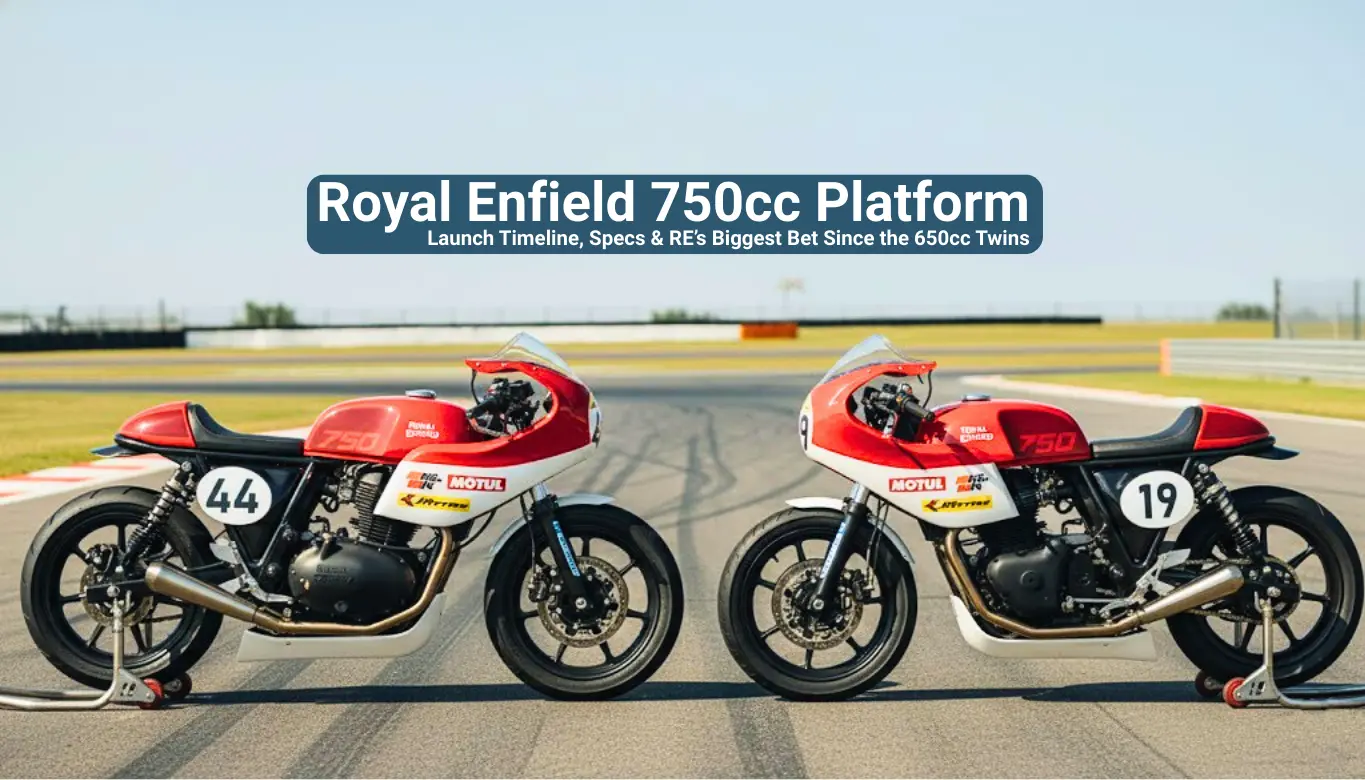
The Continental GT-R 750 will be Royal Enfield’s first faired production motorcycle ever. Drawing direct inspiration from the GT-R650 race bikes used in the Continental GT Cup series since 2021, this café racer brings race-derived styling to the road.
Key Features Identified from Spy Shots:
- Semi-fairing design: A retro-style bubble fairing extends below the fuel tank, with integrated turn indicators
- Dual front disc brakes: First for any Royal Enfield production motorcycle essential for the increased performance
- Alloy wheels: Standard fitment, enabling tubeless tyres
- Single-pod instrument cluster: Replacing the Continental GT 650’s iconic twin-pod setup this is likely to be the most controversial change among purists
- Clip-on handlebars: More aggressive riding position than the standard Continental GT
- Rear-set footpegs: Racing-derived ergonomics
The GT Cup racing programme has been instrumental in developing this motorcycle. The race-spec GT-R650 features a stainless steel exhaust that delivers a 12% power increase (from 47 to approximately 53 HP), stiffer suspension, JK racing tyres, and aerodynamic bodywork. The production GT-R 750 will incorporate learnings from multiple seasons of competitive racing.
Expected Price: ₹4.3-4.5 lakh (ex-showroom)
2. Continental GT 750 (Launch: H1 2026)
Status: Active testing
The unfaired Continental GT 750 maintains the classic café racer silhouette of the current Continental GT 650 but with the upgraded 750cc powertrain and mechanical improvements.
Key Features Identified from Spy Shots:
- Classic round headlamp: Retained from the GT 650
- Dual front disc brakes: Same upgraded braking system as the GT-R 750
- Alloy wheels: Tubeless tyre compatible
- Single-pod instrument cluster: Controversial departure from the twin-pod design
- Larger engine casing: Visibly bigger crankcase confirming displacement increase
- Clip-on handlebars: Traditional café racer ergonomics
This model will serve as the more accessible, road-focused option compared to the faired GT-R 750. It retains the Continental GT’s core appeal — that iconic café racer aesthetic — while delivering meaningfully improved performance.
Expected Price: ₹4.0-4.3 lakh (ex-showroom)
3. Interceptor 750 (Launch: H2 2026)
Status: Development phase
The Interceptor is Royal Enfield’s best-selling 650cc model globally, particularly in the UK where it has dominated the “big bike” category. An Interceptor 750 would follow the same formula relaxed ergonomics, classic roadster styling but with the more powerful engine.
Details remain limited, but the Interceptor 750 would likely feature:
- Wide, braced handlebars (roadster ergonomics)
- Dual front disc brakes
- Alloy wheels
- Classic teardrop fuel tank
- Diamond-quilted dual seat
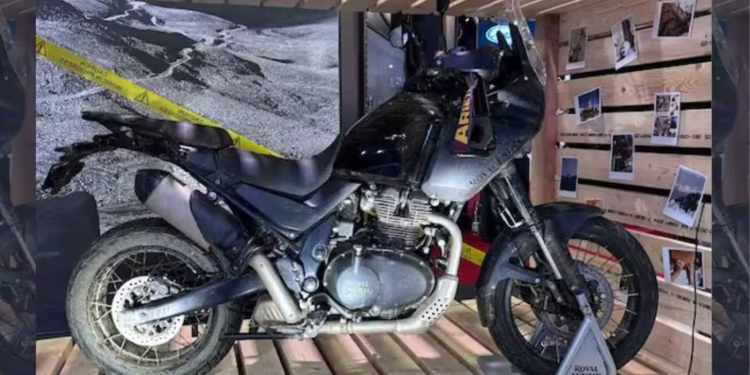
4. Himalayan 750 (Launch: Late 2026/2027)
Status: Early testing; pre-production prototype unveiled at EICMA 2025
Royal Enfield’s adventure motorcycle lineup currently includes the Himalayan 450, powered by a modern liquid-cooled single-cylinder engine. The Himalayan 750 would represent a significant step up, targeting long-distance adventure touring with the parallel-twin’s superior refinement and highway capability.
The pre-production prototype displayed at EICMA 2025 featured:
- 19-inch front and 17-inch rear wheels
- Knuckle guards
- Upswept exhaust
- Front windscreen
- Twin front disc brakes
- Rear luggage rack
The Himalayan 750 could become a genuine Triumph Tiger 900 alternative at a significantly lower price point.
Technical Deep Dive: Key Upgrades
Dual Front Disc Brakes
The most significant mechanical upgrade across the 750cc platform is the dual front disc brake system. Current 650 twins use a single 320mm front disc with a ByBre (Brembo subsidiary) twin-piston caliper. While adequate for the 47 HP output, the increased performance of the 750cc engine necessitates improved stopping power.
The dual-disc system likely uses:
- Two 320mm front discs
- Floating caliper design
- Bosch dual-channel ABS
This braking upgrade alone elevates the 750cc models to a level of mechanical sophistication previously unseen in Royal Enfield’s lineup.
Alloy Wheels as Standard
While the 650 twins offer alloy wheels on blacked-out variants, spy shots suggest alloy wheels will be standard across the 750cc range. Beyond the aesthetic benefit, alloy wheels enable:
- Tubeless tyre fitment (crucial for high-speed touring)
- Reduced unsprung weight (improving handling)
- Lower maintenance (no spoke tensioning required)
Suspension
Spy shots show telescopic front forks on test mules, though this could change for production. The Bear 650, Royal Enfield’s most recent 650cc launch, features inverted (USD) forks — it would be surprising if the flagship 750cc models didn’t receive similar treatment.
Rear suspension appears to retain the twin shock absorber setup, likely with gas-charged units featuring adjustable preload.
Instrument Cluster: The Controversial Change
Perhaps the most debated aspect of the 750cc models is the single-pod instrument cluster, replacing the Continental GT’s iconic twin-pod analog setup. The twin pods one for speed, one for rpm have been a defining visual element of the Continental GT since its introduction.
The single-pod design could be:
- The semi-digital unit from the Super Meteor 650
- The TFT display introduced with the Himalayan 450 and recently added to the Bear 650
Either way, this represents a significant departure from the retro-purist approach that defined the original Continental GT. Royal Enfield’s design team clearly believes the 750cc models warrant a more modern instrumentation solution — whether customers agree remains to be seen.
Racing Heritage: The GT Cup Connection
The Continental GT-R 750’s design language owes everything to Royal Enfield’s Continental GT Cup racing series, launched in 2021 in partnership with JK Tyre Motorsport and FMSCI.
The GT Cup uses specially prepared Continental GT-R650 race bikes featuring:
- Custom stainless steel exhaust: +12% power (47 to ~53 HP)
- Stiffer suspension: Thicker fork oil, firmer rear springs
- JK racing compound tyres
- Retro bubble fairing with integrated indicators
- Rear-set footpegs and clip-on handlebars
- 24kg weight reduction (from 202kg to ~178kg)
The series operates in Pro-Am format, with 24-bike grids split between professional and amateur riders. This accessible entry point into motorcycle racing has been transformative for the Indian motorsport scene.
As Adrian Sellers, Head of Royal Enfield’s Industrial Design Department, stated: “Anybody can be a racer.” The GT Cup embodies this philosophy and the GT-R 750 brings that experience to the road.
Crucially, Royal Enfield claims the race-spec GT-R650 modifications can be achieved for approximately ₹1 lakh on a standard Continental GT 650. This aftermarket accessibility has cultivated an engaged enthusiast community that will form the natural customer base for the GT-R 750.
Market Context: Royal Enfield’s Dominant Position
To understand the significance of the 750cc platform, we must examine Royal Enfield’s extraordinary market position.
The Numbers
- 250cc+ segment market share (India): Over 80%
- 500-800cc segment market share (India): 96%
- Global sales (2025): 1.18 million units (+26.7% YoY)
- India domestic sales (2025): First time exceeding 1 million units
- September 2025: Record 1,24,328 monthly sales highest in brand history
Royal Enfield’s dominance in the 500-800cc segment is near-monopolistic. In the 11 months from April 2024 to February 2025, Royal Enfield sold 42,258 units in this segment out of a total market of 43,956 units. The remaining 4% is split between Honda (CB650R, CBR650R, XL750), Kawasaki (various 650cc models), Triumph (various models), and others.
Premium Segment Growth
The Indian premium motorcycle market is projected to grow from USD 1.3 billion in 2024 to USD 2.5 billion by 2030 (12.5% CAGR). Key drivers include:
- Rising disposable incomes
- Expanding middle class
- Young population demographics (large 18-35 age group)
- Premiumisation trend in consumer preferences
Royal Enfield is positioned to capture a disproportionate share of this growth, particularly with the 750cc platform expanding its addressable market into segments previously dominated by Japanese and European manufacturers.
Competitive Landscape
The 750cc platform positions Royal Enfield against:
| Competitor | Engine | Power | Price (India) |
|---|---|---|---|
| Kawasaki Z650 | 649cc twin | 68 HP | ~₹6.50 lakh |
| Triumph Speed 400 | 398cc single | 40 HP | ~₹2.50 lakh |
| Honda CB650R | 649cc four | 87 HP | ~₹9.00 lakh |
| Triumph Speed Twin 900 | 900cc twin | 65 HP | ~₹11.00 lakh |
| BSA Gold Star 650 | 652cc single | 45 HP | ~₹3.00 lakh |
Royal Enfield’s 750cc models will offer:
- More power than the Speed 400 and BSA Gold Star
- Significantly lower price than the Kawasaki Z650 and Honda CB650R
- Competitive power with better value than the Triumph Speed Twin
This positioning in the “value-performance sweet spot” has driven Royal Enfield’s success with the 650 twins and should translate effectively to the 750cc range.
Pricing Expectations
Based on Royal Enfield’s pricing strategy with the 650 twins and the upgrades included in the 750cc models, we expect:
| Model | Expected Price (Ex-showroom) |
|---|---|
| Continental GT-R 750 | ₹4.30-4.50 lakh |
| Continental GT 750 | ₹4.00-4.30 lakh |
| Interceptor 750 | ₹3.80-4.10 lakh |
| Himalayan 750 | ₹4.50-5.00 lakh |
For context, current 650cc pricing:
- Continental GT 650: ₹3.19-3.47 lakh
- Interceptor 650: ₹3.14-3.47 lakh
- Super Meteor 650: ₹3.78 lakh onwards
The 750cc premium of approximately ₹0.80-1.00 lakh over equivalent 650cc models reflects the upgraded engine, dual disc brakes, and premium positioning.
Launch Timeline
| Model | Expected Reveal | Expected Launch |
|---|---|---|
| Continental GT-R 750 | EICMA 2025 (revealed in concept) | March 2026 |
| Continental GT 750 | Q1 2026 | H1 2026 |
| Interceptor 750 | Mid-2026 | H2 2026 |
| Himalayan 750 | EICMA 2025 (revealed in concept) | Late 2026/Early 2027 |
The Continental GT-R 750’s advanced testing status recent spy shots show mules without emissions testing equipment, suggesting homologation is complete — points to an imminent launch, likely coinciding with Royal Enfield’s 125th anniversary celebrations in 2026.
What This Means for Royal Enfield Buyers
For Existing 650 Owners
If you own a Continental GT 650 or Interceptor 650, the 750cc models offer a meaningful upgrade path. The additional power will be most noticeable in:
- Highway overtaking and sustained high-speed cruising
- Two-up riding with luggage
- Hill climbing in mountainous terrain
However, the 650 twins remain exceptional motorcycles. The 750cc models are additive to the lineup, not replacements Royal Enfield has confirmed both platforms will be sold simultaneously.
For Prospective Buyers
The 750cc launch creates an interesting decision matrix:
Choose the 650cc if:
- You’re a new rider building experience
- Budget is a primary constraint
- You prefer the twin-pod instrument cluster aesthetics (Continental GT)
- A2 licence compliance matters (Europe)
Choose the 750cc if:
- You want the most powerful Royal Enfield available
- Highway touring and long-distance riding are priorities
- You appreciate the GT Cup racing heritage (GT-R 750)
- You want the latest mechanical upgrades (dual disc brakes, TFT display)
For Royal Enfield’s Future
The 750cc platform signals Royal Enfield’s ambition to compete genuinely in the performance motorcycle segment not as a budget alternative, but as a compelling choice in its own right. The GT Cup racing programme, the Leicester technology centre, and the continuous evolution of the 650/750 platform all point to a company building toward something larger.
Rumours of an 850cc or even litre-class Royal Enfield persist. Whether those materialise, the 750cc platform establishes crucial capabilities: dual disc brake integration, higher-power engine management, TFT instrumentation, and performance-oriented chassis tuning. These are building blocks for whatever comes next.
Conclusion
Royal Enfield’s 750cc platform represents the natural evolution of the brand’s most successful modern architecture. By retaining the proven 650cc engine’s fundamental layout while meaningfully improving performance, braking, and equipment, Royal Enfield has created a lineup that serves both its existing customer base and new buyers seeking more from the middleweight segment.
The Continental GT-R 750, with its racing heritage and striking faired design, could become an icon in its own right the motorcycle that proved Royal Enfield could deliver genuine performance without abandoning its accessible, characterful philosophy.
For the Indian market, where Royal Enfield already commands 96% of the 500-800cc segment, the 750cc models offer a premium tier for enthusiasts who’ve graduated from 350cc machines and want to stay within the RE ecosystem. For global markets, they provide an even more compelling value proposition against Japanese and European competitors.
The next few months will reveal full specifications, final pricing, and customer reception. But based on everything we know, Royal Enfield’s 750cc platform looks like precisely what the brand and its millions of loyal riders have been waiting for.
Frequently Asked Questions
When will the Royal Enfield 750 launch in India? The Continental GT-R 750 is expected to launch in March 2026, with the Continental GT 750 following in H1 2026.
What is the expected price of the Royal Enfield Continental GT-R 750? The Continental GT-R 750 is expected to be priced between ₹4.30-4.50 lakh (ex-showroom).
How much power will the Royal Enfield 750cc engine produce? The 750cc parallel-twin engine is expected to produce 55-60 HP, compared to 47 HP in the current 648cc engine.
Will the Royal Enfield 750 have dual disc brakes? Yes, all 750cc models will feature dual front disc brakes — a first for Royal Enfield production motorcycles.
Is the Royal Enfield Himalayan 750 confirmed? Yes, a pre-production Himalayan 750 prototype was unveiled at EICMA 2025. Launch is expected in late 2026 or early 2027.
Will Royal Enfield discontinue the 650cc models? No. Royal Enfield has confirmed the 650cc and 750cc platforms will be sold simultaneously, serving different customer segments.