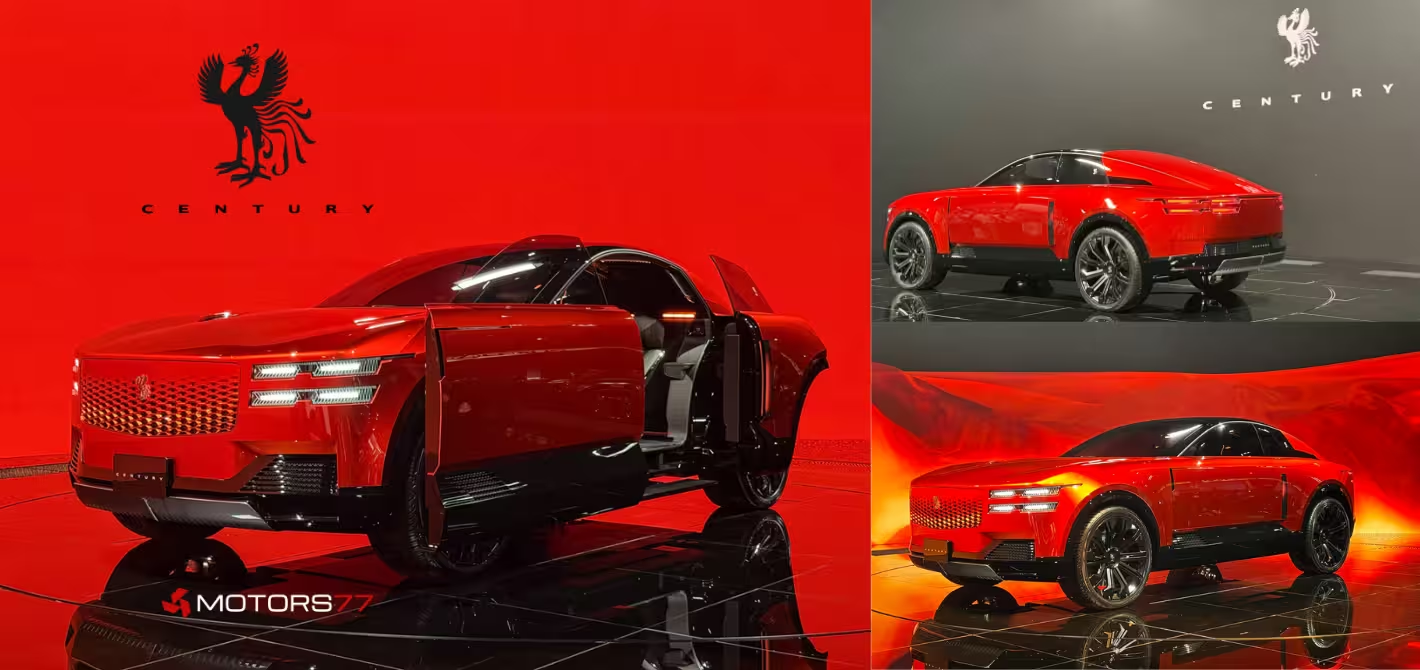
Toyota Century combustion engine: Japan’s ultra-luxury nameplate commits to internal combustion as Toyota positions Century against Rolls-Royce and Bentley
In a strategic declaration that distinguishes itself from the industry’s accelerating electrification narrative, Toyota has confirmed that its reborn Century luxury brand will retain internal combustion engines rather than transitioning to fully electric powertrains. The announcement, made by Toyota Powertrain President Takashi Uehara during media briefings at the Japan Mobility Show 2025, positions the Century nameplate as a premium alternative to the silent, battery-powered luxury vehicles increasingly dominating the high-end automotive segment.
When asked directly whether the next Century would be electric, Uehara’s response was unequivocal: “Yes, it will have an engine.” While acknowledging that Toyota has “not actually decided which kind of engine will be installed,” his statement leaves no ambiguity regarding the brand’s rejection of a battery-electric pathway for this particular luxury division.
The confirmation comes as Toyota transforms the Century from a Japan-exclusive limousine into a global luxury brand positioned to compete with ultra-premium manufacturers including Rolls-Royce, Bentley, and Mercedes-Maybach. Announced in October 2025 as one of Toyota Motor Corporation’s five global brands alongside Toyota, Lexus, Gazoo Racing, and Daihatsu, Century represents the company’s most ambitious luxury positioning to date.
The Strategic Philosophy Behind Combustion Power
Toyota’s commitment to combustion engines for Century reflects the company’s broader “multi-pathway” approach to powertrain development. Rather than treating electrification as a universal solution, Toyota maintains that different customer segments and market conditions warrant different propulsion technologies. For ultra-luxury chauffeur-driven vehicles designed for customers prioritising refinement, heritage, and traditional automotive character, the combustion engine remains central to the brand’s identity.
Uehara elaborated on this flexibility during technical sessions: “There are many combinations available. Now, the time needed for development is very much reduced, so it will be soon, actually.” This indicates that Toyota’s modular engine architecture allows rapid deployment across vehicle categories while maintaining brand-specific character.
The decision aligns with Toyota’s broader stance on combustion technology. Hiroki Nakajima, the company’s Chief Technology Officer, stated during the same event: “In my personal opinion, I think that Toyota Motor Corporation should be a company that will be making engines until the very end.” This philosophy positions Toyota as a counterpoint to manufacturers committing exclusively to electric futures.
The Current Century Powertrain Portfolio
Understanding Toyota’s future direction requires examining the existing Century lineup. The third-generation Century sedan, introduced in 2018, employs a sophisticated hybrid powertrain combining a 5.0-litre V8 petrol engine with electric motor assistance through Toyota’s Hybrid Synergy Drive technology. This system produces a combined output of 317 kW (431 PS / 425 horsepower), with the naturally aspirated V8 contributing 280 kW (381 PS) and 510 Nm of torque.
The hybrid configuration delivers impressive efficiency for a vehicle of this class, achieving 13.6 kilometres per litre under Japanese JC08 testing protocols—a significant improvement over the previous generation’s 10 km/L despite enhanced performance. The powertrain, derived from the Lexus LS 600h, exemplifies Toyota’s approach: proven hybrid technology adapted for ultra-luxury applications where reliability takes precedence over innovation.
The Century SUV, unveiled in September 2023, advances this philosophy further with a 3.5-litre V6 plug-in hybrid system generating 303 kW (412 PS / 406 horsepower) combined output. This configuration enables up to 69 kilometres of all-electric driving range for urban commutes while retaining the combustion engine for extended journeys. The SUV variant demonstrates Toyota’s evolution in electrified powertrains without abandoning the internal combustion foundation.
Engine Options Under Consideration
While Toyota has not finalised which engine architecture will power next-generation Century models, several credible options emerge from the company’s current development programmes.
The turbocharged hybrid four-cylinder represents one possibility. Toyota is developing a 2.0-litre turbocharged petrol engine paired with electric motor assistance, with executives confirming the company is “targeting around 400 horsepower” with this architecture, adding that “600 horsepower is easily possible” with optimised calibration. This configuration offers modern technology integration and sufficient performance for luxury applications, though it represents a significant displacement reduction from the current V8.
A new hybrid V8 remains the leading candidate among industry observers. Toyota has confirmed development of a 4.0-litre twin-turbocharged V8 engine designed for the upcoming GR GT supercar and its Lexus counterpart, with reports suggesting the hybrid system could deliver output exceeding 660 kW (approximately 885 horsepower) in its most potent configuration. Critically, Uehara confirmed this V8 “will serve more than just sports cars,” with potential applications in trucks, SUVs, and premium luxury models. For Century, a detuned version emphasising refinement over outright performance would align with the brand’s character.
Speculation persists regarding a potential V12 revival. The second-generation Century (1997–2017) featured a distinctive 5.0-litre V12 that became iconic among enthusiasts. While heritage and prestige associations make such speculation understandable, no substantive evidence supports active V12 development, and these reports should be treated as speculative.
Global Expansion and Market Positioning
The Century brand’s transformation from a domestic Japanese luxury sedan to a global competitor represents Toyota’s most ambitious premium market positioning. As part of its global expansion, Century vehicles will be offered through Lexus dealership networks rather than standalone showrooms, leveraging existing luxury retail infrastructure.
Market discussions have progressed furthest in Australia, with Lexus Australia confirming to CarExpert that the Century brand “was being evaluated for Australian introduction” though no launch timeline has been formalised. No confirmation exists for other specific markets, though the brand’s global ambitions suggest eventual availability across major luxury automotive regions.
Toyota’s decision to maintain combustion power acknowledges the different dynamics governing ultra-premium segments. Buyers competing with Rolls-Royce, Bentley Continental, and Mercedes-AMG make purchasing decisions based on heritage, engineering character, and exclusive design rather than efficiency ratings or environmental credentials. These customers often maintain vehicle collections and seek models offering distinct identity rather than technological parity with mainstream offerings.
Broader Industry Implications
Toyota’s commitment carries implications extending beyond a single luxury nameplate. It represents one of the automotive industry’s largest manufacturers publicly asserting that electrification will not follow a uniform path across all segments. While Tesla, Porsche Taycan, and others have shifted to electric platforms for their premium offerings, Toyota’s position suggests diverse powertrain technologies will coexist in the ultra-luxury segment for decades.
This stance aligns with evolving industry perspectives on electrification timelines. Recent years have witnessed moderation of earlier predictions that internal combustion engines would become entirely obsolete within 10–15 years. Manufacturers increasingly recognise that advanced hybrid technologies, improved emissions control, and carbon-neutral synthetic fuels may extend the practical viability of combustion powertrains in specific applications longer than once anticipated.
Uehara captured this perspective colourfully during technical sessions, comparing the experience of high-performance EVs to “trying to enjoy fireworks on mute.” The statement reflects Toyota’s belief that combustion engines offer sensory and emotional engagement that current electric motor technology, despite its torque advantages, struggles to replicate.
What This Means for Prospective Buyers
For customers interested in future Century models, the preservation of combustion powertrains delivers several concrete benefits. Extended driving range without refuelling anxiety remains relevant for the long-distance journeys chauffeur-driven vehicles often undertake. While plug-in hybrid configurations offer electric-only driving for daily commutes, the combustion engine’s ability to power extended trips maintains practical value in markets where charging infrastructure remains underdeveloped.
The maintenance ecosystem for combustion engines remains substantially more developed than for complex battery systems and electric powertrains, particularly in regions outside major metropolitan areas. For ultra-premium vehicles with ownership periods exceeding ten years, this consideration carries genuine practical weight.
Resale considerations also matter for vehicles in this price category. The marketplace for pre-owned combustion-powered luxury vehicles shows greater depth than for ageing electric vehicles, with buyers understanding traditional powertrain operation and maintenance requirements more intuitively than emerging EV technology platforms.
Combustion Power as Premium Differentiation
Toyota’s resolute commitment to keeping combustion engines in its Century luxury brand represents a deliberate strategic choice rather than technological conservatism. By positioning the brand around refined, powerful petrol powertrains—whether as traditional engines or sophisticated hybrid systems—Toyota creates genuine differentiation from the increasingly homogeneous landscape of electric luxury vehicles.
This approach acknowledges that luxury automobile buyers comprise heterogeneous segments with varying priorities. While some ultra-wealthy consumers embrace electric vehicles as environmental statements and technological showcases, others seek vehicles celebrating traditional engineering excellence and automotive heritage. The Century brand, with its legacy extending back to 1967, naturally appeals to the latter constituency.
The first Century models incorporating new powertrain options are expected within the coming years, with the full technical specification and global market strategy to be confirmed as development progresses. For the ultra-luxury segment, the internal combustion engine’s future appears considerably more secure than mass-market predictions might suggest.
Note: Power output figures marked as rumoured remain unconfirmed by Toyota. Global market availability and pricing are subject to official announcement.
You may also like reading about the 2026 Toyota Hilux debut, which showcases Toyota’s next-generation pickup updates.