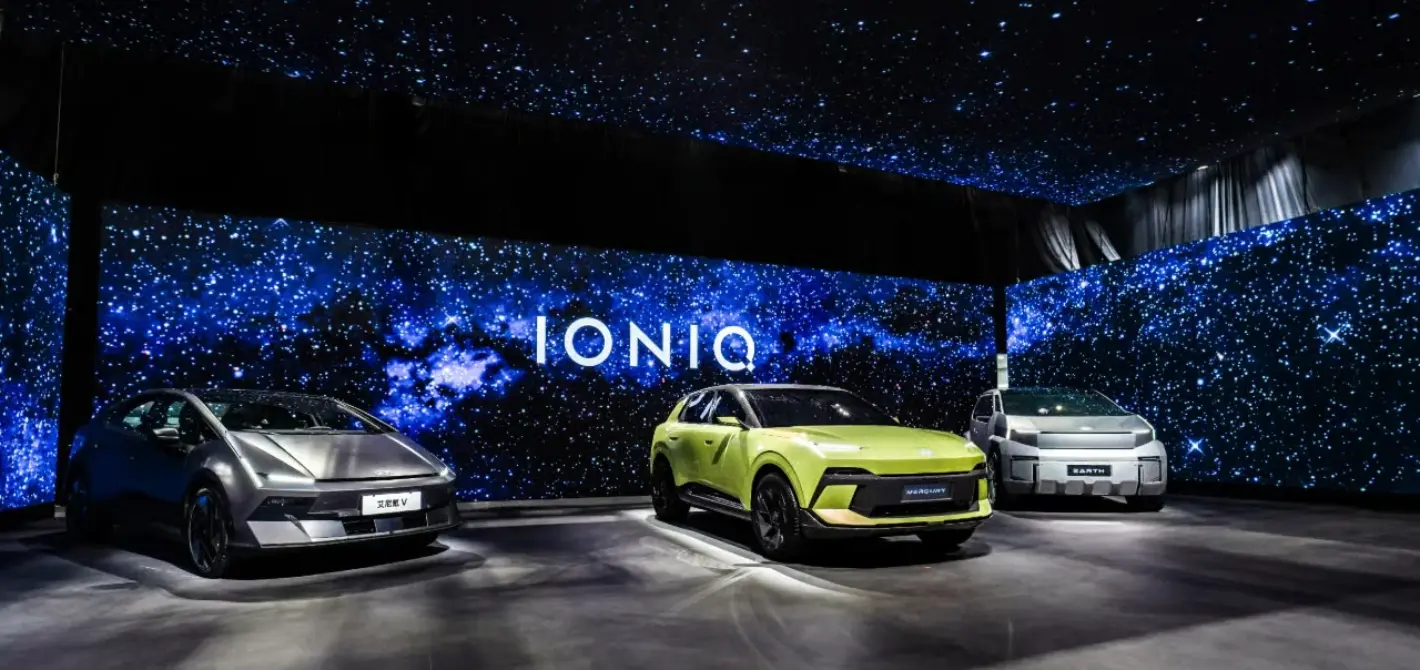
The Hyundai Mercury Concept is a small electric SUV with a big job. At its 2016 peak, Beijing Hyundai, the company’s Chinese joint venture with BAIC, reported total sales of 1.14 million vehicles. By September 2026, Hyundai and Kia together held just 0.6% of China retail sales. The Mercury, revealed at Auto Guangzhou 2026, previews the car designed to help Hyundai rebuild its position with urban Chinese buyers.
Hyundai calls it a B-segment premium smart SUV and the most accessible entry model in its China IONIQ lineup. Hyundai has confirmed the production model will be sold as the IONIQ M and is planned for China in the first half of 2027. What makes the Hyundai Mercury Concept unusual is who built it: Hyundai’s Chinese design and engineering team, using Chinese partners for driver assistance, artificial intelligence and battery swapping.
This is a concept reveal. Hyundai has not announced dimensions, battery size, range or price, so confirmed facts are kept separate from unknowns.
Hyundai Mercury Concept at a Glance
| Parameter | Details (as announced by Hyundai) |
|---|---|
| Type | B-segment premium smart SUV, all-electric |
| Position | Most accessible entry model in the China IONIQ lineup |
| Production name | IONIQ M |
| Debut | Global design debut at Auto Guangzhou 2026 (November 27 to December 6) |
| Developed by | Hyundai’s Chinese design and engineering team |
| Driver assistance | Zhuoyu L2++ ADAS |
| Smart cockpit | ByteDance Doubao AI model |
| Battery swap | Variant planned with CATL |
| China launch | First half of 2027 |
| Concept colour | Citrine Neon (custom yellow-green) |
| Target user | Daily urban commuters |
Source: Hyundai Motor Company, Auto Guangzhou 2026 announcement.
The Hyundai Mercury Concept is the third IONIQ concept created specifically for China, after the VENUS sedan and the EARTH family SUV revealed in Beijing in April 2026.
Design: What the Hyundai Mercury Concept Looks Like
Hyundai’s China IONIQ models follow a planet naming theme. Hyundai says the silhouette is meant to balance speed and power, guided by two design principles it calls “Lead, don’t follow” and “Best in First Impression.”
Front and Profile
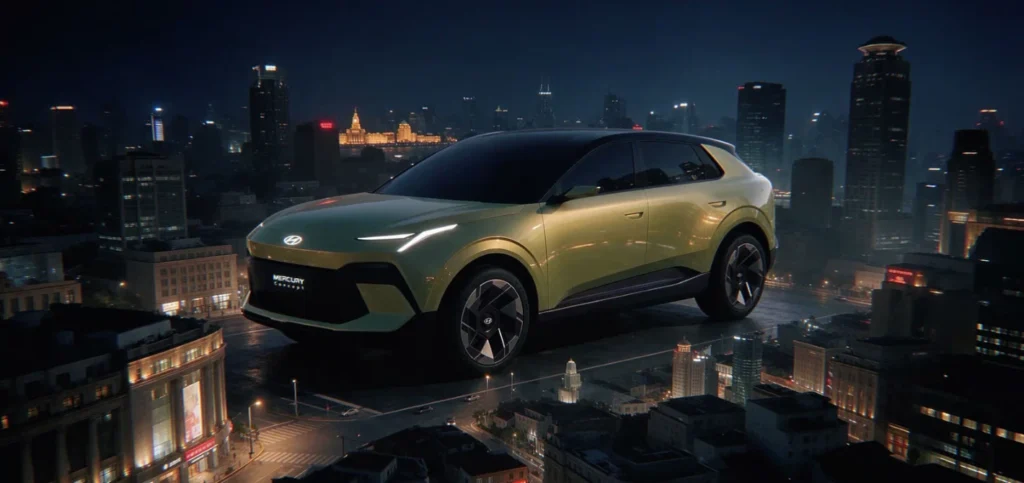
The front end is low and shaped like a shark nose. Slim signature edge lighting runs across it and forms an “H” pattern, giving the face a distinctive light signature rather than a conventional grille. From the side, the most dramatic element is the aggressively raked windshield, which gives the small SUV a fast, almost coupe-like stance.
In Hyundai’s reveal images, the lower bumper and body cladding are finished in black, and the bright body colour is paired with a contrasting black roof and black wheels.
Rear and Details
At the back, an integrated rear spoiler adds a sporty finish. Hyundai has also hidden “M” emblem Easter eggs on the car, a playful detail for owners to discover. The concept wears a custom Citrine Neon paint, a vivid yellow-green shade.
| Design element | Hyundai Mercury Concept |
|---|---|
| Front | Low-slung shark nose with “H” pattern edge lighting |
| Windshield | Aggressively raked |
| Lower body | Black bumper section and cladding |
| Roof and wheels | Contrasting black |
| Rear | Integrated spoiler, hidden “M” emblem details |
| Paint | Citrine Neon |
| Interior | Not yet shown in detail by Hyundai |
Technology: Chinese Partners at the Core
The most revealing part of the Hyundai Mercury Concept is its technology list. Every headline feature comes from a Chinese partner, tuned, in Hyundai’s words, for Chinese traffic scenarios and driver preferences.
| Technology | Partner | What it brings |
|---|---|---|
| L2++ driver assistance | Zhuoyu | Advanced assisted driving for Chinese roads |
| Smart cockpit AI | ByteDance (Doubao model) | Conversational in car assistant |
| Battery swapping | CATL | Swap a depleted pack instead of waiting to charge |
Zhuoyu L2++ ADAS
Zhuoyu began as DJI’s automotive division in 2016 and was spun off in 2023, and FAW Group became its largest shareholder in 2025. L2++ is an industry label rather than an official SAE level. The SAE J3016 standard does not define “plus” levels, and systems sold under such labels still require an attentive driver with hands on the wheel.
ByteDance Doubao AI
The cockpit runs on Doubao, ByteDance’s AI model, giving the Hyundai Mercury Concept a locally developed voice assistant of the kind domestic brands already offer.
CATL Battery Swapping
A battery swap version of the Hyundai Mercury Concept is planned through a partnership with CATL, which led the global EV battery market in 2025 with a 39.2% share, according to SNE Research. Hyundai says it will be the first battery swap model from a joint venture carmaker in China. Beijing Hyundai and CATL signed a strategic battery supply agreement at Auto China 2024, building on cooperation that dates back to 2017.
Confirmed Versus Not Yet Announced
For a concept, separating fact from expectation matters.
| Item | Status |
|---|---|
| B-segment premium smart SUV positioning | Confirmed by Hyundai |
| Entry point of China IONIQ lineup | Confirmed by Hyundai |
| Zhuoyu L2++ ADAS and Doubao AI cockpit | Confirmed by Hyundai |
| CATL battery swap variant | Confirmed as planned |
| Production name IONIQ M | Confirmed by Hyundai |
| China launch in the first half of 2027 | Confirmed by Hyundai |
| Dimensions, battery capacity, range, motor output | Not announced |
| Price | Not announced |
| Markets outside China | Under study, not confirmed |
Hyundai confirmed the IONIQ M name and first half 2027 timing at the Guangzhou reveal. In April 2026, at Auto China, Hyundai had said Beijing Hyundai would add another SUV in the first half of 2027, but it did not identify that SUV as the Mercury or IONIQ M at the time.
The Benchmark: What IONIQ V Tells Us
The best clue to the production IONIQ M is its bigger sibling. The IONIQ V, derived from the VENUS Concept, went on sale in China in September 2026 as the first localised mass production model under the IONIQ Planet banner.
| Specification | Hyundai IONIQ V (China) |
|---|---|
| Body style | Fastback electric sedan with frameless doors |
| Length | 4,900 mm |
| Width | 1,890 mm |
| Height | 1,470 mm |
| Wheelbase | 2,900 mm |
| Battery | 53.5 kWh or 66.8 kWh CATL LFP |
| Motor output | 140 kW or 168 kW, single motor |
| CLTC range | Up to 650 km |
| Display | 27 inch ultra thin 4K widescreen |
| Chip | Qualcomm Snapdragon 8295 |
| Launch price | 109,900 to 139,900 yuan before discounts |
Source: Hyundai Motor Company and Beijing Hyundai launch specifications, September 2026.
As the entry model, the IONIQ M should sit below the IONIQ V. Hyundai has not confirmed any IONIQ M hardware, so these figures are a reference point, not IONIQ M specifications.
The Roadmap: Where the Hyundai Mercury Concept Fits
Hyundai used Guangzhou to lay out its China IONIQ plan through 2029.
| Year | Planned model |
|---|---|
| September 2026 | IONIQ V launched |
| 2027 | IONIQ M (first half) and IONIQ V EREV |
| 2028 | EARTH production model |
| 2029 | Two additional new energy vehicle models |
The IONIQ V EREV, or extended range electric vehicle, adds a small petrol engine acting as a generator. With the IONIQ M, it gives Hyundai a cheaper entry point and a more flexible powertrain in 2027.
Why the Hyundai Mercury Concept Matters
Hyundai’s China Position in Numbers
Hyundai’s China figures are reported on different bases, so they should not be read as one series.
| Measure | Basis | Figure |
|---|---|---|
| Beijing Hyundai sales, 2016 peak | Joint venture total, not retail | 1.14 million |
| Beijing Hyundai sales, 2025 | China retail, Hyundai reported | 125,726 units |
| Hyundai and Kia share, September 2026 | Combined China retail share | 0.6% |
The 2016 joint venture total and the 2025 retail count are not directly comparable. Beijing Hyundai separately reported 2025 total sales of 210,015 vehicles, a broader measure than retail, and reports credit exports of about 60,000 units with part of that growth.
In December 2024, Hyundai and BAIC agreed to inject about US$1.1 billion, roughly 8 billion yuan, into Beijing Hyundai, split equally and paid in instalments.
Chinese brands have moved quickly on affordable EVs, smart cockpits and assisted driving. The Hyundai Mercury Concept is Hyundai’s response at the most accessible end of its lineup: a compact, city focused EV carrying the kind of Chinese software local rivals already offer.
Local Development as Strategy
Hyundai describes its approach as “In China, For China, To Global.” A Hyundai spokesperson in Australia has said the production model will launch in China first while the company explores other regions. Hyundai’s Korean release also says locally built vehicles will be sold in China and exported.
The Battery Swap Gamble
According to CATL, its Choco swap network reached 2,000 stations across 180 Chinese cities by mid 2026, and it plans 6,000 passenger car swap stations in 2027. A swap variant of the Hyundai Mercury Concept lowers a barrier for city buyers without home charging.
What It Means for Indian Buyers
The Hyundai Mercury Concept is a China-specific model, and Hyundai has made no announcement about India. Separately, Hyundai Motor India said in its Q2 FY27 results that it is fully geared up to launch a dedicated mass market EV in Q4 FY27, that is, between January and March 2027.
Media reports identify that model as a compact electric SUV codenamed HE1i and say Hyundai management has referred to an IONIQ P name. Hyundai Motor India has not confirmed either.
Quick Pros & Cons
Pros
- Bold, distinctive design with “H” pattern lighting and a fast windshield rake
- Developed locally by Hyundai’s Chinese team for Chinese buyers
- Zhuoyu L2++ ADAS and Doubao AI cockpit match domestic rivals’ tech
- Planned CATL battery swap variant adds charging flexibility
- Confirmed IONIQ M name and first half 2027 China launch
Cons
- No dimensions, battery, range or price announced yet
- Interior not yet shown in detail
- Battery swapping depends on network density, which varies by city
- Entry level EV segment in China is intensely price competitive
- No confirmation for markets beyond China, including India
Frequently Asked Questions
1. What is the Hyundai Mercury Concept? The Hyundai Mercury Concept is an all-electric B-segment premium smart SUV revealed at Auto Guangzhou 2026. It previews the entry model of Hyundai’s China-specific IONIQ lineup.
2. When will the production version launch? Hyundai says the production model is planned for China in the first half of 2027.
3. What will the production model be called? Hyundai has confirmed the production model will be sold as the IONIQ M.
4. What technology does the Hyundai Mercury Concept use? It uses Zhuoyu L2++ advanced driver assistance, a smart cockpit powered by ByteDance’s Doubao AI model, and a planned battery swap variant developed with CATL.
5. What is the range and price of the IONIQ M? Hyundai has not announced battery capacity, range, motor output or price. These details are expected closer to the 2027 launch.
6. Who designed the Hyundai Mercury Concept? It was designed and engineered by Hyundai’s Chinese design and engineering team, as part of the company’s “In China, For China, To Global” strategy.
7. Will the Hyundai Mercury Concept come to India? There is no announcement for India. Separately, Hyundai Motor India plans to launch a dedicated mass market EV in Q4 FY27. Media reports identify it as the HE1i compact SUV, which Hyundai has not confirmed.
Motors77 Verdict
The Hyundai Mercury Concept is less a design exercise than a statement of how Hyundai now plans to compete in China. The styling is bold, with its shark nose, “H” lighting and Citrine Neon paint, but the real story is underneath. Hyundai has handed its most affordable China EV to a local team and built it around Chinese partners: Zhuoyu for assisted driving, ByteDance for the cockpit and CATL for battery swapping.
That approach reflects how competitive China has become for foreign brands. The IONIQ M now has to win urban buyers at the most price sensitive end of the market.
Until Hyundai reveals the battery, range and price, the IONIQ M remains a promise. If it keeps the concept’s character and lands at the right price in the first half of 2027, it could give Beijing Hyundai the accessible, higher volume entry point its lineup has lacked. Motors77 will track the production reveal and any plans for markets beyond China.