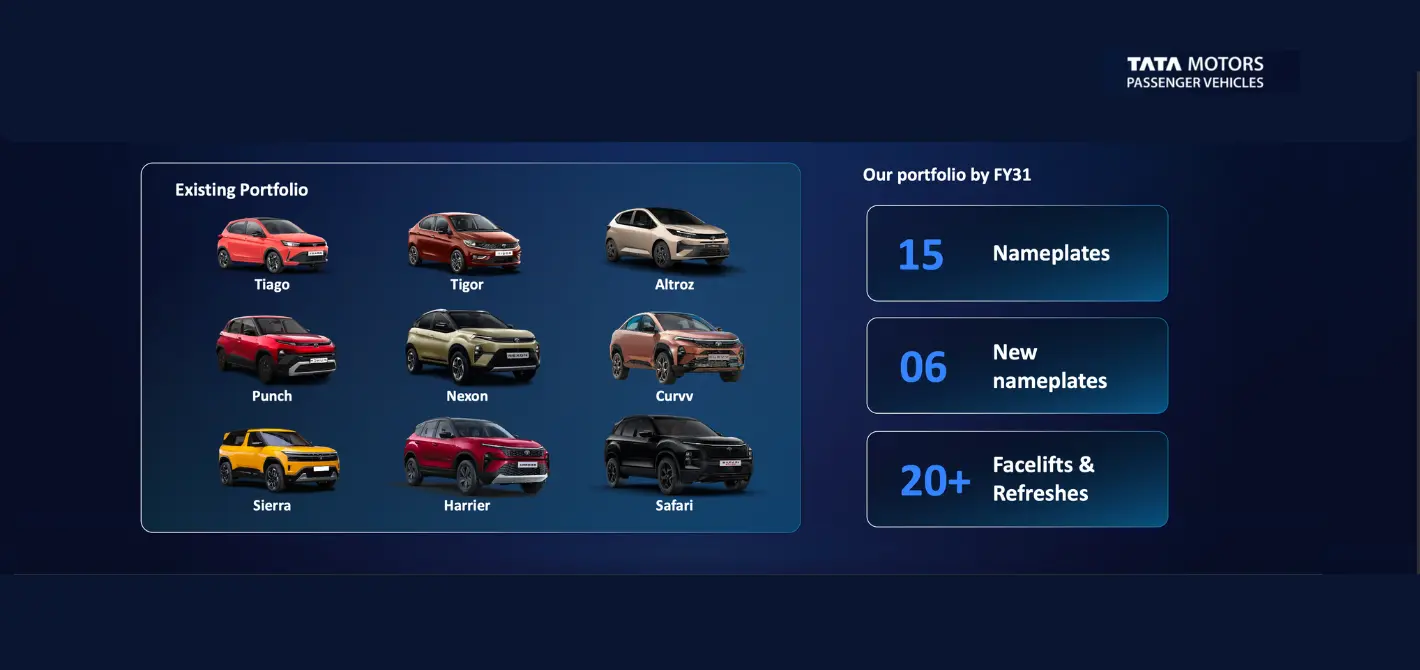
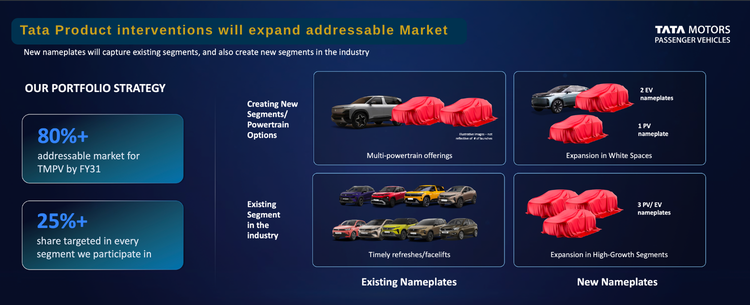
At its 2026 Investor Day, Tata Motors did something rare for an Indian carmaker. It put its entire next five years on a single slide. The Tata Motors FY31 roadmap is not a vague promise of “more SUVs soon.” It is a counted, dated, funded plan to grow the showroom from nine nameplates today to fifteen by FY31, double annual sales, and chase a fifth of the entire Indian car market.
If you have followed Tata’s rise from a struggling also ran to India’s second largest carmaker, this is the slide that tells you where the next chapter goes. And the headline number everyone is quoting, nine to fifteen, hides a far more interesting story underneath. Let us pull the Tata Motors FY31 roadmap apart, separate what is confirmed from what is still speculation, and work out what it actually means for you as a buyer.
Tata Motors FY31 roadmap at a glance
Before the detail, here is the whole plan in one table. Every figure below comes from Tata’s own Investor Day presentation.
| Metric | FY26 (today) | FY31 target |
|---|---|---|
| Total nameplates | 9 | 15 |
| Brand new nameplates | reference base | 6 |
| Facelifts and refreshes | reference base | 20 plus |
| EV nameplates | 6 | 10 |
| Annual sales | about 6.4 lakh units | 12 lakh plus units |
| Market share | No. 2, roughly 14 percent | about 20 percent |
| Tata’s own EV penetration | about 14 percent | 30 percent plus |
| Production capacity | about 9 lakh units | 13 lakh units |
| Capex (FY27 to FY29, step-up phase) | reference base | ₹37,500 to 40,000 crore |
That is the spine of the Tata Motors FY31 roadmap. Now the twist that the plain “nine to fifteen” headline misses.
The number that gets misreported
A lot of coverage has muddled two separate figures. So let us be precise.
Tata is adding six all new nameplates to take the portfolio from nine to fifteen. That is the company wide number, spanning petrol, diesel, CNG and electric.
Separately, Tata’s electric line up grows from six nameplates to ten by FY31. That ten is the total EV portfolio, not the count of new launches. Of those, only four EV nameplates are genuinely new.
So when a headline says “ten new nameplates,” it has accidentally borrowed the EV portfolio total and stapled it to the new launch story. The real arithmetic is cleaner: nine existing nameplates, plus six brand new ones, equals fifteen. The EV slice of that future fifteen happens to total ten. Both numbers are true. They are just measuring different things.
How the six new nameplates break down
Tata’s product chief Shailesh Chandra gave a useful split of where the six newcomers will land. Two of them chase white space EV segments where Tata has no product today. One is a fresh ICE or multi powertrain entry into a white space segment. The remaining three sit in existing high growth segments, badged across petrol, CNG or electric.
| Bucket | New nameplates | Powertrain focus | Strategic intent |
|---|---|---|---|
| White space | 2 | EV | Create entirely new electric segments |
| White space | 1 | ICE or multi powertrain | Enter an untapped conventional segment |
| High growth | 3 | Petrol, CNG or EV | Defend and grab share in fast growing segments |
Layered on top sit more than twenty facelifts, feature upgrades and powertrain additions. This is the part of the Tata Motors FY31 roadmap that keeps existing cars fresh: think a 2026 Tigor facelift, refreshed Punch and Altroz derivatives, and CNG or electric versions added to nameplates that do not have them yet.
From 6 to 10: the four new electric Tatas
This is where the action concentrates. Tata already runs India’s widest EV range, the Tiago.ev, Xpres-T, Punch.ev, Nexon.ev, Curvv.ev and Harrier.ev, spanning roughly ₹7 lakh to ₹29 lakh. Four more EV nameplates round it out to ten.
Two of the four are effectively public. The other two are confirmed in count but not yet in detail, so treat their specifications as expected rather than official.
| New EV | Status | Expected timing | Platform (expected) | What we expect |
|---|---|---|---|---|
| Sierra.ev | Launch confirmed | 30 June 2026 | acti.ev plus | Slots between Curvv.ev and Harrier.ev, 500 plus km range, triple screen, Level 2 plus ADAS, QWD dual motor on top trims |
| Safari.ev | Confirmed | Festive season 2026 | acti.ev plus | Seven seat electric SUV, derived from Harrier.ev hardware |
| Avinya (first model) | Nameplate confirmed | Around 2027 | JLR and Chery derived | Premium electric SUV sub brand, production version of the Avinya X concept |
| Fourth EV | Count confirmed, model undisclosed | By FY31 | To be decided | Widely speculated to be a three row Avinya or an electric MPV |
Two caveats matter here, because Motors77 will not pretend speculation is fact. First, every specification for Sierra.ev above is expected, drawn from teasers and reliable reporting, until Tata publishes the official numbers on launch day. Second, recent reports suggest the Avinya brand may eventually stretch beyond pure electric to include strong hybrid power, which would blur the neat EV only label it launched with. We will update this article once Tata confirms.
CNG and the multi powertrain bet
The Tata Motors FY31 roadmap is not an EV only story, and that is deliberate. Tata sold over 1.7 lakh CNG cars in FY26 and wants 25 percent plus share of the CNG segment, which it expects to keep growing sharply. Add EVs and CNG together and Tata expects them to make up close to 45 percent of the Indian market by FY31.
That multi powertrain stance is the quiet genius of the plan. While rivals place concentrated bets, Tata is spreading its growth across electric, CNG and efficient petrol, so a slowdown in any one fuel does not derail the whole roadmap. The company has openly said its twin cylinder CNG range will keep features and boot space intact, removing the historic compromise that pushed buyers away from factory CNG.
The money and the metal behind the plan
Ambition without capacity is just a press release. Tata has put real capital behind the Tata Motors FY31 roadmap: around ₹37,500 to 40,000 crore of investment through FY29, front loaded in the early years for capacity creation, with capacity rising from about 9 lakh units a year to 13 lakh within two to three years across its Pune, Sanand 1, Sanand 2, Ranjangaon and Panapakkam plants.
The financial trajectory for the passenger vehicle business is just as telling.
| Metric (PV business) | FY26 actual | FY29 mid term | FY31 long term |
|---|---|---|---|
| Revenue | ₹58,500 crore | ₹1,15,000 crore plus | ₹1,40,000 crore |
| EBITDA margin | 6.9 percent (5.0 percent without PLI) | 8 percent | 10 percent |
| EBIT margin | 1.4 percent | 4 percent | 5 percent plus |
The honest reading: Tata is still in an investment heavy phase, so EBIT margins look thin today. The roadmap is a bet that scale, cost reductions of 5 to 6 percent on ICE cars, and deeper EV localisation after the PLI window will lift double digit EBITDA by FY31. It is a credible path, but it depends on flawless execution while Mahindra and JSW MG Motor crowd the same segments.
What the roadmap means if you are buying a Tata
Strip away the investor jargon and the Tata Motors FY31 roadmap points to a few concrete things for ordinary buyers. The showroom you walk into in 2027 or 2028 will have noticeably more choice, especially in electric and CNG. Existing favourites like Nexon, Punch and Harrier will keep getting facelifts and new powertrains rather than going stale. And Tata is openly chasing a more premium, tech first image, with Level 2 plus ADAS, triple screens and software defined features migrating down to mainstream price points.
The flip side is patience. Most of the exciting metal, the Avinya range, the white space EVs, the fourth mystery electric car, lands closer to FY31 than to today. The near term excitement is concentrated in the Sierra.ev and Safari.ev.
Quick Pros and Cons
| Pros | Cons |
|---|---|
| Clear, counted plan: 9 to 15 nameplates with dates and funding | Several key models are years away, not months |
| Widest multi powertrain spread (petrol, CNG, EV) reduces risk | Thin current EBIT margins leave little room for error |
| EV portfolio grows 6 to 10, keeping Tata’s electric lead | Specifications for new EVs are still largely expected, not official |
| Big capex of up to ₹40,000 crore and 13 lakh unit capacity backs the ambition | Rising competition from Mahindra and JSW MG in the same segments |
| Premium tech (ADAS, triple screens) trickling to mass market | Avinya’s EV only positioning may shift to hybrids, muddying the story |
Frequently Asked Questions
1. How many cars is Tata Motors launching by FY31? Tata is adding six all new nameplates, taking its portfolio from nine to fifteen, plus more than twenty facelifts, refreshes and powertrain additions across existing models.
2. Is “ten new nameplates” correct? No. The figure of ten refers to Tata’s total EV portfolio by FY31, not new launches. Tata’s electric range grows from six to ten nameplates, of which only four are genuinely new EVs.
3. What are the four new Tata EVs? The Sierra.ev (launching 30 June 2026), the Safari.ev (festive season 2026), the first Avinya premium EV (around 2027) and a fourth, still undisclosed electric model widely expected to be a three row Avinya or an electric MPV.
4. How much is Tata Motors investing in this plan? Around ₹37,500 to 40,000 crore through FY29, front loaded for capacity creation, funding new products, technology and a capacity increase from about 9 lakh to 13 lakh units a year.
5. What market share is Tata targeting by FY31? Around 20 percent of the Indian passenger vehicle market, up from its current No. 2 position of roughly 14 percent, alongside 30 percent plus EV penetration within its own line up.
6. When does the Tata Sierra EV launch? Tata has confirmed a 30 June 2026 launch for the Sierra.ev, built on the acti.ev plus platform, with an expected range of over 500 km and quad wheel drive on higher trims.
7. Will Tata still sell petrol and CNG cars under this roadmap? Yes. The plan is explicitly multi powertrain. Tata expects EVs and CNG together to make up close to 45 percent of the market by FY31, with efficient petrol cars covering the rest.
Motors77 Verdict
The Tata Motors FY31 roadmap is one of the most concrete five year plans any Indian carmaker has put on paper, and that clarity is its biggest strength. Nine to fifteen nameplates, six all new cars, four fresh EVs, up to ₹40,000 crore of capex and a 13 lakh unit capacity are not loose ambitions; they are countable commitments that the company can now be held to.
What we like is the discipline. Tata is not betting the house on electric alone. By spreading growth across EVs, CNG and efficient petrol, it has built a roadmap that can survive a wobble in any single fuel. The EV line up expanding from six to ten keeps its hard won electric lead intact, and the premium Avinya push finally gives Tata a credible answer to the top of the market.
What we will watch closely is execution and margins. The exciting metal is back loaded toward FY31, current EBIT margins are slim, and Mahindra and JSW MG Motor are fighting for the exact same buyers. Plans like this live or die on delivery, not slides.
For now, the takeaway is simple. If you are buying a Tata in the next eighteen months, the Sierra.ev and Safari.ev are the cars to wait for. If you are watching the brand’s bigger arc, the Tata Motors FY31 roadmap says Tata intends to stop being India’s value champion and start being its volume and technology leader. Whether it gets there is the most interesting question in the Indian car market right now.