Breaking: Japan’s first 5-star electric SUV achieves near-perfect safety scores, ranking fourth among India’s elite EV safety performers
Maruti e Vitara Scores: In a significant milestone for Indian automotive safety, the Maruti Suzuki e Vitara has secured a comprehensive 5-star rating from Bharat NCAP (Bharat New Car Assessment Programme), joining an exclusive club of just five electric SUVs to achieve the highest safety certification under India’s domestic crash testing protocol. According to the official Bharat NCAP fact sheet, the e Vitara was formally assessed in September 2025.
The e Vitara becomes Maruti Suzuki’s fourth consecutive model to earn the coveted 5-star Bharat NCAP rating, following the Dzire, Baleno, and Invicto. More significantly, based on the five electric SUVs that have received 5-star Bharat NCAP ratings (all others being from Indian manufacturers Mahindra and Tata), this represents what is widely reported as the first electric SUV from a Japanese manufacturer to achieve this distinction in India a transformative moment for the country’s largest automaker.
Outstanding crash test performance: Near-perfect safety scores
The official Bharat NCAP fact sheet reveals exceptional protection levels that position the e Vitara among India’s safest vehicles tested under the domestic crash safety protocol. The vehicle achieved an adult occupant protection score of 31.49 out of 32 points, placing it fourth among the five electric SUVs that have achieved 5-star Bharat NCAP ratings. This outstanding performance sits just 0.51 points (1.6%) behind the perfect 32/32 scores achieved by the Mahindra XEV 9e and Tata Harrier EV, demonstrating exceptional structural integrity and occupant protection systems.
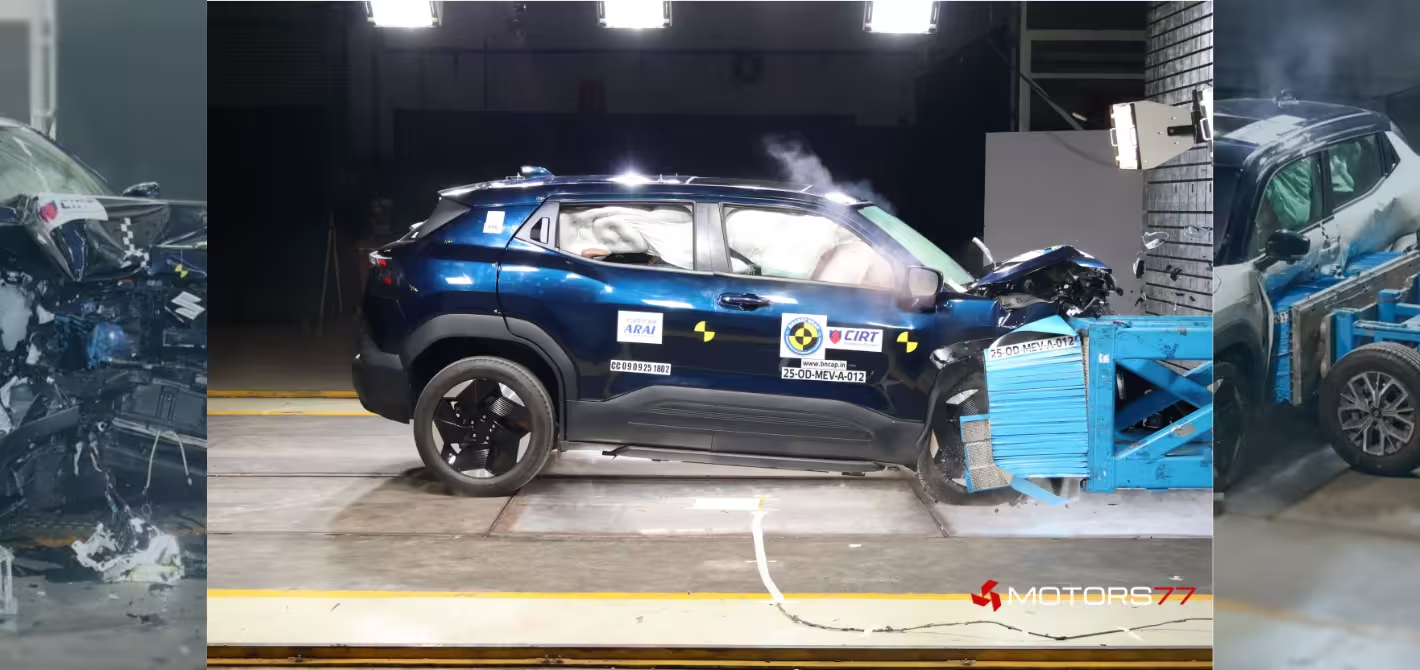
The comprehensive testing evaluated three critical impact scenarios. In the frontal offset deformable barrier test, the e Vitara scored 15.49 out of 16 points, providing “good” protection to the driver’s head, neck, pelvis, thighs, and feet. The passenger compartment maintained structural integrity throughout the impact, with minimal intrusion into the survival space a critical factor in preventing severe injuries during real-world accidents.
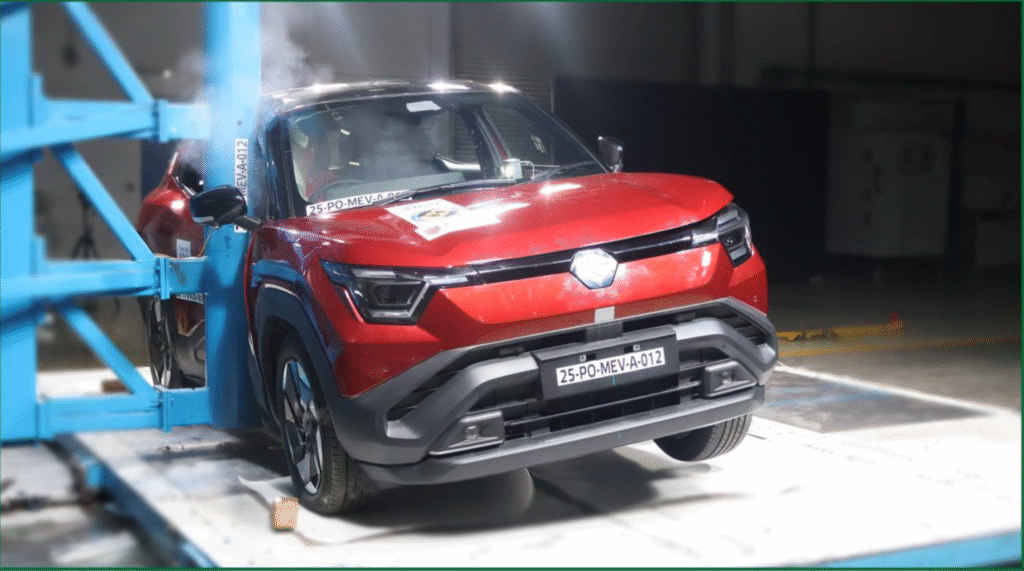
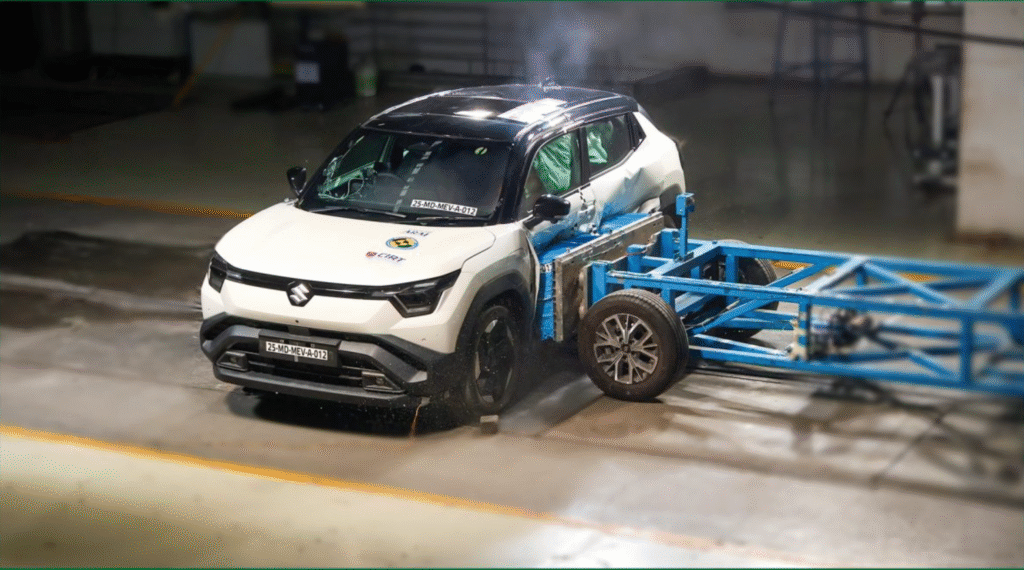
The e Vitara achieved a perfect 16 out of 16 points in the side movable deformable barrier test, demonstrating exceptional protection against one of the most dangerous collision types. Side impacts account for approximately 25 percent of severe injuries in vehicle crashes, making this flawless performance particularly significant for family safety. The vehicle also received an “OK” rating in the side pole impact test, confirming comprehensive lateral collision protection across multiple impact angles.
For child occupant protection, the e Vitara achieved 43 out of 49 points through a combination of excellent scores across all testing parameters. The vehicle earned a perfect 24 out of 24 points in the dynamic score category, along with a perfect 12 out of 12 points for child restraint system installation ease and reliability. The vehicle assessment component contributed 7 out of 13 points to the total child protection score.
Bharat NCAP tested the vehicle using i-SIZE certified child restraint systems specifically the Dualfix 5Z with Vario Base for both 18-month-old and 3-year-old child dummies. Both age groups received maximum scores for frontal (8 out of 8) and side impact (4 out of 4) protection when properly secured in approved child seats. The testing confirms that ISOFIX anchorage points are available as standard on the second-row outboard seats, though the center rear seat lacks ISOFIX provision a limitation common across most vehicles in this segment.
Tested variant and rating applicability
Bharat NCAP conducted crash testing on the fully-loaded e Vitara Alpha variant equipped with the 61 kilowatt-hour battery pack. The test vehicle weighed 2,082 kilograms at the time of testing significantly heavier than conventional ICE SUVs due to the substantial battery mass, which actually contributes positively to crash protection by absorbing impact energy.
Critically, the 5-star rating applies to all variants of the e Vitara as documented in the official annexure, covering the Delta variant with 49 kWh battery, the Zeta variant with 61 kWh battery, and the Alpha variant with 61 kWh battery which served as the tested configuration. This universal applicability ensures that even base variant buyers receive the same structural safety and crash protection as top-specification customers a democratic approach to safety that aligns with India’s regulatory philosophy.
Comprehensive safety equipment: Standard across tested variants
The official fact sheet confirms that the e Vitara comes equipped with an extensive array of safety features as standard fitment on the tested Alpha variant, with ratings applicable to the variants listed in the official annexure (Delta 49 kWh, Zeta 61 kWh, and Alpha 61 kWh).
For frontal crash protection, the vehicle includes dual front airbags as standard for both driver and passenger, complemented by belt pretensioners and belt load limiters for both front seats. The inclusion of a driver knee airbag as standard equipment represents a significant safety advantage unique in this segment, protecting the lower extremities during frontal impacts an injury zone often neglected in more affordable vehicles.
Side crash protection extends comprehensively across all three rows through side head curtain airbags, with side chest airbags provided as standard for driver and passenger. This configuration delivers a total airbag count of seven airbags standard on the tested variant, representing the highest count in the electric SUV segment. The comprehensive side airbag coverage, including curtain airbags extending to rear passengers, provides protection that exceeds segment standards and rivals premium vehicles costing significantly more.
Child safety provisions include ISOFIX anchorage points as standard on second-row outboard seats, with top tether anchorages available for securing child restraint systems. The vehicle has been tested and certified with multiple child seat types including both rear-facing and forward-facing configurations, ensuring compatibility across the typical age range of children requiring specialized restraint systems.
The e Vitara includes advanced electronic safety systems mandated and tested by Bharat NCAP. Electronic Stability Control comes as standard equipment, fully compliant with UN GTR No.8, UNECE R140, and AIS-133 standards. Seat Belt Reminder functionality covers all seating positions and meets AIS-145 compliance standards. Pedestrian Protection systems are standard across all variants, compliant with AIS-100 standards. Additional standard safety equipment includes Tire Pressure Monitoring System across all variants, Electronic Parking Brake with Auto-Hold functionality, a 360-degree camera system confirmed on the Alpha variant, and front and rear parking sensors as standard equipment.
According to the official Bharat NCAP fact sheet, the e Vitara is equipped with Electronic Stability Control compliant with UN GTR No.8, UNECE R140, and AIS-133 standards, Seat Belt Reminder for all seating positions compliant with AIS-145 standards, and Pedestrian Protection systems compliant with AIS-100 standards. Maruti Suzuki has indicated the e Vitara will feature Level 2 ADAS capabilities (making it the company’s second model with this technology after the Victoris). However, the specific ADAS feature list including details on adaptive cruise control, lane-keeping assist, automatic emergency braking, and other advanced driver assistance functions should be confirmed from Maruti Suzuki’s official specification documentation or launch communications, as these details are not enumerated in the Bharat NCAP fact sheet.
How the e Vitara compares: India’s elite electric SUV safety club
The Maruti Suzuki e Vitara joins an exclusive group of electric SUVs that have achieved 5-star Bharat NCAP ratings, representing the highest safety certification available in India. Based on official Bharat NCAP fact sheets, the competitive landscape reveals how the e Vitara compares against its electric SUV competitors.
Official Bharat NCAP Safety Rankings (Electric SUVs)
| Rank | Vehicle | Adult Occupant Protection | Child Occupant Protection | Total Score | Test Date |
|---|---|---|---|---|---|
| #1 | Mahindra XEV 9e | 32.00/32 ⭐ | 45.00/49 | 77.00/81 | Jan 2025 |
| #1 | Tata Harrier EV | 32.00/32 ⭐ | 45.00/49 | 77.00/81 | May 2025 |
| #3 | Mahindra BE 6 | 31.97/32 | 45.00/49 | 76.97/81 | Jan 2025 |
| #4 | Maruti e Vitara | 31.49/32 | 43.00/49 | 74.49/81 | Sep 2025 |
| #5 | Tata Punch EV | 31.46/32 | 45.00/49 | 76.46/81 | Apr 2024 |
Understanding the e Vitara’s Safety Position
The e Vitara ranks fourth out of five electric SUVs tested by Bharat NCAP, but the margins are extraordinarily narrow. The difference between first place and the e Vitara amounts to just 2.51 points out of 81 possible, representing approximately 3% variation in total safety scores. In absolute terms, all five vehicles deliver exceptional crash protection that far exceeds minimum regulatory requirements.
The e Vitara demonstrates particular excellence in several key areas. The vehicle achieved perfect 16/16 side-impact protection, matching the performance of the XEV 9e, Harrier EV, and BE 6. With seven airbags standard across all variants, the e Vitara offers the highest airbag count in the segment. The vehicle earned a perfect 24/24 dynamic child protection score, tying with all competitors in this critical safety category. Similarly, the perfect 12/12 child restraint system installation score matches the performance of competing vehicles. The e Vitara also holds the distinction of being the first Japanese manufacturer to achieve a 5-star Bharat NCAP rating for an electric SUV.
The adult occupant protection score of 31.49/32 places the vehicle 0.51 points (1.6%) behind the perfect scores achieved by the Mahindra XEV 9e and Tata Harrier EV. In the frontal offset deformable barrier test, the e Vitara scored 15.49/16.00 excellent performance, though marginally behind the perfect 16/16 achieved by the two category leaders.
In child occupant protection, the e Vitara’s score of 43/49 represents a loss of 2 points compared to competitors, primarily in the vehicle assessment score category (7/13 versus 9/13 for top performers). This category evaluates factors like ISOFIX accessibility, child seat accommodation across vehicle variants, and child safety information provided to consumers areas where incremental improvements could have closed the gap.
Critical perspective demands acknowledging that these score differences are so minimal they fall within normal testing variation margins. A vehicle scoring 31.49 versus 32.00 would perform virtually identically in real-world crashes. The e Vitara’s 5-star rating confirms it meets the same stringent safety thresholds as the category leaders.
Detailed Test Performance Breakdown
Examining frontal crash test results across all five vehicles reveals the competitive landscape. The Mahindra XEV 9e achieved a perfect 16.00/16.00, with the Tata Harrier EV matching this flawless performance. The Mahindra BE 6 scored 15.97/16.00, followed by the Tata Punch EV at 15.71/16.00. The Maruti e Vitara recorded 15.49/16.00, representing excellent protection despite ranking last among these five elite performers.
Side impact testing produced remarkably consistent results, with four vehicles achieving perfect 16.00/16.00 scores: the XEV 9e, Harrier EV, BE 6, and e Vitara all demonstrated flawless lateral collision protection. The Tata Punch EV scored 15.74/16.00 in this category. In side pole impact testing, all five vehicles received “OK” ratings, confirming that each passed this demanding assessment of structural integrity during concentrated lateral impacts.
The e Vitara’s perfect side-impact score demonstrates exceptional structural integrity in lateral collisions one of the most dangerous crash scenarios that accounts for approximately 25% of severe vehicle injuries. This perfect performance matches vehicles weighing up to 500 kilograms more, indicating highly effective side-impact engineering despite the e Vitara’s relatively lighter 2,082-kilogram test weight.
Safety Equipment Comparison
Comparing standard safety equipment across the five vehicles reveals where the e Vitara distinguishes itself from competitors. For standard airbags, the XEV 9e, Harrier EV, BE 6, and Punch EV all provide six airbags, while the e Vitara offers seven as standard. The driver knee airbag is standard on the e Vitara, whereas it’s offered as optional equipment on the XEV 9e, Harrier EV, and BE 6, and is not available at all on the Punch EV.
Side curtain airbags and side chest airbags come standard on all five vehicles, ensuring comprehensive lateral protection across the category. Side pelvis airbags distinguish the XEV 9e and BE 6, which include this feature, while the Harrier EV, e Vitara, and Punch EV do not offer side pelvis airbags. Electronic Stability Control and pedestrian protection systems are standard across all five vehicles, confirming that these fundamental safety technologies have become non-negotiable features in the premium electric SUV segment.
Source: Official Bharat NCAP fact sheets for all five vehicles. Equipment specifications reflect tested variants and ratings apply to variants listed in respective annexures.
The e Vitara’s standardization of seven airbags including a driver knee airbag represents genuine safety leadership. While competitors offer six airbags standard with knee airbags available only on premium variants (or not at all), Maruti Suzuki chose to make this protection universal across the entire e Vitara range—a decision that benefits even base variant buyers.
The Broader Context: All Five Are Exceptionally Safe
Industry perspective requires acknowledging that the 2.51-point spread between first and fourth place represents the smallest safety variation ever recorded among vehicles tested by Bharat NCAP. Traditional segments show spreads of 10-15 points between best and worst performers. The electric SUV category’s tight clustering indicates manufacturers are competing on safety excellence, not just meeting minimum standards.
For family buyers, the practical takeaway is straightforward: all five electric SUVs provide world-class crash protection. Choosing between them based on safety scores alone would be splitting hairs factors like pricing, range, features, charging infrastructure, and brand service networks deserve equal or greater weight in purchase decisions.
What the Rankings Don’t Show
Bharat NCAP scores measure crashworthiness the vehicle’s ability to protect occupants after a collision occurs. These ratings don’t evaluate active safety technologies and collision avoidance capabilities that prevent accidents before impact. Build quality consistency across production batches remains outside the scope of crash testing. Long-term structural integrity after years of use and exposure to varying road conditions cannot be assessed through one-time testing. Repairability and parts availability after crashes significantly impact real-world safety outcomes but aren’t reflected in initial crash test scores. Real-world crash statistics from actual road accidents provide different insights than controlled laboratory testing conditions.
Advanced driver assistance systems that help prevent accidents before they occur may ultimately provide greater safety value than incremental differences in crashworthiness scores measured in laboratory testing conditions.
Global safety validation: Bharat NCAP certification
The e Vitara’s safety credentials are established through comprehensive Bharat NCAP testing conducted in September 2025. The model has also been reported to have undergone Euro NCAP evaluation in Europe, though the Bharat NCAP fact sheet does not include Euro NCAP results. Buyers interested in European test results should refer to Euro NCAP’s official documentation.
The Bharat NCAP 5-star certification provides Indian buyers with confidence that the e Vitara meets the highest safety standards established for the domestic market, with testing protocols specifically designed for Indian road conditions and crash scenarios.
Minister Gadkari’s commendation: Industry leadership recognized
Union Minister Nitin Gadkari, who has been instrumental in establishing Bharat NCAP and driving India’s automotive safety agenda, specifically praised Maruti Suzuki’s decision to standardize seven airbags across all e Vitara variants. In his official statement, the Minister congratulated Maruti Suzuki for achieving 5-star Bharat NCAP ratings in both adult and child occupant protection for the e Vitara, expressing particular satisfaction that the company has demonstrated real leadership in providing seven airbags as standard across all variants of the vehicle.
This recognition acknowledges Maruti Suzuki’s evolution from a manufacturer once criticized for offering minimal safety equipment to an industry leader setting new standards for standard safety features in the mass market segment.
What the safety rating means for buyers
The 5-star Bharat NCAP certification provides tangible benefits beyond peace of mind, starting with real-world crash protection. The testing simulates actual collision scenarios at 64 kilometers per hour the speed at which most urban and suburban crashes occur. The e Vitara’s excellent performance indicates that occupants have a significantly higher probability of surviving crashes with minimal injury compared to vehicles with lower safety ratings.
Insurance implications favor vehicles with higher safety ratings, as they typically qualify for lower insurance premiums due to reduced claim severity in accidents. The e Vitara’s 5-star rating should translate to competitive insurance costs despite being an electric vehicle with higher repair costs.
Safety ratings increasingly influence used car values as buyers become more aware of crash protection differences, providing resale value protection for owners. The e Vitara’s top-tier safety certification will likely support stronger residual values compared to competitors with lesser safety credentials.
For families prioritizing child safety, the perfect 24/24 dynamic score in child occupant protection, combined with ISOFIX anchorages and compatibility with multiple certified child seat types, provides assurance that the youngest passengers receive maximum protection.
Launch timeline and market positioning
Maruti Suzuki officially unveiled the production-spec e Vitara today, December 2, 2024, with the full market launch scheduled for early 2026. Production will take place at the company’s Gujarat manufacturing facility, with vehicles destined for both domestic sales and export to markets including the UK, Europe, and Japan.
Expected pricing positions the e Vitara between ₹20 lakh and ₹25 lakh ex-showroom, placing it in direct competition with the Tata Curvv EV, Mahindra BE 6, and the upcoming Hyundai Creta EV. The 5-star safety rating provides a significant marketing advantage in a segment where safety-conscious buyers increasingly prioritize crash protection.
The e Vitara offers two battery options. The 49 kWh battery configuration is expected to deliver a range of approximately 400-450 kilometers, while the larger 61 kWh battery should provide approximately 500-550 kilometers of range between charges.
Maruti Suzuki has also announced a Battery-as-a-Service (BaaS) program allowing customers to purchase the vehicle without the battery and pay a monthly subscription, potentially bringing the upfront cost down to more accessible levels while maintaining the full 5-star safety rating.
Charging infrastructure commitment
Coinciding with the safety rating announcement, Maruti Suzuki unveiled its comprehensive charging ecosystem strategy under the “e for me” platform. The company promises immediate availability of over 2,000 exclusive charging points across more than 1,100 cities upon the vehicle’s launch. Looking toward 2030, Maruti Suzuki has committed to establishing 100,000 charging stations nationwide, with coverage extending across India’s top 100 EV markets plus inter-city corridors.
The infrastructure strategy includes partnerships with 13 Charge Point Operators for wider network access, ensuring owners aren’t limited to proprietary charging stations. A unified “e for me” app will handle charging location discovery, real-time availability checking, and payment processing, streamlining the charging experience.
This infrastructure commitment addresses range anxiety—one of the primary barriers to EV adoption—while the 5-star safety rating addresses crash protection concerns that traditional buyers prioritize.
The broader significance: Maruti’s safety transformation
The e Vitara’s 5-star Bharat NCAP rating represents the culmination of Maruti Suzuki’s systematic safety improvement journey. Just a few years ago, models like the Alto K10 (2 stars) and WagonR (2 stars) earned criticism for basic safety shortcomings. The company’s recent track record tells a different story.
The 2024 Dzire secured a 5-star Bharat NCAP rating, followed by 5-star ratings for the Baleno and Invicto. The e Vitara’s 5-star achievement in 2024 marks the fourth consecutive model to earn top-tier safety certification. This consistent achievement of top-tier safety ratings across multiple vehicle segments demonstrates that Maruti Suzuki has fundamentally redesigned its approach to vehicle engineering, prioritizing occupant protection from the earliest design stages rather than treating safety as an afterthought.
Final verdict: Elite safety credentials confirmed
The Maruti Suzuki e Vitara’s 5-star Bharat NCAP rating, achieved with near-perfect scores of 31.49/32 in adult occupant protection and 43/49 in child occupant protection, establishes it as a member of India’s most exclusive electric SUV safety club. While ranking fourth among the five electric SUVs tested by Bharat NCAP, the e Vitara’s performance is separated from the category leaders by margins so small (less than 2% in adult protection, less than 5% in child protection) that they represent statistically insignificant differences in real-world crash protection.
The e Vitara’s distinctive achievement lies not in claiming the absolute highest scores, but in democratizing premium safety features: seven airbags including a driver knee airbag on the tested variants (as listed in the official annexure), comprehensive side-impact protection that achieved perfect 16/16 test scores, and reported Level 2 ADAS technology. This approach makes world-class crash protection accessible to a broader range of buyers rather than restricting it to top-specification models.
For buyers prioritizing crash protection alongside environmental sustainability, the e Vitara offers a combination previously unavailable from Japan’s largest automotive manufacturer in India: zero-emission transportation without compromising occupant safety. The official launch in early 2026 will reveal final pricing and specification details, but the safety credentials are already established the e Vitara enters the market as one of India’s safest electric SUVs, certified by Bharat NCAP’s comprehensive testing protocols.
The 5-star rating isn’t just a marketing achievement; it’s validation that Maruti Suzuki has engineered the e Vitara to protect its occupants in real-world crashes with the same rigor that premium European manufacturers and domestic Indian safety leaders apply to their flagship offerings. For Indian families, that promise matters more than fractional point differences in laboratory testing scores. All five vehicles in the 5-star electric SUV category deliver exceptional safety the e Vitara simply does so while offering seven airbags on tested variants and representing Japan’s first entry into India’s elite EV safety club.
Maruti Suzuki e Vitara – Official Bharat NCAP Vehicle Page
https://www.bncap.in/vehicle/maruti-suzuki-e-vitara/
Read Also:
Maruti Suzuki e Vitara Goes Global – India’s EV ‘Make in India’ Moment Unleashed